

Research at the South Pole studied the mysterious quantum structure of space and time.
Einstein’s theory of general relativity explains that gravity is caused by a curvature of the directions of space and time. The most familiar manifestation of this is the Earth’s gravity, which keeps us on the ground and explains why balls fall to the floor and individuals have weight when stepping on a scale.
In the field of high-energy physics, on the other hand, scientists study tiny invisible objects that obey the laws of quantum mechanics—characterized by random fluctuations that create uncertainty in the positions and energies of particles like electrons, protons, and neutrons. Understanding the randomness of quantum mechanics is required to explain the behavior of matter and light on a subatomic scale.
Pursuit of Quantum Gravity
For decades, scientists have been trying to unite those two fields of study to achieve a quantum description of gravity. This would combine the physics of curvature associated with general relativity with the mysterious random fluctuations associated with quantum mechanics.
A new study in Nature Physics from physicists at The University of Texas at Arlington reports on a deep new probe into the interface between these two theories, using ultra-high energy neutrino particles detected by a particle detector set deep into the Antarctic glacier at the south pole.
Experimental Efforts in Antarctica
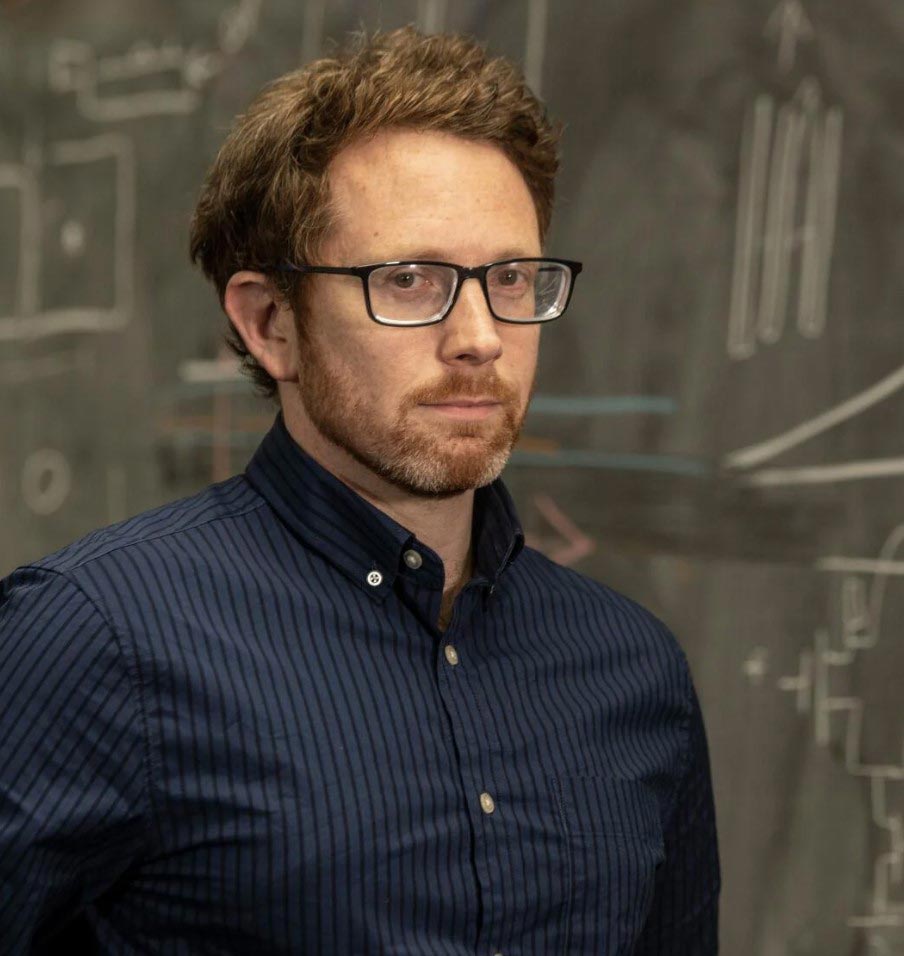
“The challenge of unifying quantum mechanics with the theory of gravitation remains one of the most pressing unsolved problems in physics,” said co-author Benjamin Jones, associate professor of physics. “If the gravitational field behaves in a similar way to the other fields in nature, its curvature should exhibit random quantum fluctuations.”
Jones and UTA graduate students Akshima Negi and Grant Parker were part of an international IceCube Collaboration team that included more than 300 scientists from around the U.S., as well as Australia, Belgium, Canada, Denmark, Germany, Italy, Japan, New Zealand, Korea, Sweden, Switzerland, Taiwan and the United Kingdom.
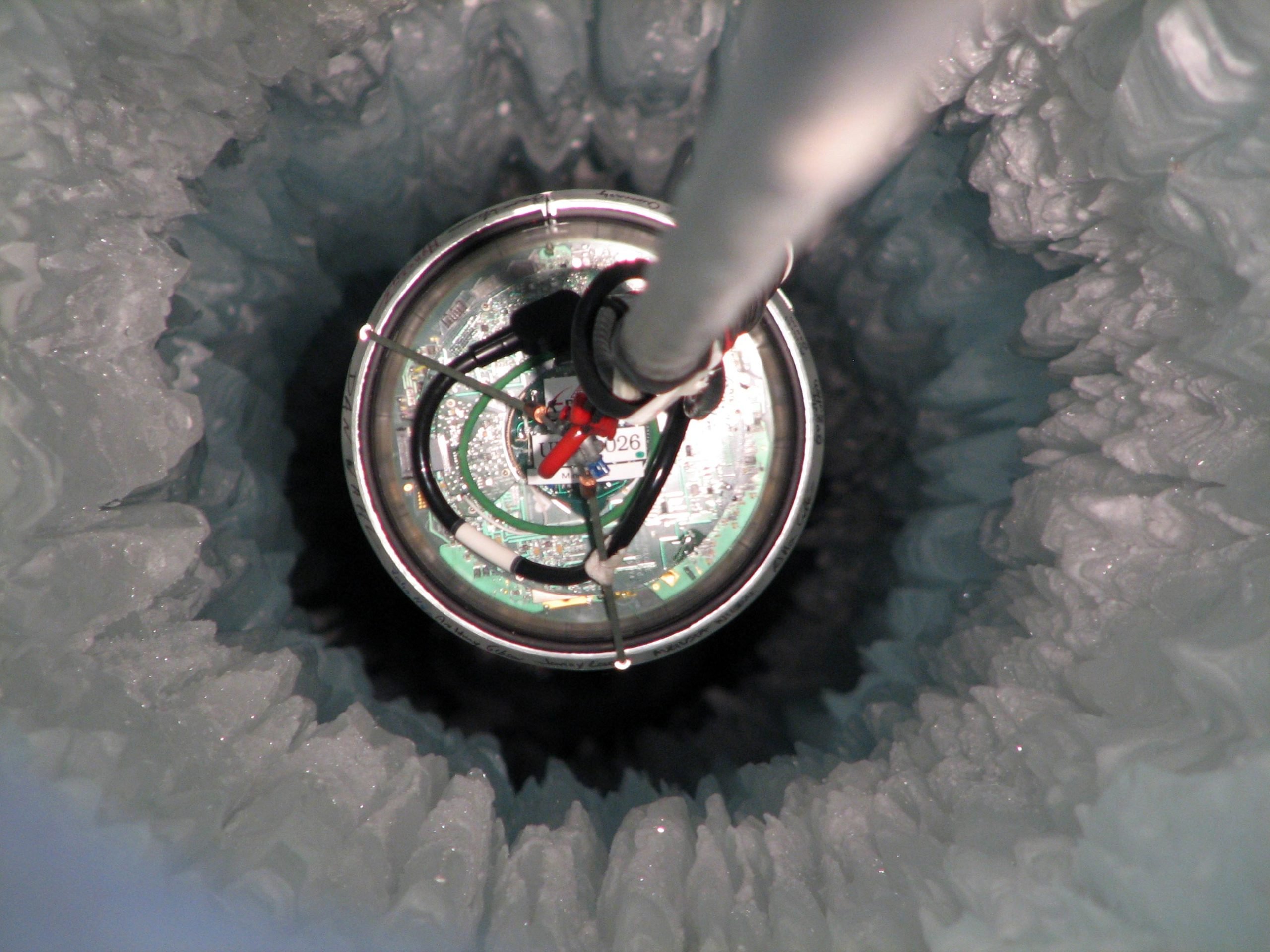
To search for signatures of quantum gravity, the team placed thousands of sensors throughout one square kilometer near the south pole in Antarctica that monitored neutrinos, unusual but abundant subatomic particles that are neutral in charge and have no mass. The team was able to study more than 300,000 neutrinos. They were looking to see whether these ultra-high-energy particles were bothered by random quantum fluctuations in spacetime that would be expected if gravity were quantum mechanical, as they travel long distances across the Earth.
Results of Neutrino Observations
“We searched for those fluctuations by studying the flavors of neutrinos detected by the IceCube Observatory,” Negi said. “Our work resulted in a measurement that was far more sensitive than previous ones (over a million times more, for some of the models), but it did not find evidence of the expected quantum gravitational effects.”
This non-observation of a quantum geometry of spacetime is a powerful statement about the still-unknown physics that operate at the interface of quantum physics and general relativity.
“This analysis represents the final chapter in UTA’s nearly decade-long contribution to the IceCube Observatory,” said Jones. “My group is now pursuing new experiments that aim to understand the origin and value of the neutrinos mass using atomic, molecular, and optical physics techniques.”
For more on this research, see Neutrinos Whisper Quantum Gravity Secrets From the South Pole.
Reference: “Search for decoherence from quantum gravity with atmospheric neutrinos” by The IceCube Collaboration, 26 March 2024, Nature Physics.
DOI: 10.1038/s41567-024-02436-w
Never miss a breakthrough: Join the SciTechDaily newsletter.
Follow us on Google and Google News.
9 Comments
I really don’t like to ‘rain on anyone’s parade’ or be a ‘wet blanket’ but, as from time to time some of these extreme experiments garner my attention, I simply have to repeat myself that in 2009 (first demonstration video in 2012; then YouTube now https://odysee.com/@charlesgshaver:d/1Gravity:8) I discovered that gravity is locally induced in all matter by some higher force to radiate across the universe in generally spherical fields of pulsing, angular, coherent, lines of perpendicularly attractive force, which decrease in density and strength with the inverse square law of attraction. As I see it, the quandary between Einstein’s gravity and quantum gravity originated with the misinterpretation of the scattered dot patterns of the classical double-slit experiments, with pulsing lines of gravity force (not a duality of particles and waves) causing redirection of the tiny particles (whether photons, electrons or large molecules). Never eligible for any large research grants as only a lone lay investigator, I can only postulate that gravity is so predictable that electrons orbit the neuclei of atoms in prescribed rings of gravity lines of force. Simply put regarding “space-time;” ‘space’ just is and ‘time’ just isn’t. Simply put about ‘oscillating neutrinos;’ pulsing gravity.
This is simply “word salad”.
Prove me wrong.
Well said they need to spend more time on what there hiding in Antarctica instead of messing with natural proving and proving where its not there buccness period.
Looks like they’ve found a soda can.
AFTER TRYING SO HARD, JUST ADMIT HUMAN SCIENCE IS ALWAYS A LOSER AND POOR COPY CAT…LORD SHIVA SCIENCE ALWAYS WINS.
“[…] and have no mass”
You’ve gotten one of the most amazing things ever completely wrong. Neutrinos do have mass. The three flavors have distinct masses. We don’t know what their masses actually are but we do know that they’re very light. Oh yeah, and the neutrinos change flavor over time.
I suggest you ask a particle physicist for more details but be prepared to understand it no better than this even after a lot of effort. But you’ll better understand just how little you understand! I suggest the Even Bananas series on YouTube for a very gentle introduction.
Thanks for being knowledge 👍
Though they didn’t get what they expected, it doesn’t mean in any way that there is no quantum explanation of gravity. Because nobody has proven that quantum theory and theory of relativity can’t be merged. We should keep trying. Even if we find that it’s impossible to merge these two theories, it will also be an answer to our investigation.