

A quantum sensing experiment now has the potential to identify single gravitons — the particles that make up gravity — which was considered impossible until now.
A team led by Stevens professor Igor Pikovski has recently proposed a method to detect individual gravitons, believed to be the quantum building blocks of gravity. They suggest that with advancements in quantum technology, this experiment could become a reality in the near future.
“This is a foundational experiment that was long thought impossible, but we think we’ve found a way to do it,” says Stevens physics professor Igor Pikovski, also affiliated with Stockholm University.
Pikovski led a team of first-year graduate students Germain Tobar, Thomas Beitel, and postdoctoral researcher Sreenath Manikandan. Their results on “detecting single gravitons with quantum sensing” were published in Nature Communications this week.
Elusive particles that build up the cosmic fabric
Gravity just works. Things fall, planets orbit each other. Over a hundred years ago, Einstein revolutionized our understanding of gravity, by explaining it as changes in space and time. Many effects of gravity previously unimaginable have now been confirmed: time dilation, gravitational waves, or black holes.
But something else is special about gravity: we have only seen its “classical” version so far, whereas all other forces are explained by quantum theory. One of the holy grails of physics has long been to link gravity with quantum mechanics, but that problem remains unsolved. In any quantum theory of gravity, we’d expect certain single indivisible particles to occur.
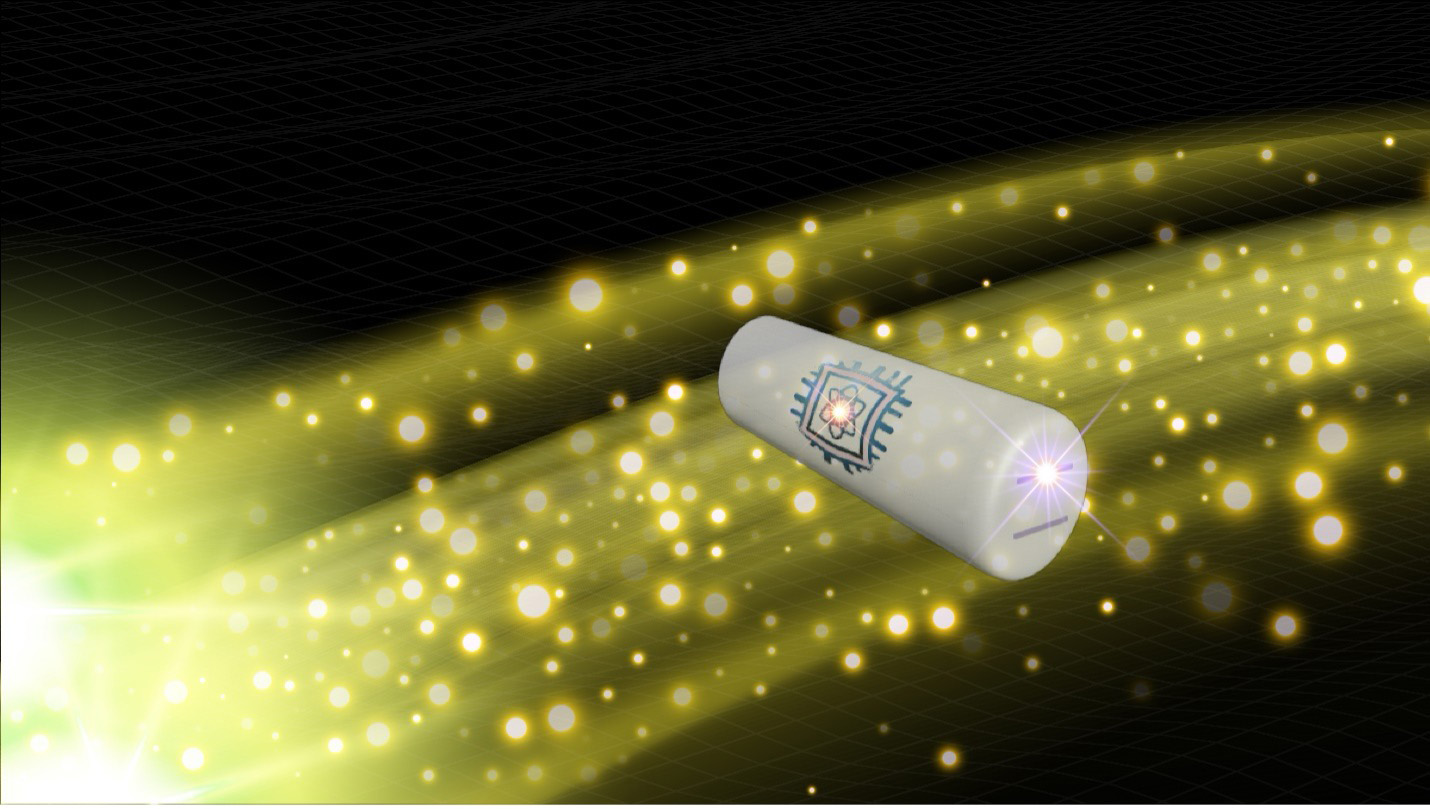
Physicists have named these elusive particles gravitons — think of them as building blocks of gravity, just as atoms are the building blocks of matter. In theory, the gravitational waves that frequently pass through Earth from colossal cosmic events like black hole collisions are made up of huge numbers of those gravitons. Impressive big detectors like LIGO can now confirm the existence of such gravitational waves. Yet a graviton has never been detected in history; even the idea of spotting one was long thought impossible.
That may have just changed, however.
Pikovski’s team proposed a solution that involves coupling existing physical detection technology — something called an acoustic resonator, basically a heavy cylinder — and fitting it with improved energy state-detection methods (also known as quantum sensing).
“Our solution is similar to the photo-electric effect that led Einstein to the quantum theory of light,” explains Pikovski, “just with gravitational waves replacing electromagnetic waves. The key is that energy is exchanged between the material and the waves only in discrete steps – single gravitons are absorbed and emitted.”
But how to detect them?
“We need to cool the material and then monitor how the energy changes in a single step, and this can be achieved through quantum sensing,” says Manikandan, a postdoctoral fellow at The Nordic Institute for Theoretical Physics in Stockholm.
“By observing these quantum jumps in the material, we can deduce that a graviton was absorbed” adds Tobar, now a graduate student at Stockholm University. “We call it the ‘gravito-phononic effect.’”
One of the team’s proposed innovations is to use available data from LIGO – a two-facility U.S. observatory that recently confirmed the existence of gravitational waves.
“The LIGO observatories are very good at detecting gravitational waves, but they cannot catch single gravitons,” notes Beitel, a Stevens doctoral student. “But we can use their data to cross-correlate with our proposed detector to isolate single gravitons.”
Cosmic collisions, heavy cylinders, quantum sensors
How did Pikovski’s team design this ingenious experiment? Lots of math and creativity, plus some big help from recent advancements in technology.
“Many physicists thought about this over the years, but the answer was always the same: it cannot be done,” says Pikovski. “It was impossible to imagine quantum experiments that go beyond a few atoms, and they hardly interact with gravitons at all.”
But the game has now changed: scientists have recently begun to create and observe quantum effects in macroscopic objects. Pikovski realized these macroscopic quantum objects are ideal for seeing single graviton signatures: they interact much more strongly with gravity, and we can detect how these objects absorb and emit energy in discrete steps.
The team began thinking through a possible experiment. Using data from gravitational waves that have previously been measured on Earth, such as those that arrived in 2017 from a collision of two Manhattan-sized (but super-dense) faraway neutron stars, they calculated the parameters that would optimize the absorption probability for a single graviton.
“It turns out, this measurement can be done,” says Manikandan, “for example by using a device similar to the Weber bar.”
Weber bars are thick, heavy (up to a ton) cylindrical bars named for their inventor, New Jersey native Joseph Weber. The bars have fallen into disuse recently as optical-based detection technologies have proliferated, but they would actually work well for a physicist’s graviton-hunting expedition.
That’s because they can absorb and emit gravitons—in direct analogy to what Einstein coined the “stimulated emission and absorption” of photons, the smallest building blocks of light.
A newly designed quantum detector would be cooled to its lowest energy, then would be set vibrating very slightly by the passage of a gravitational wave. Super-sensitive energy sensors could then theoretically capture how those vibrations changed in discrete steps. Each discrete change (also known as a quantum jump) would indicate a single graviton event.
Of course, there’s a catch with catching gravitons. The necessary sensing technology doesn’t quite yet exist.
“Quantum jumps have been observed in materials recently, but not yet at the masses we need,” points out Tobar. “But technology advances very rapidly, and we have more ideas on how to make it easier.”
“We’re certain this experiment would work,” enthuses Thomas. “Now that we know that gravitons can be detected, it’s added motivation to further develop the appropriate quantum-sensing technology. With some luck, one will be able to capture single gravitons soon.”
But while new quantum technologies are critical, the inspiration for this result came from elsewhere. “We know that quantum gravity is still unsolved, and it’s too hard to test it in its full glory,” says Pikovski, “but we can now take the first steps, just as scientists did over a hundred years ago with quanta of light.”
Reference: “Detecting single gravitons with quantum sensing” by Germain Tobar, Sreenath K. Manikandan, Thomas Beitel and Igor Pikovski, 22 August 2024, Nature Communications.
DOI: 10.1038/s41467-024-51420-8
Never miss a breakthrough: Join the SciTechDaily newsletter.
Follow us on Google and Google News.
21 Comments
“monitor how the energy changes in a single step”
Seems to suppose a whole lot, like gravity is expressed essentially by dynamic waves although a number of observations suggest otherwise. Detecting and classifying single neutrinos by mass for each of the three known types would be relatively easy compared to detecting gravitons, yet no one is suggesting doing that with interferometers, thus the idea appears to be another excuse to avoid seeing stationary quantum gravity waves, as far as I can tell. Notably missing from the story is an estimate of the energy imparted by a graviton.
Supposing they are looking at the lowest wavelength gravity waves detected so far and coming up with a guess for the lowest frequency possible that is a very close match to that, then treating gravity like light to justify using E = hf to come up with a guess for graviton energy, looks like it could end up off by 10^38.
Probably missing some big details. My preference is to visualize gravity in terms of loops of energy flow as the individual quantum particle seems likely too small to resolve, even while the stationary quantum wave can be obvious. Seems reasonable to suppose every nucleon is already coupled to possibly a countless number of local gravity exchange loops.
In other words, the most problematic assumption there appears to be that “gravity exists only as dynamic waves.”
My take ultimately is that gravity waves that spread are classical gravity waves, detectable pseudo-continuous intensity variations in received graviton flows. Quantum graviton effects, on the other hand (unlike the massless photon, which is a dynamic wave with phases moving along with the particle and a wave-length on close to the same scale as the particle) form graviton streams defining a quantum wave through its motion such that a point of relative motionlessness relative to the source sits on a single phase, the quantum seems sub-Planck small even as its wavelength is cosmologically long. Thus, a quantum graviton it is undetectable as a particle with spin but evident as a spin-2 phase variation modulating the effective strength of coherently (i.e. compactly-sourced) gravity between full value and zero. The QG particle wave relationship I’m suggesting is more like the particle-wave relationship between electrons and photons, as electrons can coordinate to form infinitely large waves.
Just to clarify a little,
Gravitons, as individual spin-2 quanta or as spin-1 carrier pairings with opposing phases or rotations, are undetectable, yet the graviton’s spin-2 phase variation’s periodic galaxy-scaled and periodic cluster-scaled modulations of the effective strength of coherently-sourced (i.e. compactly-sourced) gravity between full value and zero effect as a function of distance from the source, not as a function of time given that phases are, in a first approximation supposing a relatively stationary non-spinning source of gravity, is here considered evident in bulk.
IMO the effect of spin with quantum gravity is to direct (“modulate”) the pulling effect that a graviton imparts on contact with a quark triplet (i.e. hadrons aka nucleons). A pairing of spin-1 particles with opposing phases or opposing rotations can be abstracted as a spin-2 pairing of rotating vectors representable effectively as two loosely joined arrows joined at the back.
The arrow can be replaced with a directional effect dipole for a more realistic representation.
As the effect in question is a pull, encountering the back end of an arrow would result in a push, if possible, but if the particle is effectively ubiquitous, has an identical spin rate, is sub-Planck in size and has a randomness in its path-bound spin-plane orientation then it’s always to pair away and cancel out a spin-1 arrow-“tail” (push action) aspect into part of a net spin-2 effect.
Just my two cents.
Hopefully to clarify the topic of my 2 cents on spin, I refer essentially to graviton quantum spin in the previous comment. Excluding nuclear details, quantum spin is (electric) charge-based spin. For gravitons, quantum spins and kinetic spins are here considered the same and no net electric charge or electric field is needed. The spin-1 half-graviton component dipole would be an “energy dipole” wherein hypothetical exotic sub-ZPE “true vacuum” “negative energy” is allowed.
Matter particles can have kinetic spin and quantum spin. Gravity source spin would presumably affect the distribution of gravity carrier (“quantum graviton”) rotation planes along any direction radiated from a spinning source.
Scientists Propose Groundbreaking Method To Detect Single Gravitons.
Ask the scientists:
Why do gravitons produce gravity?
Spin can generate gravitation, and spin can counteract gravitation. Studying gravitons should consider studying the Spin of Topological Vortex. Scientific research guided by correct theories can help humanity avoid detours, failures, and pomposity. Please witness the exemplary collaboration between theoretical physicists and experimentalists ( https://scitechdaily.com/microscope-spacecrafts-most-precise-test-of-key-component-of-the-theory-of-general-relativity/#comment-854286 ).
My ruthless repetition may make some people unhappy, but in order to fight against rampant pseudoscience, I can only do so. Topological vortex research reflections on the philosophy and methodology of science help us understand the nature essence of science and the limitations of scientific methods. This not only has guiding significance for scientific research itself, but also has important implications for science education and popularization.
Topological vortex research may have a profound impact on the development direction and research methods of modern physics.
As I’ve commented many times before, gravity is induced by some higher force to radiate from all objects in pulsing angular lines of attractive force to form rather spherical fields of gravity which decline in density and strength in accordance with the inverse square law of attraction. And, rotation intensifies the strength of the gravity field of any object. Less often I include that in time dilation experiments it is the forcing of a clock to travel faster through ambient lines of gravity force which causes the ‘clock’ to slow down, not time. Also, due to the immense distances involved, the inverse law of attraction ensures that gravity waves cannot exist and LIGO is sensing something other than gravity. Most controversial, perhaps, with gravity ‘lensing’ proving lines of gravity force can affect individual photons, light accelerates (blue shift) on widening lines of gravity force when leaving their sources and decelerates (red shift) on narrowing lines of gravity force when arriving to earth. In brief summary, unless lines of gravity force are composed of gravitons they do not exist and we still don’t know the true age, expansion and/or size of the visible universe.
The universe does not write algebra, formulas, or fractions. The universe is a superposition, deflection, and entanglement of geometric shapes. It is the interaction and synchronization effect of countless topological vortices and their fractal structures. The formation of energy gaps between topological vortices is crucial for the evolution of spatiotemporal motion from low dimensional spacetime to high-dimensional spacetime. Please consider: Can topological vortices generate gravitation?
Topological vortex research reflections on the philosophy and methodology of science help us understand the nature essence of science and the limitations of scientific methods. This not only has guiding significance for scientific research itself, but also has important implications for science education and popularization.
As recalled as an independent lay discoverer, the first rule of good science is to take a good, fresh, objective look at what is being studied. The second rule is to devise, perform and document experiments which can be duplicated and replicated by others. I’ve done those. Also, in case you haven’t noticed, in cosmology the predominant shapes are spheres and circles. If vortices ruled I doubt there would be any life forms to debate the theory of gravitons. View the video, repeat the experiment, feel the ‘pull’ and observe the ‘lift:’ “1Gravity:” https://odysee.com/@charlesgshaver:d/1Gravity:8 I can imagine some invisible vortices forming in the air as the wheels rotate but that’s about it. Thank you for commenting.
Topological vortex research reflections on the philosophy and methodology of science help us understand the nature essence of science and the limitations of scientific methods.
Bao is abso-fu**ing-lutely OBSESSESD with vortices. It’s pretty funny.
Trying to see some perspective in all the unanswered mysteries of physics . it seems to be at a level of size that our most sensitive detection methods are not enough, some detections are becoming more aware the more advanced of sensitivity becomes . Question is where did we start the quest ? the simple acceptance of the sciences in conjunction with religious beliefs would be my guess . Then we have two differing human beliefs battling causing conflict , it was best explained as Spooky action, this still stands because of differing processes of thought each with their own evidence , but in the equation they all have to fit. The process could be so complicated to solve even a super quantum computer would struggle for a cognitive radiant collective. A Physics outside our present understanding, a lot of evidence is showing this to be a factor. I chose random action being a constant that does not have a ridged explanation. 🤞
Topological vortex research reflections on the philosophy and methodology of science help us understand the nature essence of science and the limitations of scientific methods.
“Quanta” is running a giant series on the most worn-out gravity cliches, “Unraveling Space-Time (Itself)”IIRC. Turns out to be a series on scotch-guarding the topic, showing liberal use of the “forever brain chemistry” that had them claiming to make a black hole inside a building. A building apparently large enough to hide multiple generations of imperial propaganda, ever-shifting much like the sands of an oversized religion-operating hourglass.
Topological vortex research reflections on the philosophy and methodology of science help us understand the nature essence of science and the limitations of scientific methods.
Between Bao-hua and here let me fix that for you, this comment s action is ridiculous. Sigh @ the internet….
… in the case that there is no any gravitons found, there is an alternative way to look at it… let say that you are some boy/girls with a lasso, and in case that you have ten boxes of space time you have mass of 10*the mass of a space-time box on quantum level… and if you try to travel faster you will have more in your lasso tool… and at one point there you have nothing because, your lasso has to obey Albert thingi about size that becomes smaller and smaller…