
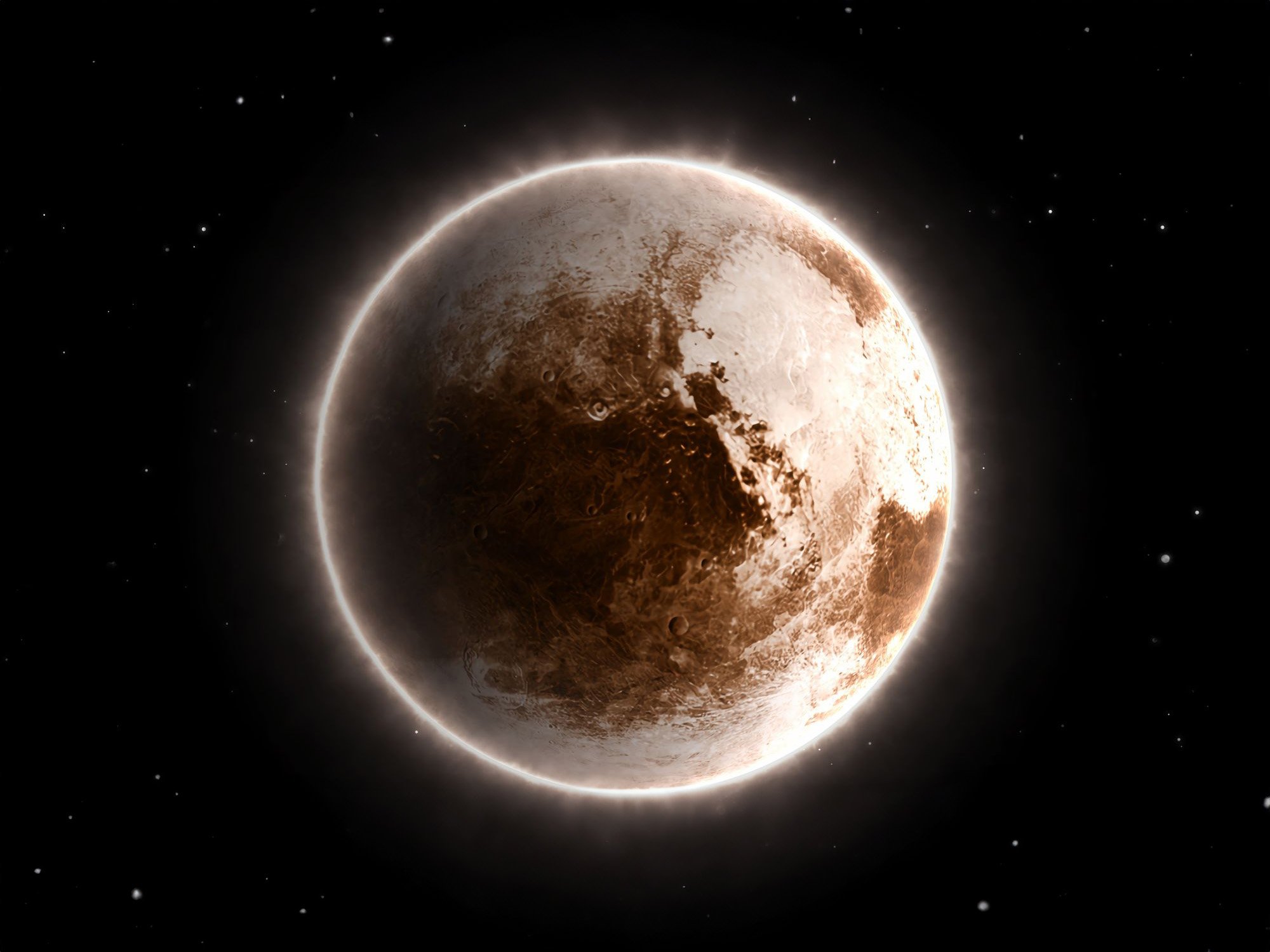
Graduate student Alex Nguyen calculated the depth and density of the solar system’s most mysterious and remote body of water.
New calculations by Alex Nguyen, a graduate student in the Department of Earth, Environmental, and Planetary Sciences, are bringing into focus the existence of a vast ocean of liquid water beneath Pluto’s icy surface.
In a paper published in the journal Icarus, Nguyen used mathematical models and images from the New Horizons spacecraft that passed by Pluto in 2015 to take a closer look at the ocean that likely covers the planet beneath a thick shell of nitrogen, methane, and water ice.
Patrick McGovern of the Lunar and Planetary Institute in Houston, Texas, was a co-author of the paper.
For many decades, planetary scientists assumed that Pluto could not support an ocean. The surface temperature is about -220 C, a temperature so cold even gases like nitrogen and methane freeze solid. Water shouldn’t have a chance. “Pluto is a small body,” Nguyen said. “It should have lost almost all of its heat shortly after it was formed, so basic calculations would suggest that it’s frozen solid to its core.”
Recent Evidence of Liquid Water
But in recent years, prominent scientists including Professor Bill McKinnon have gathered evidence suggesting Pluto likely contains an ocean of liquid water beneath the ice. That inference came from several lines of evidence, including Pluto’s cryovolcanoes that spew ice and water vapor. Although there is still some debate, “it’s now generally accepted that Pluto has an ocean,” Nguyen said.
The new study probes the ocean in greater detail, even if it’s far too deep below the ice for scientists to ever see. Nguyen and McGovern created mathematical models to explain the cracks and bulges in the ice covering Pluto’s Sputnik Platina Basin, the site of a meteor collision billions of years ago. Their calculations suggest the ocean in this area exists beneath a shell of water ice 40 to 80 km thick, a blanket of protection that likely keeps the inner ocean from freezing solid.
They also calculated the likely density or salinity of the ocean based on the fractures in the ice above. They estimate Pluto’s ocean is at most about 8% denser than seawater on Earth, or roughly the same as Utah’s Great Salt Lake. If you could somehow get to Pluto’s ocean, you could effortlessly float.
As Nguyen explained, that level of density would explain the abundance of fractures seen on the surface. If the ocean was significantly less dense, the ice shell would collapse, creating many more fractures than actually observed. If the ocean was much denser, there would be fewer fractures. “We estimated a sort of Goldilocks zone where the density and shell thickness is just right,” he said.
Space agencies have no plans to return to Pluto any time soon, so many of its mysteries will remain for future generations of researchers. Whether it’s called a planet, a planetoid, or merely one of many objects in the outer reaches of the solar system, it’s worth studying, Nguyen said. “From my perspective, it’s a planet.”
Reference: “The role of Pluto’s ocean’s salinity in supporting nitrogen ice loads within the Sputnik Planitia basin” by P.J. McGovern and A.L. Nguyen, 28 January 2024, Icarus.
DOI: 10.1016/j.icarus.2024.115968
Never miss a breakthrough: Join the SciTechDaily newsletter.
Follow us on Google and Google News.
3 Comments
It’s a planet.
Alex Nguyen said, “From my perspective, it’s a planet.” Darn right, it was a planet when I was a kid, it’s a planet now, and it forever will be.
Yeah, but just try to convince certain members of the IAU of that. They have spent years trying to deny the obvious.