
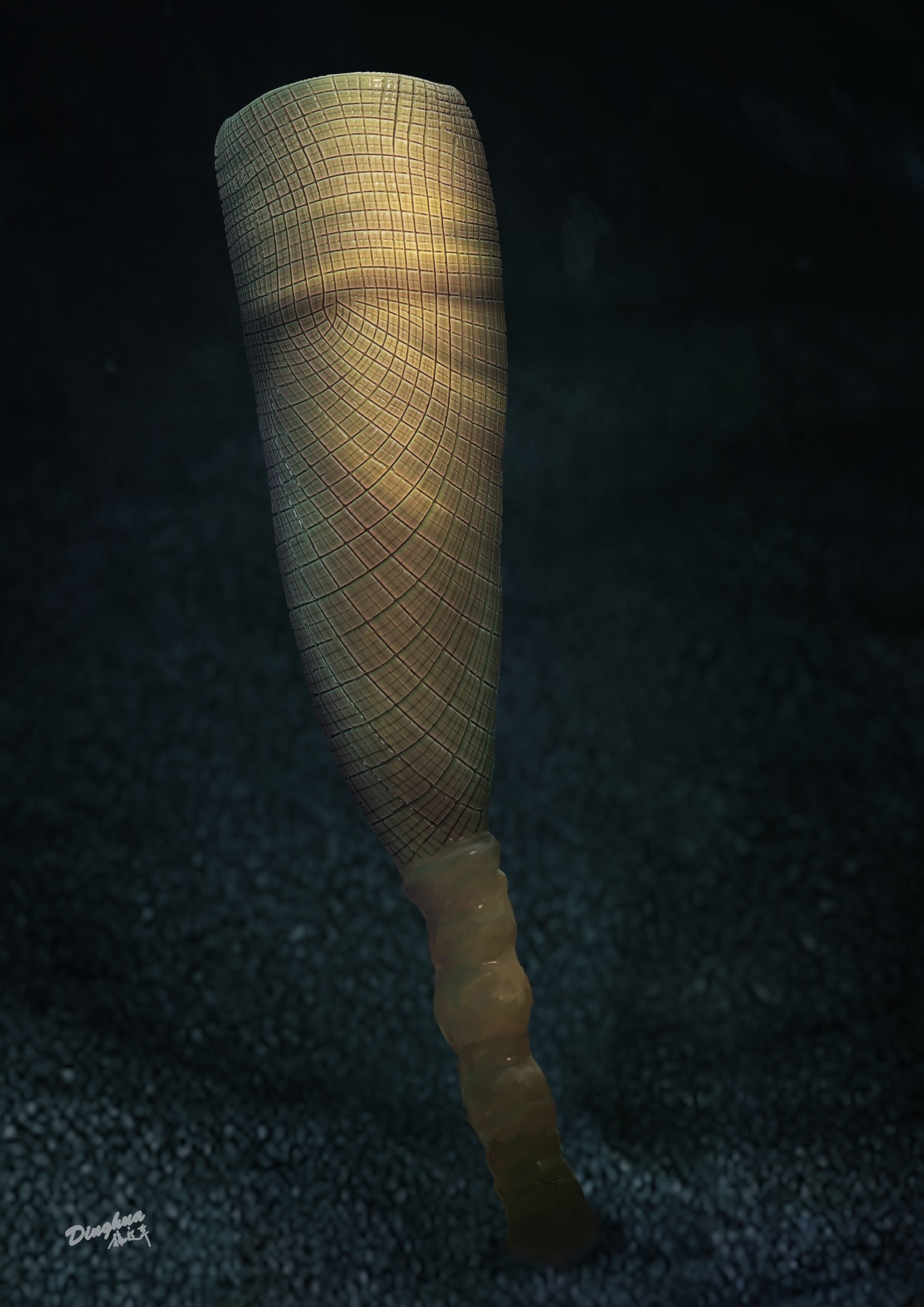
The discovery of the late Ediacaran sponge, Helicolocellus, offers new insights into early sponge evolution, suggesting non-biomineralizing forms existed about 550 million years ago and bridging a critical evolutionary gap between the Ediacaran and Cambrian periods.
Prof. Yuan Xunlai and his team at the Nanjing Institute of Geology and Palaeontology, a part of the Chinese Academy of Sciences, have uncovered a crown-group sponge from the late Ediacaran period named Helicolocellus in the Shibantan Biota located in Hubei Province. This fossil biota dates back approximately 550 million years.
This finding, which fills an important gap in the early evolution of sponges, was recently published in Nature.
Sponges are often considered to be the most basal and primitive metazoan phylum. Early sponge fossils can provide important clues to the origin and early evolution of animals. Molecular clock estimates and controversial biomarker data suggest that sponges should have appeared around 700 million years ago. Enigmatically, however, no unambiguous sponge fossils have been found before the Cambrian Period (about 539 million years ago). Therefore, a 160-million-year gap exists in the sponge fossil record, a period in early sponge evolution known as the “lost years.”
Theories on the Absence of Precambrian Sponges
Two competing hypotheses have been proposed to explain the absence of Precambrian sponges: One hypothesis holds that, since most extant sponges have siliceous or calcareous spicules, the common ancestor of sponges also had mineralized spicules. Under this hypothesis, the absence of Precambrian sponge fossils can be attributed to poor preservation potential due to the chemical composition of porewaters. The other hypothesis holds that the common ancestor of sponges was non-biomineralizing animals.
Only after the emergence of major classes did they independently evolve biomineralized spicules. Therefore, early Precambrian sponges lacked spicules, thus making it difficult for these sponges to be preserved and identified in the fossil record.
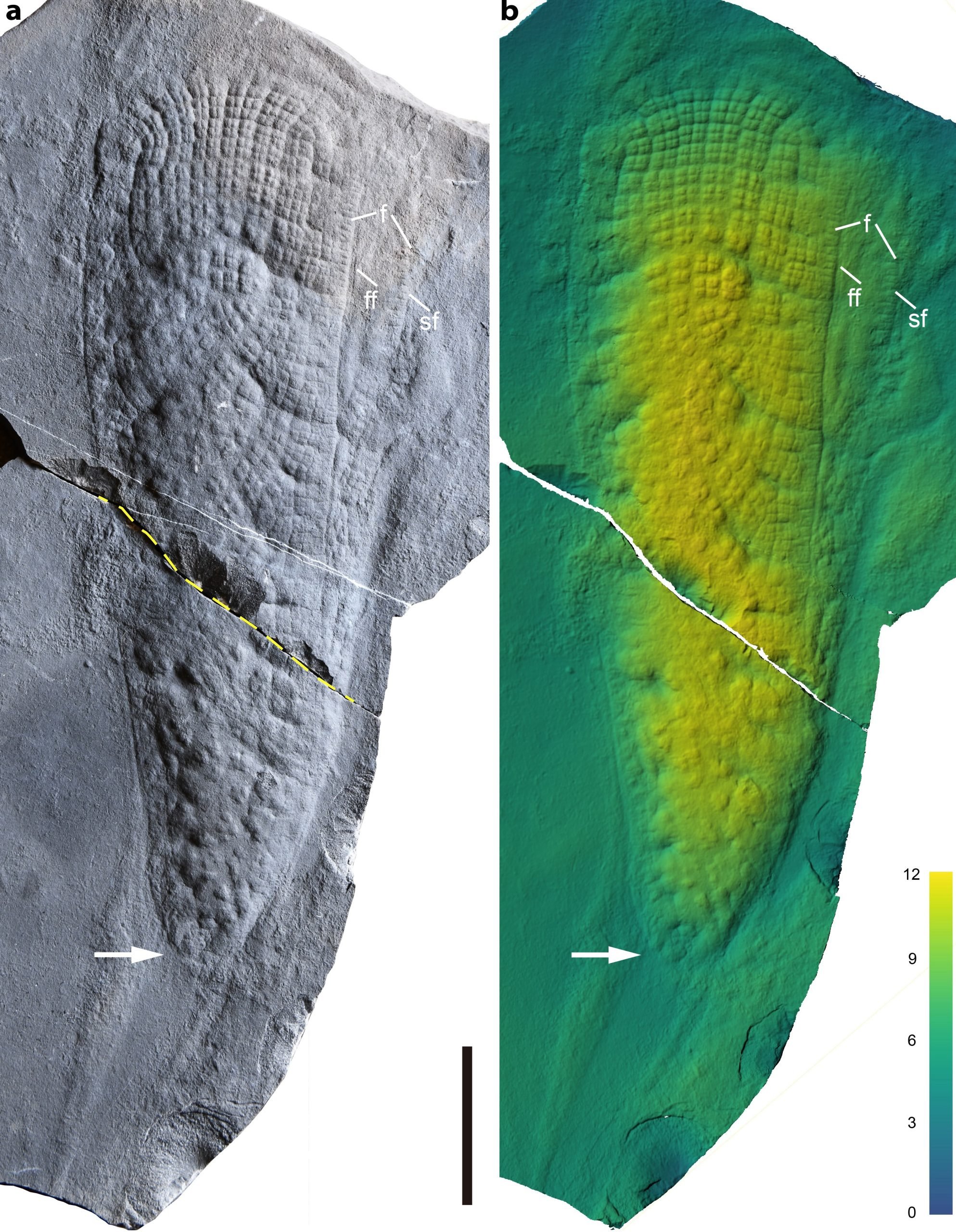
The newly discovered Helicolocellus shows morphological characteristics similar to those of glass sponges (Hexactinellida), such as a radially symmetric conical body, a discoidal attachment structure, a possible central cavity, and inferred excurrent canals. In addition, the surface of Helicolocellus consists of regular boxes, each of which is divided into four similar but smaller boxes, which in turn are subdivided into even smaller ones. This unique grid pattern is also found in some typical Paleozoic hexactinellids.
Their shapes and structures are very similar; however, the grids in Helicolocellus are made of organic matter, whereas the grids in Paleozoic sponge fossils are made of biomineralized spicules. This study suggests that Helicolocellus may represent an early sponge without biomineralized spicules.
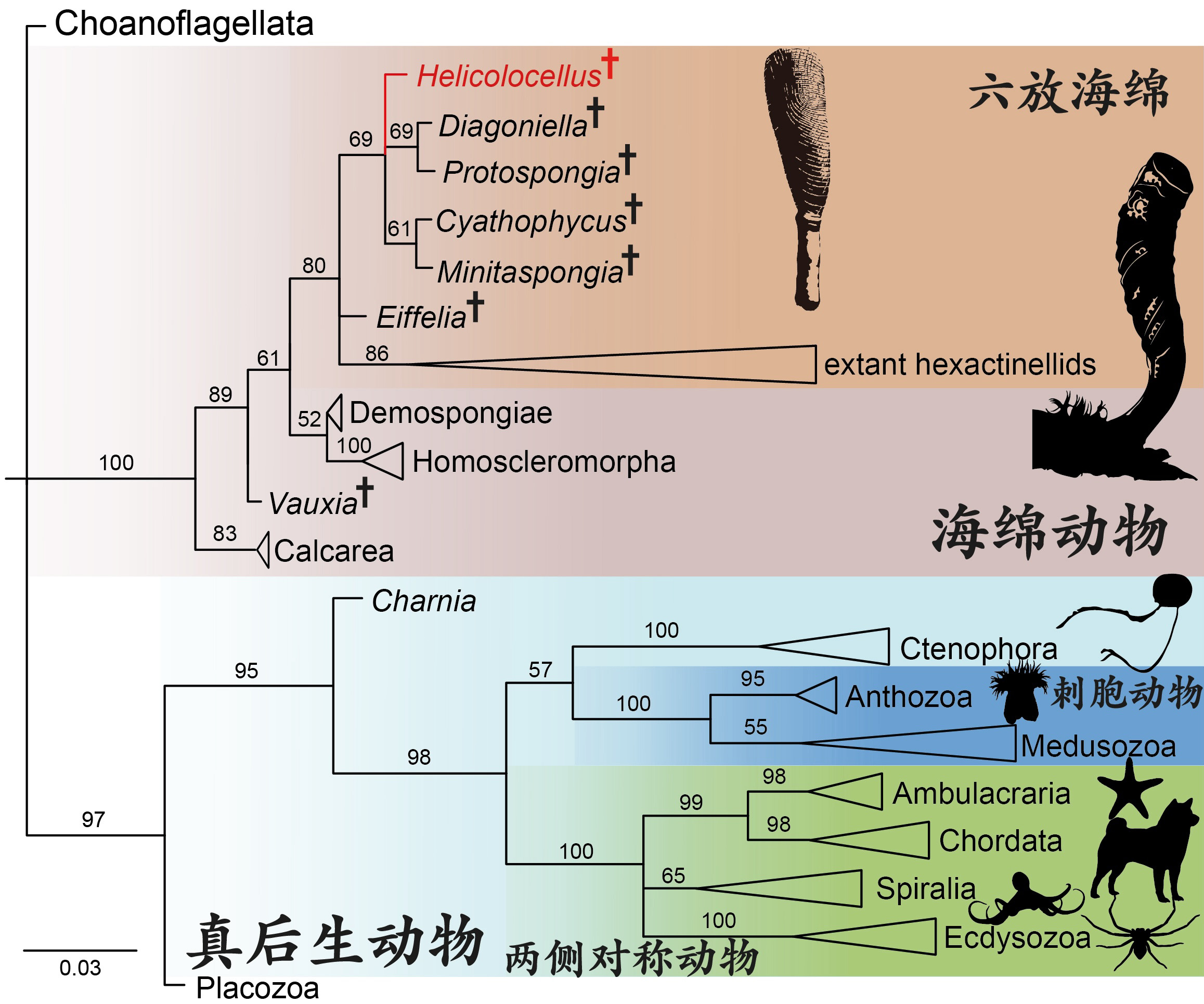
To further test this interpretation, the researchers constructed a morphological data matrix containing several extant and fossil animals and performed a rigorous phylogenetic analysis. The results show that Helicolocellus belongs to the crown group of sponges and is closely related to the hexactinellids.
The discovery of Helicolocellus indicates that non-biomineralizing sponges did exist in the Precambrian. It suggests that modern sponges should not be used as the sole guide for finding Precambrian sponge fossils, as early sponges may not have had biomineralized spicules and may not have had all the features of modern sponges. Moreover, early hexactinellid sponges first laid out the reticulate skeletal blueprint using organic material, and later added siliceous biominerals to the recipe for skeletal formation in the Cambrian.
Fossil assemblages on either side of the Ediacaran-Cambrian boundary are extremely disparate. The Ediacaran Period is dominated by the enigmatic and phylogenetically unknown Ediacara Biota, while in the Cambrian, modern marine ecosystems begin to take shape with the emergence of extant animal phyla. The discovery of Helicolocellus bridges the Ediacaran and Cambrian fossil assemblages, indicating that the Ediacara Biota have evolutionary links to Cambrian animals. As one reviewer commented, the discovery of Helicolocellus may be the “Rosetta Stone” for understanding animal evolution.
Reference: “A late-Ediacaran crown-group sponge animal” by Xiaopeng Wang, Alexander G. Liu, Zhe Chen, Chengxi Wu, Yarong Liu, Bin Wan, Ke Pang, Chuanming Zhou, Xunlai Yuan and Shuhai Xiao, 5 June 2024, Nature.
DOI: 10.1038/s41586-024-07520-y
Never miss a breakthrough: Join the SciTechDaily newsletter.
Follow us on Google and Google News.
1 Comment
Any fossil found in sedementary rock doesn’t just challenge evolutionary theory, it is “rock-hard” evidence those theories are a hoax advanced by those who cannot admit the Genesis flood is the fact and the God Who revealed it to Moses told him the truth about the creation story. This sponge is only one of the billions of dead things buried in rock laid down by water all over the earth, due to the extreme sinfulness of man.