
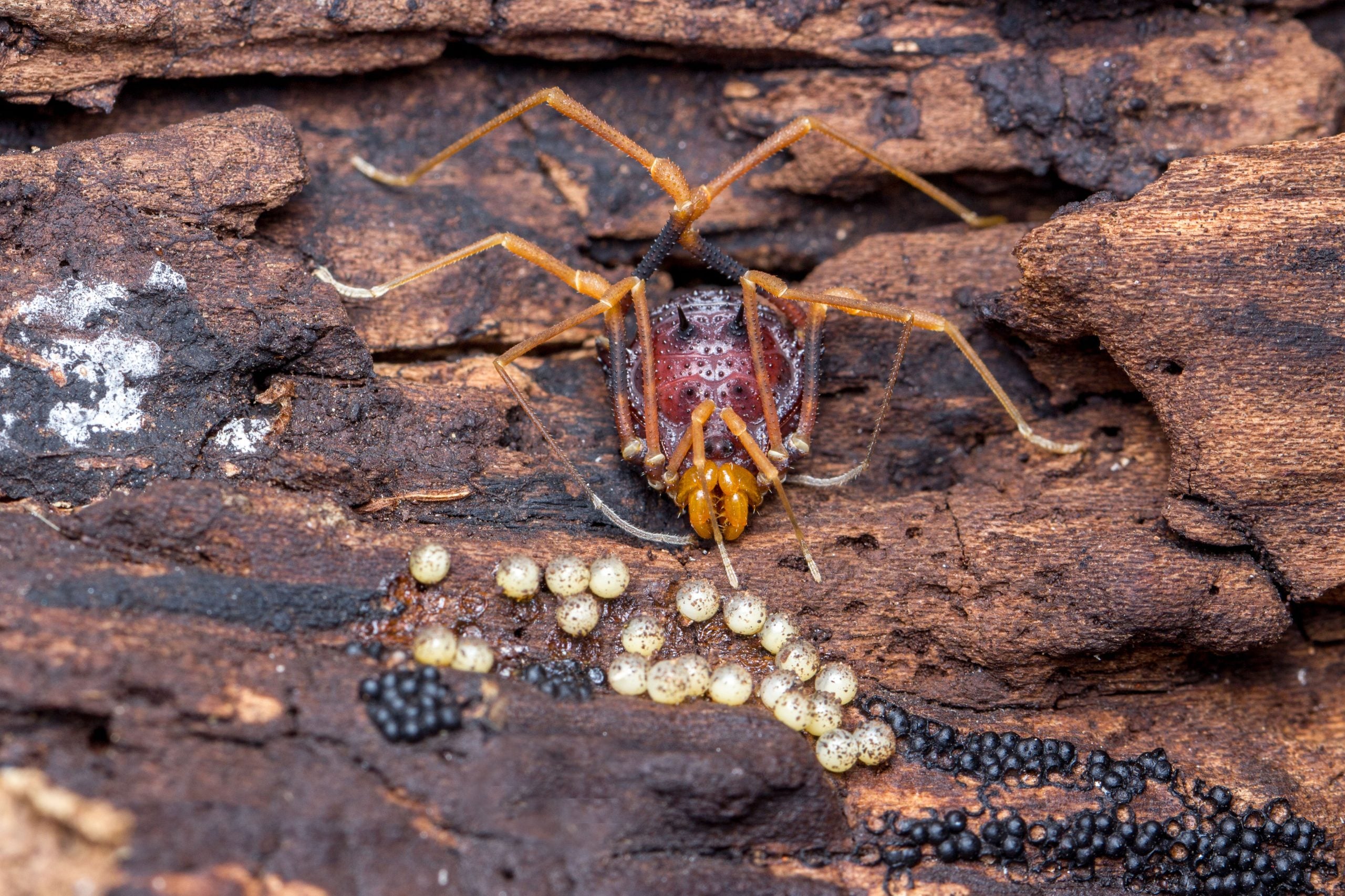
Citizen science helped reveal that parental care in harvestmen has evolved repeatedly across their evolutionary history.
Citizen science observations from the popular platform iNaturalist have helped clarify how parental guarding behavior evolved in harvestmen, according to research published in the Zoological Journal of the Linnean Society.
By combining almost 30 years of fieldwork with iNaturalist records, an international group led by a scientist from the University of São Paulo more than doubled the number of known cases of parental care in harvestmen. The expanded dataset made it possible to reconstruct the evolution of maternal and paternal care in the superfamily Gonyleptoidea for the first time.
Care evolved more than once
The study found that parental guarding behavior did not arise just once in harvestmen. Instead, it evolved, disappeared, and later reappeared multiple times across their evolutionary history. When this behavior was mapped, maternal care appeared to evolve only from a state of no care, a pattern also found in insects.
Paternal care, however, could arise either from no care or from maternal care, suggesting that different evolutionary pressures shaped the two forms of parenting. Machado and his colleagues theorized that when paternal care developed from maternal care, it may reflect a sexually selected behavior known as ‘enhanced fecundity’.
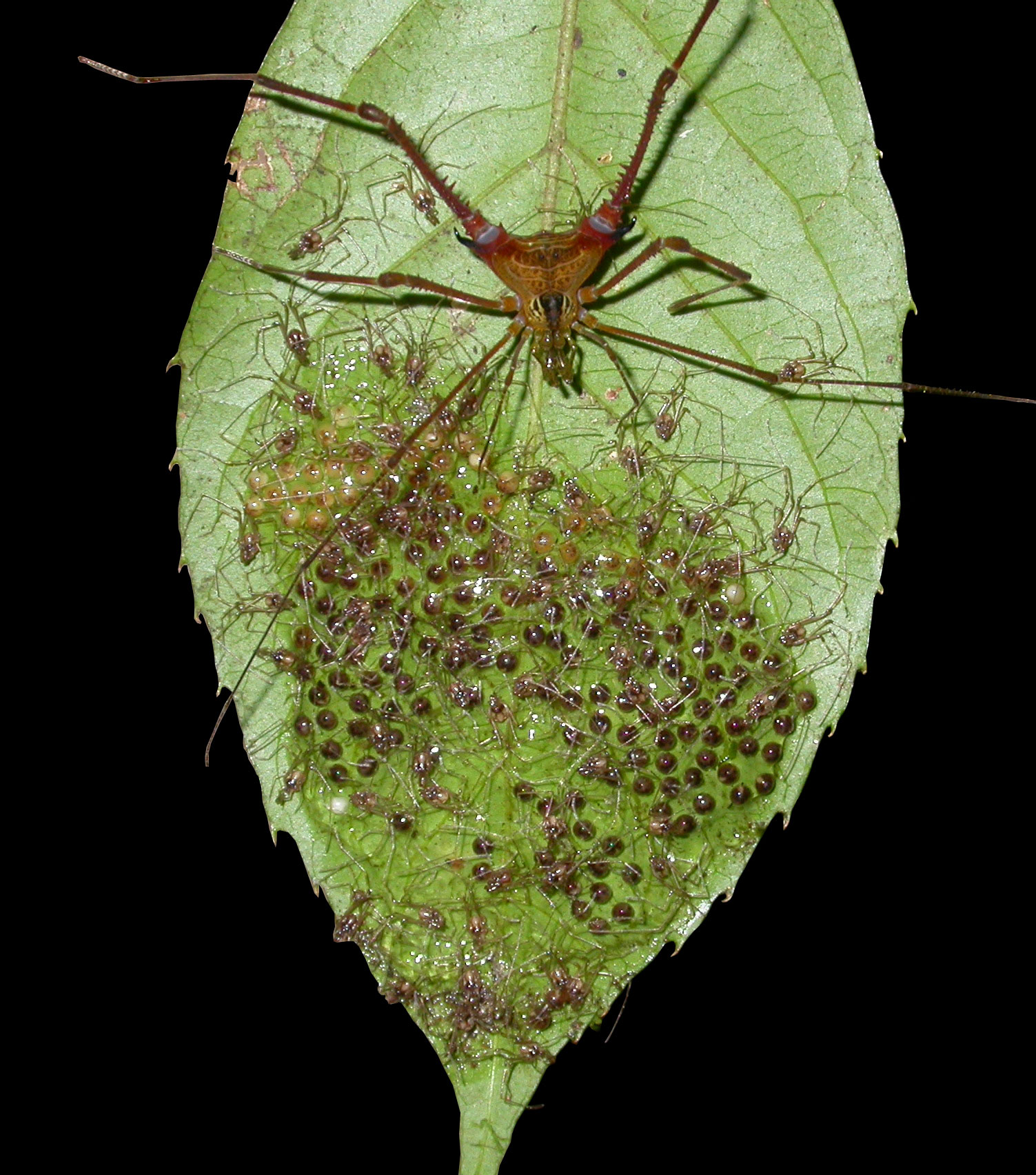
Harvestmen are among the world’s most diverse arachnid orders, with more than 6900 species currently recognized. Although they make up only 0.6% of arthropod diversity, they account for more than half of the independent origins of paternal care, which is uncommon in the animal kingdom. That makes them especially valuable for studying how parental care evolves across a broad evolutionary scale.
Lead author Glauco Machado explained: “It’s very rare in nature, paternal care, and this behavior evolved many times independently. So, by looking at harvestmen, we can explore questions related to the factors that led to the evolution of this behavior. In many species where males care for the offspring alone, the caring activity is a sexually selected behavior, which means that females prefer males that are caring for the eggs.”
Public observations expanded the record
Citizen science lets people contribute time and curiosity to research projects around the world, often without specialist training. Public observations have supported projects ranging from garden bird counts for the RSPB as part of ‘Big Garden Bird Watch’ to the rediscovery of a lost grasshopper species in Australia and the discovery of an ancient writing system in cave art. These examples show how citizen science has become an increasingly important resource for modern research.
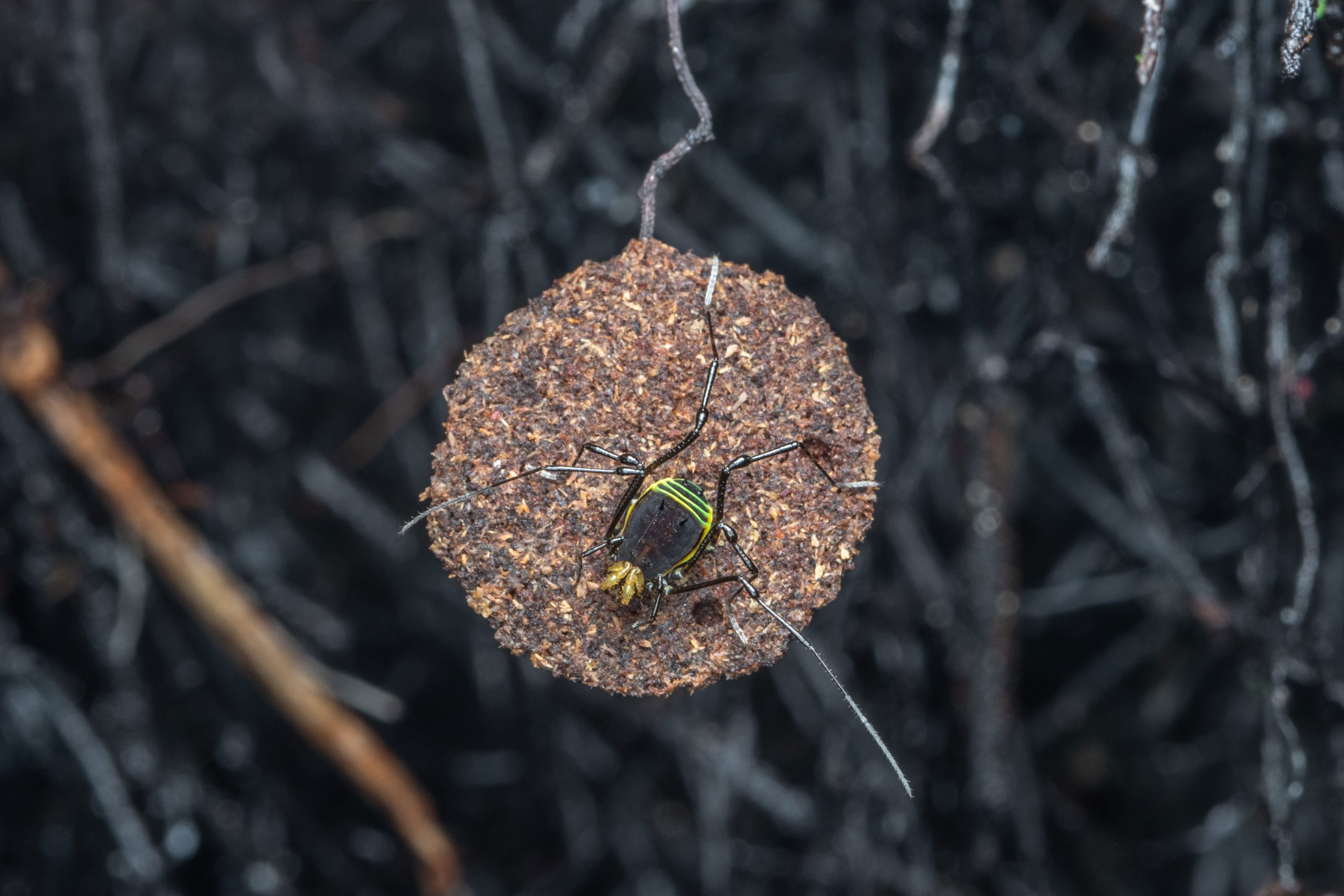
After hearing a talk on the use of citizen science in bird research, Machado and his team turned to iNaturalist, a global database where users upload georeferenced observations of organisms from around the world. The platform allowed them to expand their dataset much faster than traditional scientific approaches would have allowed. From 1936 to 2025, scientific literature had recorded parental guarding behavior in 80 species of harvestmen. This study more than doubled that total, with 62 records coming from iNaturalist alone. Machado and his team gathered those records in only two days.
Open data can widen research
For Machado, iNaturalist matters not only because it expands datasets, but because it makes biological information more accessible to scientists around the world.
“It’s a tremendous source of information that can improve the velocity with which we accumulate biological information. I would never be able to do this by visiting museums around the world. It would be very expensive, very time-consuming, but here we conducted the search in only one week.”
By reducing access costs and the need for slow and expensive fieldwork, citizen science platforms are changing how research can be done. They are also creating new possibilities for large-scale studies led by scientists in the Global South.
Expertise remains essential
The study also underscores the continued importance of taxonomists in modern science. Citizen science platforms can gather enormous volumes of data quickly, but Machado emphasizes that taxonomic expertise is still needed to correctly identify species, recognize the sex of caregiving individuals, and distinguish similar-looking behaviors such as parental care and mate guarding.
“I think taxonomists’ role in modern science is more important than ever. We cannot preserve a species that doesn’t have a name. And names are provided by taxonomists. So, it’s very important.”
Even with its important findings, the study has limits. Sampling bias remains a challenge because examples of parental care are easier to record than examples of no care. Still, Machado and his colleagues argue that work like this helps fill major gaps in what is known about whether care is present or absent. Since more than half of the records in this study were new, Machado hopes more scientists will explore citizen science platforms in future research.
“I think it’s a very broad contribution for people that are working with insects, frogs, and all kinds of groups, animal groups, in which we have both maternal care and paternal care.”
Reference: “One small step for citizens, one giant leap for science: iNaturalist records boost our understanding of the evolution of parental care in a clade of arachnids” by Glauco Machado, Bruno A Buzatto, Daniel S Caetano, Edgardo Flores, Solimary García-Hernández, Osvaldo Grob, Laís A Grossel, Hubert Höfer, Adriano B Kury, Héctor Lancheros, Miguel Medrano, Carlos Oyarzún, Jorge Pérez-Schultheiss, Ricardo Pinto-da-Rocha, Luis E Robledo-Ospina, Joaquín Sáenz-Mancheno, Diego Solano-Brenes, Rosannette Quesada-Hidalgo, Emilia Triana and Osvaldo Villarreal, 15 June 2026, Zoological Journal of the Linnean Society.
DOI: 10.1093/zoolinnean/zlag061
Funding: Conselho Nacional de Desenvolvimento Científico e Tecnológico, Fundação de Amparo à Pesquisa do Estado de São Paulo, Fundação de Amparo à Pesquisa do Estado do Rio de Janeiro, Sistema Nacional de Investigación, Secretaria Nacional de Ciencia y Tecnología
Never miss a breakthrough: Join the SciTechDaily newsletter.
Follow us on Google and Google News.
2 Comments
God. The origin is God.
You repeatedly refer to the harvestmen as ‘Spiders’ in your image captions. They should be called ‘Harvestmen’ or ‘Opiliones’, not spiders, as they belong to a different arachnid order