

Close Menu
    Facebook X (Twitter) Instagram
    SciTechDaily
    • Biology
    • Chemistry
    • Earth
    • Health
    • Physics
    • Science
    • Space
    • Technology
    Facebook X (Twitter) Pinterest YouTube RSS
    SciTechDaily
    Home»Biology»Fossils Reveal New Insight on Mesozoic Pollinating Insects
    Biology

    Fossils Reveal New Insight on Mesozoic Pollinating Insects

    By Chen Xiaozheng, Chinese Academy of SciencesSeptember 17, 20181 Comment3 Mins Read
    Facebook Twitter Pinterest Telegram LinkedIn WhatsApp Email Reddit
    Share
    Facebook Twitter LinkedIn Pinterest Telegram Email Reddit
    Fossils Reveal Diverse Mesozoic Pollinating Lacewings
    a, Jurassic kalligrammatids in the Daohugou forest. b, Cretaceous kalligrammatids in the Burmese amber forest. Credit: YANG Dinghua

    Insect pollination played an important role in the evolution of angiosperms. Little is known, however, about ancient pollination insects and their niche diversity during the pre-angiosperm period due to the rarity of fossil evidence of plant-pollinator interactions.

    Recently, a research group led by Prof. Wang Bo from the Nanjing Institute of Geology and Palaeontology of the Chinese Academy of Sciences (NIGPAS) has provided new insight into the niche diversity, chemical communication, and defense mechanisms of Mesozoic pollinating insects. Its findings were published in Nature Communications on September 17.

    One of the most intensely investigated examples of pollination niches is the morphological match between insect proboscis and floral tube length, which Darwin described in a publication in 1877. Kalligrammatid lacewings are among the largest and most conspicuous Mesozoic insects with siphoning mouthparts.
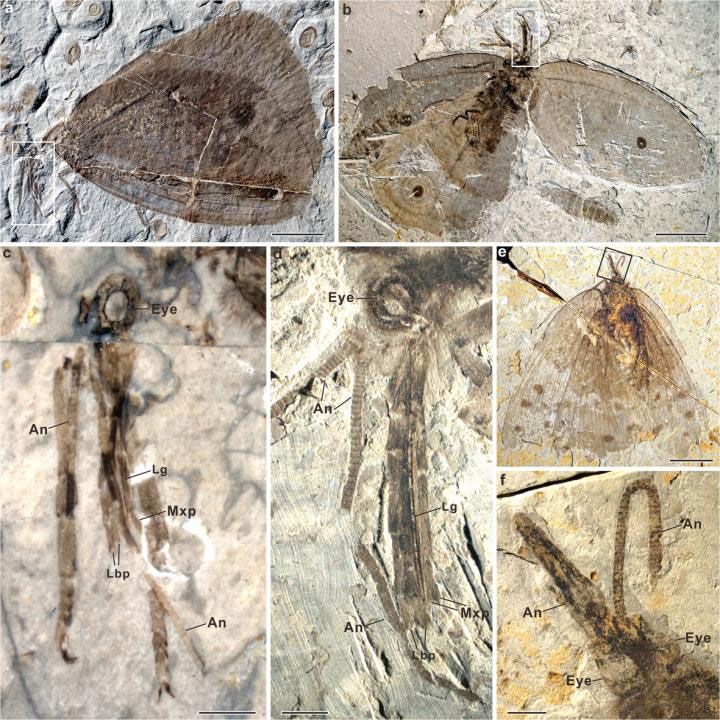
    Jurassic and Cretaceous Kalligrammatids from China
    These are Jurassic and Cretaceous kalligrammatids from China. Credit: NIGPAS

    The NIGPAS researchers reported 27 well-preserved kalligrammatids from late Cretaceous Burmese amber (99 Ma) and Chinese Early Cretaceous (125 Ma) and Middle Jurassic (165 Ma) compression rocks.

    Kalligrammatid proboscides vary greatly in length, from 0.6 to 3.2 mm in amber inclusions and about 5 to 18 mm in compression fossils. The high diversity of kalligrammatids and large variation in proboscis length strongly suggest diverse plant hosts with different floral tube lengths. Therefore, pollination niche partitioning may have been present among some Mesozoic insects.

    If pollination niches were partitioned, as in extant ecosystems, this likely increased pollination effectiveness and reduced the cost of pollination mutualism, thus contributing to the high diversity of pollinating insects and the success of pollinator-dependent plants during the Cretaceous period.
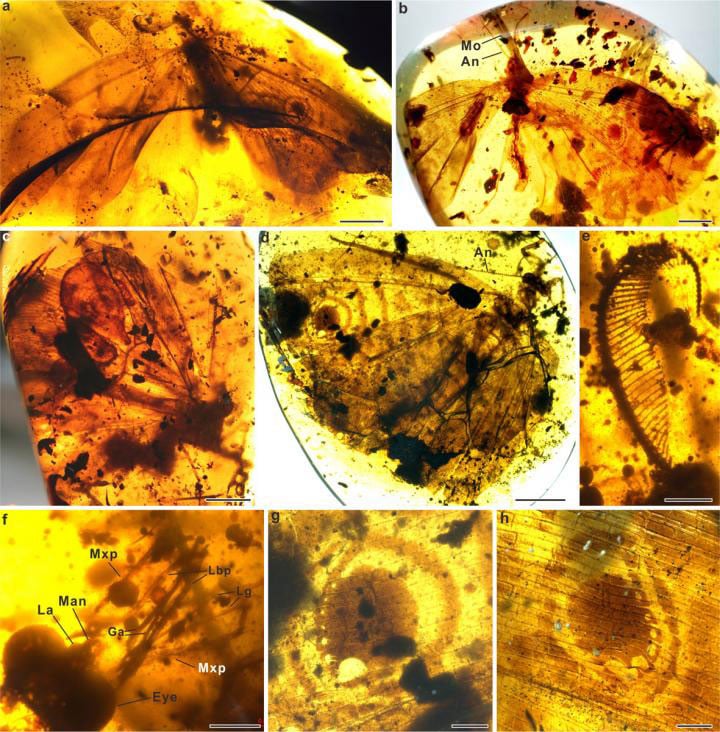
    Kalligrammatids in Burmese Amber
    These are kalligrammatids in Burmese amber. Credit: NIGPAS

    Kalligrammatid species diversification was potentially promoted by coevolution between pollinating kalligrammatids and their host plants under highly partitioned pollination niches.

    Traits such as wing eyespots, which likely functioned as a defense in large-sized species, and sexually dimorphic antennae, which were likely used for pre-mating chemical communication, elucidate how kalligrammatids survived in the Mesozoic terrestrial ecosystem under intense competition.

    However, such elaborate associations between kalligrammatids and their host plants (mostly confined to gymnosperms) could have been a key factor contributing to the extinction of kalligrammatids, which likely occurred during the late Cretaceous with the decline in gymnosperm diversity.

    Reference: “High niche diversity in Mesozoic pollinating lacewings” by EQing Liu, Xiumei Lu, Qingqing Zhang, Jun Chen, Xiaoting Zheng, Weiwei Zhang, Xingyue Liu and Bo Wang, 17 September 2018, Nature Communications.
    DOI: 10.1038/s41467-018-06120-5

    Never miss a breakthrough: Join the SciTechDaily newsletter.
    Follow us on Google and Google News.

    Archaeology Chinese Academy of Sciences Fossils Insect Paleontology
    Share. Facebook Twitter Pinterest LinkedIn Email Reddit

    Related Articles

    ‘An Experiment of Nature’ – Fossil Fish Gives New Insights Into Evolution After a Mass Extinction

    Scientists Discover 3-Foot-Tall Relative of the Tyrannosaurus Rex

    New Dinosaur Species Discovered in Mongolia, Gobiraptor Minutus

    Finding the ‘Breath of Life’ in a Silurian Ostracod

    When Did Animals Leave Their First Footprint on Earth?

    ‘Bloat-and-Float’ Explains Dinosaur Fossil Mystery

    Tiny Jurassic Dinosaur Featured Rainbow Ruff and a Bony Crest

    Habelia Optata – A 508-Million-Year-Old Sea Creature

    Drepanosaurus – A Small Reptile with a Rearsome Finger

    1 Comment

    1. Bruce Campbell on September 17, 2018 2:13 pm

      The kalligrammatid clearly show a morphology much closer to that of modern butterflies than what is depicted in the illustrations.

      Reply
    Leave A Reply Cancel Reply

    • Facebook
    • Twitter
    • Pinterest
    • YouTube

    Don't Miss a Discovery

    Subscribe for the Latest in Science & Tech!

    Trending News

    Artificial Sweeteners May Harm Future Generations, Study Suggests

    Splashdown! NASA Artemis II Returns From Record-Breaking Moon Mission

    What If Consciousness Exists Beyond Your Brain

    Scientists Finally Crack the 100-Million-Year Evolutionary Mystery of Squid and Cuttlefish

    Beyond “Safe Levels”: Study Challenges What We Know About Pesticides and Cancer

    Researchers Have Found a Dietary Compound That Increases Longevity

    Scientists Baffled by Bizarre “Living Fossil” From 275 Million Years Ago

    Your IQ at 23 Could Predict Your Wealth at 27, Study Finds

    Follow SciTechDaily
    • Facebook
    • Twitter
    • YouTube
    • Pinterest
    • Newsletter
    • RSS
    SciTech News
    • Biology News
    • Chemistry News
    • Earth News
    • Health News
    • Physics News
    • Science News
    • Space News
    • Technology News
    Recent Posts
    • Scientists Uncover Hidden Force Powering Yellowstone’s Supervolcano
    • This Metal Melts in Your Hand – and Scientists Just Discovered Something Strange
    • Why Losing Too Much Fat Can Be Just As Dangerous as Obesity
    • Beef vs. Chicken: Surprising Results From New Prediabetes Study
    • Alzheimer’s Breakthrough: Scientists Discover Key Protein May Prevent Toxic Protein Clumps in the Brain
    Copyright © 1998 - 2026 SciTechDaily. All Rights Reserved.
    • Science News
    • About
    • Contact
    • Editorial Board
    • Privacy Policy
    • Terms of Use

    Type above and press Enter to search. Press Esc to cancel.