
Close Menu
    Facebook X (Twitter) Instagram
    SciTechDaily
    • Biology
    • Chemistry
    • Earth
    • Health
    • Physics
    • Science
    • Space
    • Technology
    Facebook X (Twitter) Pinterest YouTube RSS
    SciTechDaily
    Home»Space»Chandra Detects Diskless Young Stars in Serpens South Cluster
    Space

    Chandra Detects Diskless Young Stars in Serpens South Cluster

    By Megan Watzke, Harvard-Smithsonian Center for AstrophysicsSeptember 17, 2018No Comments3 Mins Read
    Facebook Twitter Pinterest Telegram LinkedIn WhatsApp Email Reddit
    Share
    Facebook Twitter LinkedIn Pinterest Telegram Email Reddit
    Chandra Detects Diskless Young Stars
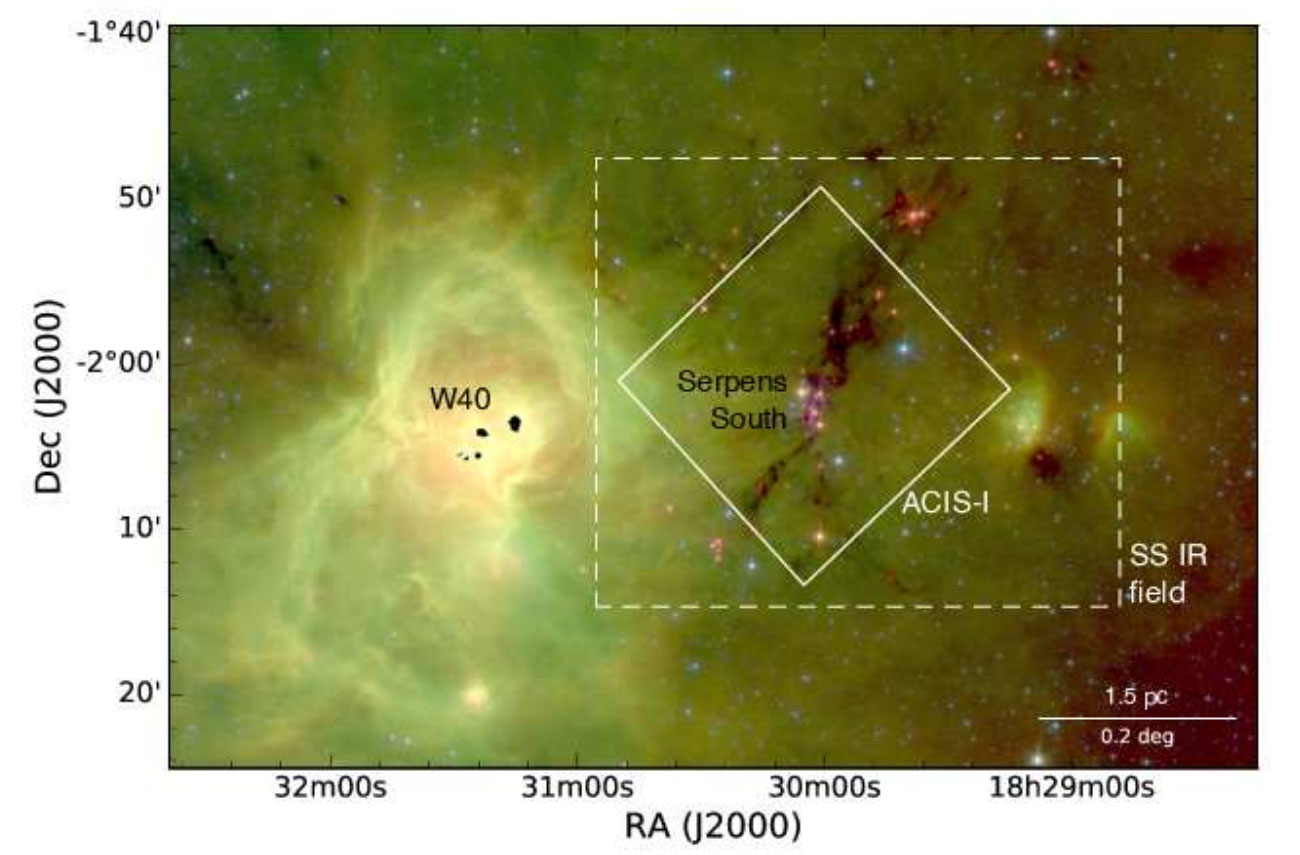
    Spitzer IRAC and MIPS three-color image of the Serpens South and W40 region, blue: 4.5 µm, green: 8.0 µm, red: 24 µm. The dark dust filament running through Serpens South is clearly visible, even at 24 µm. The inner box outlines the Chandra ACIS-I field of view, while the outer dashed box outlines the Serpens South IR field.

    Stars frequently form in crowded environments. By combining the resources of multi-wavelength missions like Chandra in the X-ray and Spitzer in the infrared, astronomers are able to resolve ambiguities and assemble a much more complete census of cluster content and the individual properties of the population. A case in point is the development of disks (possibly protoplanetary) around new stars. Disks form along with the new star and then evolve over a few million years before dissipating, perhaps leaving planets behind, and in clustered environments their development can be influenced by interactions with neighbors.

    Stellar disks are warmed by their stars and were first spotted via the infrared emission from the warm dust. More evolved young stars without disks lack this characteristic infrared signature and thus can be identified as the more evolved ones in a cluster. Young stars were also discovered to emit elevated levels of X-rays as compared to main-sequence stars because of their still-developing internal circulation. (In fact, young stars can have luminosities thousands of times brighter in X-rays than their older stellar counterparts.) In a crowded cluster environment, however, where other factors besides age are thought to be able to inhibit or disrupt the development of a disk, the X-ray emission offers an independent tool to identify those young stars without disks.

    The Serpens South cluster of stars, estimated to be located about 900 light-years away in the direction of the constellation Serpens, is very young and its stars are heavily masked by the thick natal dust in their environment – indeed, it is thought to be among the youngest regions near us, making it an important test-bed for the study of disk evolution in clustered environments. CfA astronomers Elaine Winston and Scott Wolk and two collaborators used data from Chandra and Spitzer to analyze sixty-six young stars in the cluster with both infrared and X-ray emission. They found five stars that appeared to be diskless and old because they lacked the infrared signature of disks, but based on their X-ray emission they are actually still quite young: Their disk dissipation is the result not of aging but of cluster interactions, consistent with the theory. The team was also able to address a long-standing dispute over the distance to the cluster. Many astronomers had assumed it was as much as three-thousand light-years away, the same distance as another cluster in that region of sky, but the intrinsic X-ray brightness of young stars in clusters is known to follow a relatively narrow distribution of values, and the observed X-ray emission of these stars argues against the farther distance estimate and in favor of the 900 light-tear value.

    Reference: “Chandra Detection of an Evolved Population of Young Stars in Serpens South” by E. Winston, S. J. Wolk, R. Gutermuth and T. L. Bourke, 17 May 2018, The Astronomical Journal.
    DOI: 10.3847/1538-3881/aabe82

    Never miss a breakthrough: Join the SciTechDaily newsletter.
    Follow us on Google and Google News.

    Astronomy Chandra X-ray Observatory Cosmology Spitzer Space Telescope
    Share. Facebook Twitter Pinterest LinkedIn Email Reddit

    Related Articles

    Spitzer Finishes Its Frontier Fields Observations

    Astronomers Discover Clues For How Giant Black Holes Formed So Quickly

    The Destructive Results of a Mighty Supernova Explosion

    Chandra Reveals a New Composite Image of NGC 4258

    A New View of Centaurus A

    Amateur Astronomers Combine Data to Reveal New Images of Galaxies

    3D Viewer Offers a New Look at Cassiopeia A

    NASA to Look Deeper Into the Universe than Ever Before

    NASA Data Suggests Black Holes Abundant Among the Earliest Stars

    Leave A Reply Cancel Reply

    • Facebook
    • Twitter
    • Pinterest
    • YouTube

    Don't Miss a Discovery

    Subscribe for the Latest in Science & Tech!

    Trending News

    Millions of People Have Osteopenia Without Realizing It – Here’s What You Need To Know

    Researchers Discover Boosting a Single Protein Helps the Brain Fight Alzheimer’s

    World-First Study Reveals Human Hearts Can Regenerate After a Heart Attack

    Why Your Dreams Feel So Real Sometimes and So Strange Other Times

    This Simple Home Device May Boost Brain Power in Adults Over 40

    Enormous Prehistoric Insects Puzzle Scientists

    Scientists Develop Bioengineered Chewing Gum That Could Help Fight Oral Cancer

    After 37 Years, the World’s Longest-Running Soil Warming Experiment Uncovers a Startling Climate Secret

    Follow SciTechDaily
    • Facebook
    • Twitter
    • YouTube
    • Pinterest
    • Newsletter
    • RSS
    SciTech News
    • Biology News
    • Chemistry News
    • Earth News
    • Health News
    • Physics News
    • Science News
    • Space News
    • Technology News
    Recent Posts
    • This New “Sound Laser” Could Measure Gravity With Stunning Precision
    • Quantum Breakthrough: New Algorithm Solves “Impossible” Materials in Seconds
    • Could the Universe’s Hidden Shape Solve One of Physics’ Biggest Mysteries?
    • Rewriting Dinosaur Evolution: Scientists Unearth Remarkable 150-Million-Year-Old Stegosaur Skull
    • Scientists Identify Two Simple Treatments for Cancer-Related Cognitive Impairment
    Copyright © 1998 - 2026 SciTechDaily. All Rights Reserved.
    • Science News
    • About
    • Contact
    • Editorial Board
    • Privacy Policy
    • Terms of Use

    Type above and press Enter to search. Press Esc to cancel.