
Close Menu
    Facebook X (Twitter) Instagram
    SciTechDaily
    • Biology
    • Chemistry
    • Earth
    • Health
    • Physics
    • Science
    • Space
    • Technology
    Facebook X (Twitter) Pinterest YouTube RSS
    SciTechDaily
    Home»Space»Spitzer Views the Serpens Cloud Core
    Space

    Spitzer Views the Serpens Cloud Core

    By Whitney Clavin, Jet Propulsion Laboratory; NASAMay 29, 20141 Comment3 Mins Read
    Facebook Twitter Pinterest Telegram LinkedIn WhatsApp Email Reddit
    Share
    Facebook Twitter LinkedIn Pinterest Telegram Email Reddit
    Spitzer Views the Serpens Cloud Core
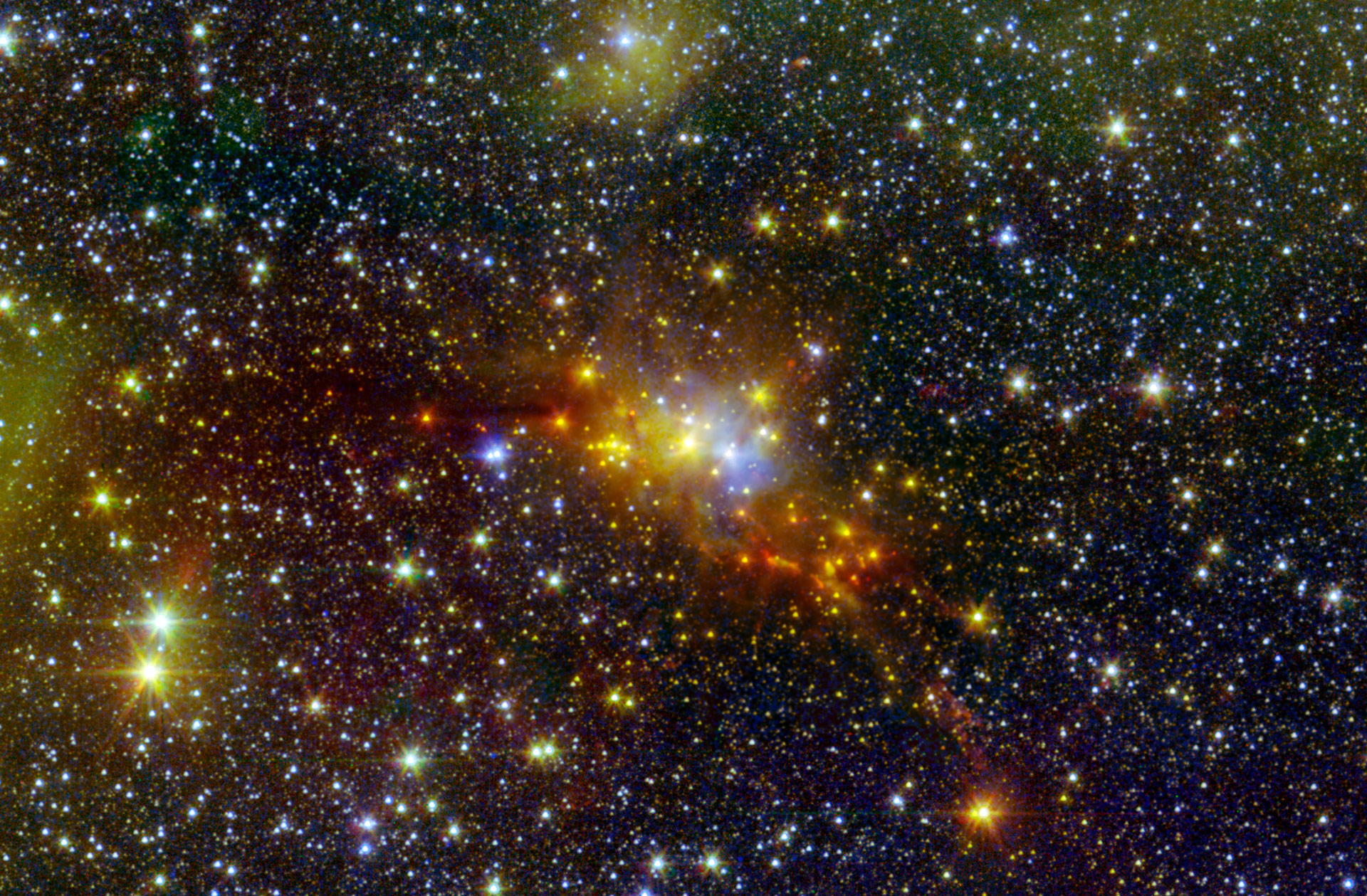
    Within the swaddling dust of the Serpens Cloud Core, astronomers are studying one of the youngest collections of stars ever seen in our galaxy. Credit: NASA/JPL-Caltech/2MASS

    This new image from NASA’s Spitzer Space Telescope and the Two Micron All Sky Survey takes a closer look at the Serpens Cloud Core, a star-forming region that is located about 750 light-years away.

    Stars that are just beginning to coalesce out of cool swaths of dust and gas are showcased in this image from NASA’s Spitzer Space Telescope and the Two Micron All Sky Survey (2MASS). Infrared light has been assigned colors we see with our eyes, revealing young stars in orange and yellow, and a central parcel of gas in blue. This area is hidden in visible-light views, but infrared light can travel through the dust, offering a peek inside the stellar hatchery.

    The dark patch to the left of the center is swaddled in so much dust, even the infrared light is blocked. It is within these dark wombs that stars are just beginning to take shape.

    Called the Serpens Cloud Core, this star-forming region is located about 750 light-years away in Serpens, or the “Serpent,” a constellation named after its resemblance to a snake in visible light. The region is noteworthy as it only contains stars of relatively low to moderate mass, and lacks any of the massive and incredibly bright stars found in larger star-forming regions like the Orion nebula. Our sun is a star of moderate mass. Whether it formed in a low-mass stellar region like Serpens, or a high-mass stellar region like Orion, is an ongoing mystery.

    The inner Serpens Cloud Core is remarkably detailed in this image. It was assembled from 82 snapshots representing a whopping 16.2 hours of Spitzer observing time. The observations were made during Spitzer’s “warm mission,” a phase that began in 2009 after the observatory ran out of liquid coolant, as planned.

    Most of the small dots in this image are stars located behind, or in front of, the Serpens nebula.

    The 2MASS mission was a joint effort between the California Institute of Technology, Pasadena; the University of Massachusetts, Amherst; and NASA’s Jet Propulsion Laboratory, also in Pasadena.

    JPL manages the Spitzer Space Telescope mission for NASA’s Science Mission Directorate, Washington. Science operations are conducted at the Spitzer Science Center at the California Institute of Technology in Pasadena. Spacecraft operations are based at Lockheed Martin Space Systems Company, Littleton, Colorado. Data are archived at the Infrared Science Archive housed at the Infrared Processing and Analysis Center at Caltech. Caltech manages JPL for NASA.

    Never miss a breakthrough: Join the SciTechDaily newsletter.
    Follow us on Google and Google News.

    Astronomy NASA Spitzer Space Telescope
    Share. Facebook Twitter Pinterest LinkedIn Email Reddit

    Related Articles

    “Space Butterfly” Is Actually a Nursery for Hundreds of Baby Stars

    Scores of Baby Stars Revealed in the Orion Constellation

    NASA’s Spitzer Space Telescope Illuminates Exoplanets

    Godzilla Nebula: A “Monster” Star-Forming Region Spied by NASA’s Spitzer Space Telescope

    Hidden Supernova: Stars Are Exploding in Dusty Galaxies – We Just Can’t Always See Them

    New Worlds in a River of Young Stars Discovered by NASA’s Transiting Exoplanet Survey Satellite

    3D Map of Cosmic Neighborhood Created With Help From Worldwide Network of Citizen Scientists

    Stellar Snowflake Cluster Spotted by Spitzer Space Telescope

    Chaos Swirls at the Heart of the Orion Nebula

    1 Comment

    1. Tjesimir Tkalcevic on November 27, 2023 9:19 am

      Matična Zvijezda udaljena više od 7000 Au[astronomskih jedinica],otkriva u nastanaku, da je planet BD Smeđi Patuljak otpuhivan samom uspostavom fuzijske vatre Zv., prije ikave podijele primarnog Diska na jezgre planeta? Plinska Mini-Zv Smeđi Patuljak BD?

      Reply
    Leave A Reply Cancel Reply

    • Facebook
    • Twitter
    • Pinterest
    • YouTube

    Don't Miss a Discovery

    Subscribe for the Latest in Science & Tech!

    Trending News

    Massive Study Warns Marijuana Use in Teens Is Linked to Serious Mental Illness

    Scientists Discover a Completely Unexpected Way T Cells Kill Cancer

    Scientists Just Found the Solar System’s Original “Planet Factory”

    Study Warns Widely Used Food Preservatives Linked to High Blood Pressure and Heart Disease

    New Treatment Could Reverse Osteoarthritis Within Weeks

    Physicists Have Measured “Negative Time” in Bizarre Quantum Experiment

    The Deadly Tapeworm Spreading Across America Has Reached the Pacific Northwest

    Could Low Vitamin D Be Making Your Pain Worse?

    Follow SciTechDaily
    • Facebook
    • Twitter
    • YouTube
    • Pinterest
    • Newsletter
    • RSS
    SciTech News
    • Biology News
    • Chemistry News
    • Earth News
    • Health News
    • Physics News
    • Science News
    • Space News
    • Technology News
    Recent Posts
    • Scientists Discover Mysterious Creature Living in the Great Salt Lake – and It Exists Nowhere Else on Earth
    • It’s Alive? Surprising Discovery Changes What We Know About Fog
    • Simple Family Routines May Be the Secret to a Smoother Start at School
    • Brain Study Overturns Long-Held Beliefs About How Humans Learn Speech
    • Ancient Goose Fossil Challenges Long-Held Theories About New Zealand Birds
    Copyright © 1998 - 2026 SciTechDaily. All Rights Reserved.
    • Science News
    • About
    • Contact
    • Editorial Board
    • Privacy Policy
    • Terms of Use

    Type above and press Enter to search. Press Esc to cancel.