
Close Menu
    Facebook X (Twitter) Instagram
    SciTechDaily
    • Biology
    • Chemistry
    • Earth
    • Health
    • Physics
    • Science
    • Space
    • Technology
    Facebook X (Twitter) Pinterest YouTube RSS
    SciTechDaily
    Home»Space»Astronomers Reveal Some of the Earliest Galaxies in the Universe
    Space

    Astronomers Reveal Some of the Earliest Galaxies in the Universe

    By Megan Watzke, Harvard-Smithsonian Center for AstrophysicsSeptember 17, 2018No Comments5 Mins Read
    Facebook Twitter Pinterest Telegram LinkedIn WhatsApp Email Reddit
    Share
    Facebook Twitter LinkedIn Pinterest Telegram Email Reddit
    Astronomers Identify Some of the Earliest Galaxies
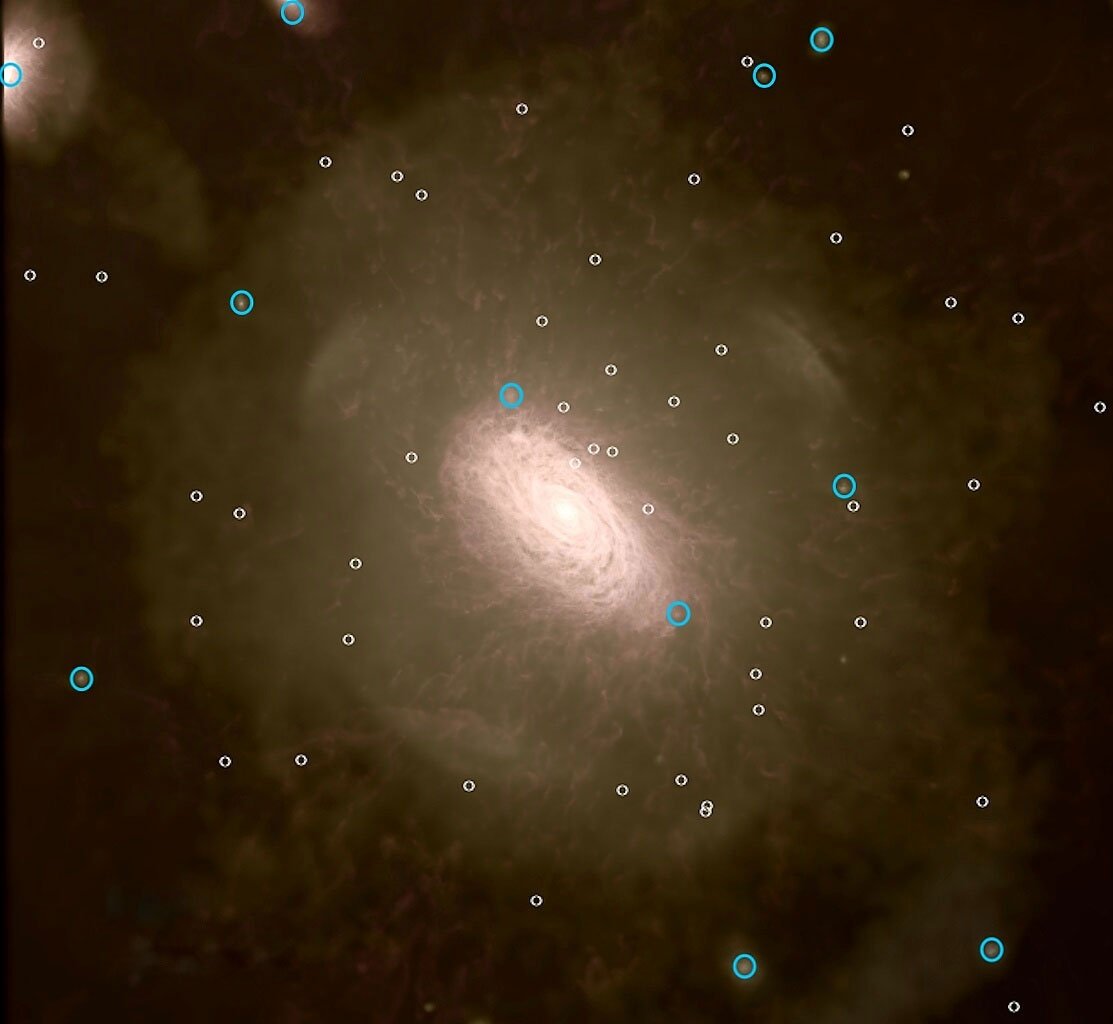
    The distribution of satellite galaxies orbiting a computer-simulated galaxy, as predicted by the Lambda-cold-dark-matter cosmological model. The blue circles surround the brighter satellites, the white circles the ultrafaint satellites (so faint that they are not readily visible in the image). The ultrafaint satellites are amongst the most ancient galaxies in the Universe; they began to form when the Universe was only about 100 million years old (compared to its current age of 13.8 billion years). The image has been generated from simulations from the Auriga project carried out by researchers at the Institute for Computational Cosmology, Durham University, UK, the Heidelberg Institute for Theoretical Studies, Germany, and the Max Planck Institute for Astrophysics, Germany. Credit: Durham ICC/HITS/MPIA/Auriga/S. Bose et al.

    Astronomers from Durham University and the Harvard-Smithsonian Center for Astrophysics (CfA) have found evidence that the faintest satellite galaxies orbiting our own Milky Way galaxy are among the very first galaxies that formed in our Universe.

    The research group’s results suggest that galaxies including Segue-1, Bootes I, Tucana II, and Ursa Major I are, in fact, some of the first galaxies ever formed, thought to be over 13 billion years old. Their findings are published in The Astrophysical Journal.

    When the Universe was about 380,000 years old, the very first atoms formed. These were hydrogen atoms, the simplest element in the periodic table. These atoms collected into clouds and began to cool gradually and settle into the small clumps or “halos” of dark matter that emerged from the Big Bang.

    This cooling phase, known as the “cosmic dark ages,” lasted about 100 million years. Eventually, the gas that had cooled inside the halos became unstable and began to form stars. These objects are the very first galaxies ever to have formed. With the formation of the first galaxies, the Universe burst into light, bringing the cosmic dark ages to an end.

    Dr. Sownak Bose of the CfA, working with Dr. Alis Deason and Professor Carlos Frenk at Durham University’s Institute for Computational Cosmology (ICC), identified two populations of satellite galaxies orbiting the Milky Way.
    Some of the Earliest Galaxies Identified
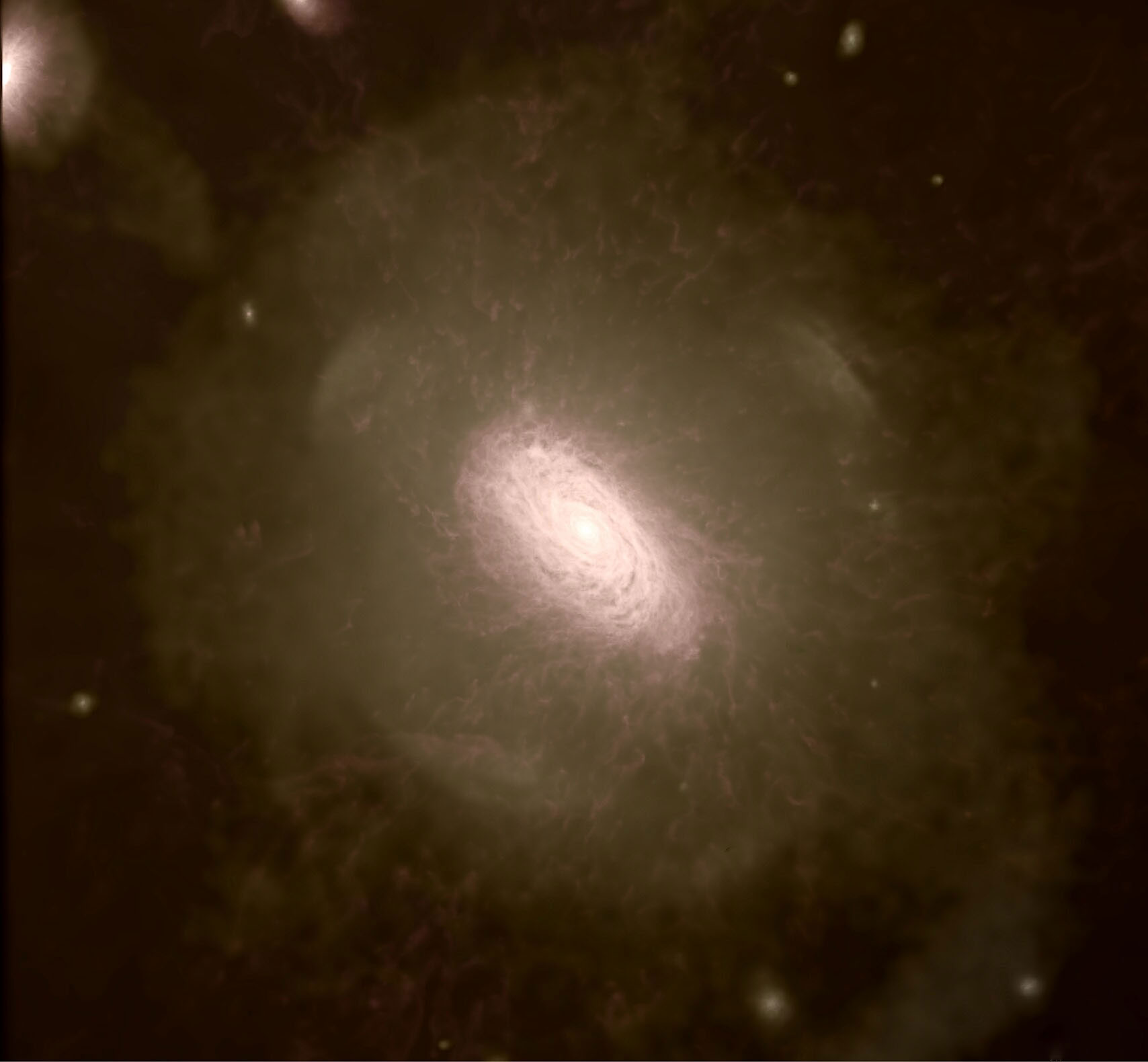
    The distribution of satellite galaxies orbiting a computer-simulated galaxy, as predicted by the Lambda-cold-dark-matter cosmological model. Ultrafaint satellites are amongst the most ancient galaxies in the Universe; they began to form when the Universe was only about 100 million years old (compared to its current age of 13.8 billion years). The image has been generated from simulations from the Auriga project carried out by researchers at the Institute for Computational Cosmology, Durham University, UK, the Heidelberg Institute for Theoretical Studies, Germany, and the Max Planck Institute for Astrophysics, Germany. Credit: Durham ICC/HITS/MPIA/Auriga/S. Bose et al.

    The first was a very faint population consisting of the galaxies that formed at the end of the “cosmic dark ages”. The second was a slightly brighter population consisting of galaxies that formed hundreds of millions of years later — once the hydrogen that had been ionized (that is, had their electrons knocked out) — by the intense ultraviolet radiation emitted by the first stars was able to cool into more massive dark matter halos. Eventually, the halos of dark matter became so massive that bright galaxies like our own Milky Way were able to form.

    Remarkably, the team found that a model of galaxy formation that they had developed previously agreed perfectly with the data, allowing them to infer the formation times of the faint satellite galaxies.

    Professor Frenk, Director of Durham’s ICC, said: “Finding some of the very first galaxies that formed in our Universe orbiting in the Milky Way’s own backyard is the astronomical equivalent of finding the remains of the first humans that inhabited the Earth. It is hugely exciting.

    “Our finding supports the current model for the evolution of our Universe, the ‘Lambda-cold-dark-matter model’ in which the elementary particles that make up the dark matter drive cosmic evolution,” said Professor Frenk. In this model “Lambda” refers to dark energy, which is causing the expansion of the Universe to accelerate.

    Dr. Bose, who was a Ph.D. student at the ICC when this work began and is now a research fellow at the CfA, said: “A nice aspect of this work is that it highlights the complementarity between the predictions of a theoretical model and real data.

    “A decade ago, the faintest galaxies in the vicinity of the Milky Way would have gone under the radar. With the increasing sensitivity of present and future galaxy censuses, a whole new trove of the tiniest galaxies has come into the light, allowing us to test theoretical models in new regimes.”

    Dr. Deason, who is a Royal Society University Research Fellow at the ICC said: “This is a wonderful example of how observations of the tiniest dwarf galaxies residing in our own Milky Way can be used to learn about the early Universe.”

    Dr. Bose is supported through the Institute for Theory and Computation fellowship at Harvard University, while Dr. Deason is supported by a Royal Society University Research Fellowship. Professor Frenk and Dr. Deason are both supported by the Science and Technology Facilities Council Consolidated Grant for Astronomy and Durham University.

    Reference: “The Imprint of Cosmic Reionization on the Luminosity Function of Galaxies” by Sownak Bose, Alis J. Deason and Carlos S. Frenk, 16 August 2018, The Astrophysical Journal.
    DOI: 10.3847/1538-4357/aacbc4

    Never miss a breakthrough: Join the SciTechDaily newsletter.
    Follow us on Google and Google News.

    Astronomy Cosmology Harvard-Smithsonian Center for Astrophysics
    Share. Facebook Twitter Pinterest LinkedIn Email Reddit

    Related Articles

    Astronomers Just Reconstructed a Galaxy’s 12-Billion-Year History

    Webb’s Mysterious “Little Red Dots” May Be the Cradle of the First Black Holes

    Mysterious Radio Signals Reveal What’s Hiding Between Galaxies

    Cosmic Mystery Solved: Astronomers Have Discovered the Universe’s “Missing” Matter

    Invisible Storm Lights Up Galaxy Cluster With Record-Breaking Radio Glow

    Herschel Observations Help Identify the Physical Processes Underway in Cold, Dense Clouds

    CfA Scientists Measure the Rate of Expansion of the Universe

    New Study Challenges Planck Results

    Calculations Show the Ideal Time to Study the Cosmos

    Leave A Reply Cancel Reply

    • Facebook
    • Twitter
    • Pinterest
    • YouTube

    Don't Miss a Discovery

    Subscribe for the Latest in Science & Tech!

    Trending News

    Scientists Finally Uncover How a “Forever Chemical” Causes Birth Defects

    Scientists Uncover the Earliest Brain Changes That May Predict Alzheimer’s Decades Before Symptoms

    Surprising New Study Challenges a Century-Old Theory of Habit Formation

    Scientists Turn Seawater Into Drinking Water Without Toxic Brine

    Vitamin D Drug Shows Surprising Promise Against One of the Deadliest Cancers

    NASA’s X-59 Sonic Boom Killer Is Ready for Its Biggest Test Yet

    The Best Exercise Combination for Longevity, According to a 30-Year Study

    Popular Weight-Loss Drug Found To Slow Biological Aging in Landmark Human Trial

    Follow SciTechDaily
    • Facebook
    • Twitter
    • YouTube
    • Pinterest
    • Newsletter
    • RSS
    SciTech News
    • Biology News
    • Chemistry News
    • Earth News
    • Health News
    • Physics News
    • Science News
    • Space News
    • Technology News
    Recent Posts
    • The Probiotic Breakthrough for Natural Anxiety Relief and Better Mental Health
    • Animal vs. Plant Protein: Scientists Found a Surprising Nutritional Difference
    • Tiny Genetic Change Turns Female Mice Into Males, Scientists Discover
    • Scientists Discover Strange New Spider Species That Disguises Itself as a Fungus
    • This Simple Drink Could Help Calm the Inflammation Behind Many Diseases
    Copyright © 1998 - 2026 SciTechDaily. All Rights Reserved.
    • Science News
    • About
    • Contact
    • Editorial Board
    • Privacy Policy
    • Terms of Use

    Type above and press Enter to search. Press Esc to cancel.