
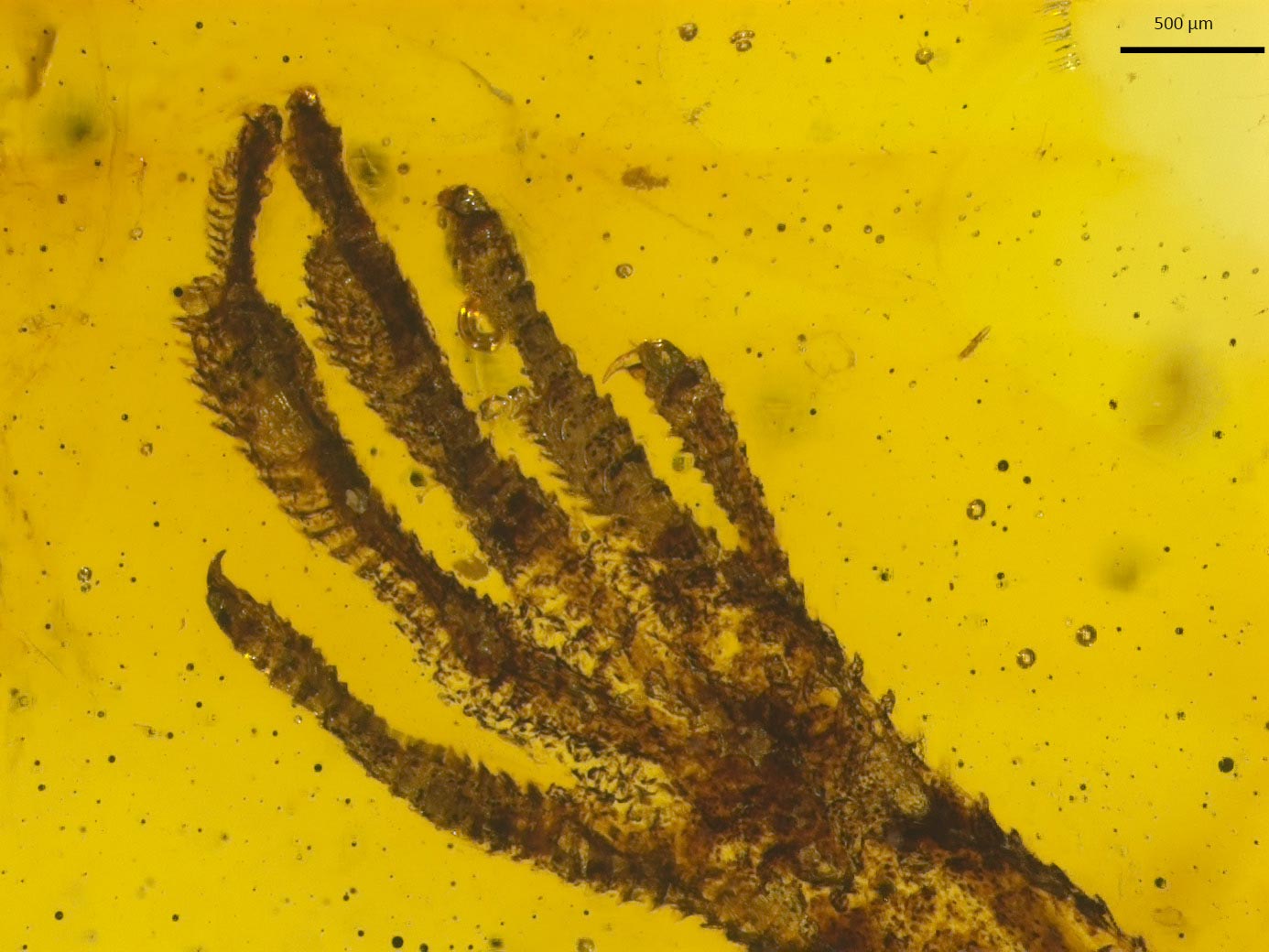
Researchers at the University of Bonn are investigating the conservation status of the reptile, which is up to 20 million years old.
The tiny forefoot of a lizard of the genus Anolis was trapped in amber about 15 to 20 million years ago. Every detail of this rare fossil is visible under the microscope. But the seemingly very good condition is deceptive: The bone is largely decomposed and chemically transformed, very little of the original structure remains. The results, which are now presented in the journal “PLOS ONE,” provide important clues as to what exactly happens during fossilization.
How do fossils stay preserved for millions of years? Rapid embedding is an important prerequisite for protecting the organisms from access by scavengers, for example. Decomposition by microorganisms can for instance be prevented by extreme aridity. In addition, the original substance is gradually replaced by minerals. The pressure from the sediment on top of the fossil ensures that the fossil is solidified. “That’s the theory,” says Jonas Barthel, a doctoral student at the Institute for Geosciences at the University of Bonn. “How exactly fossilization proceeds is currently the subject of intensive scientific investigation.”
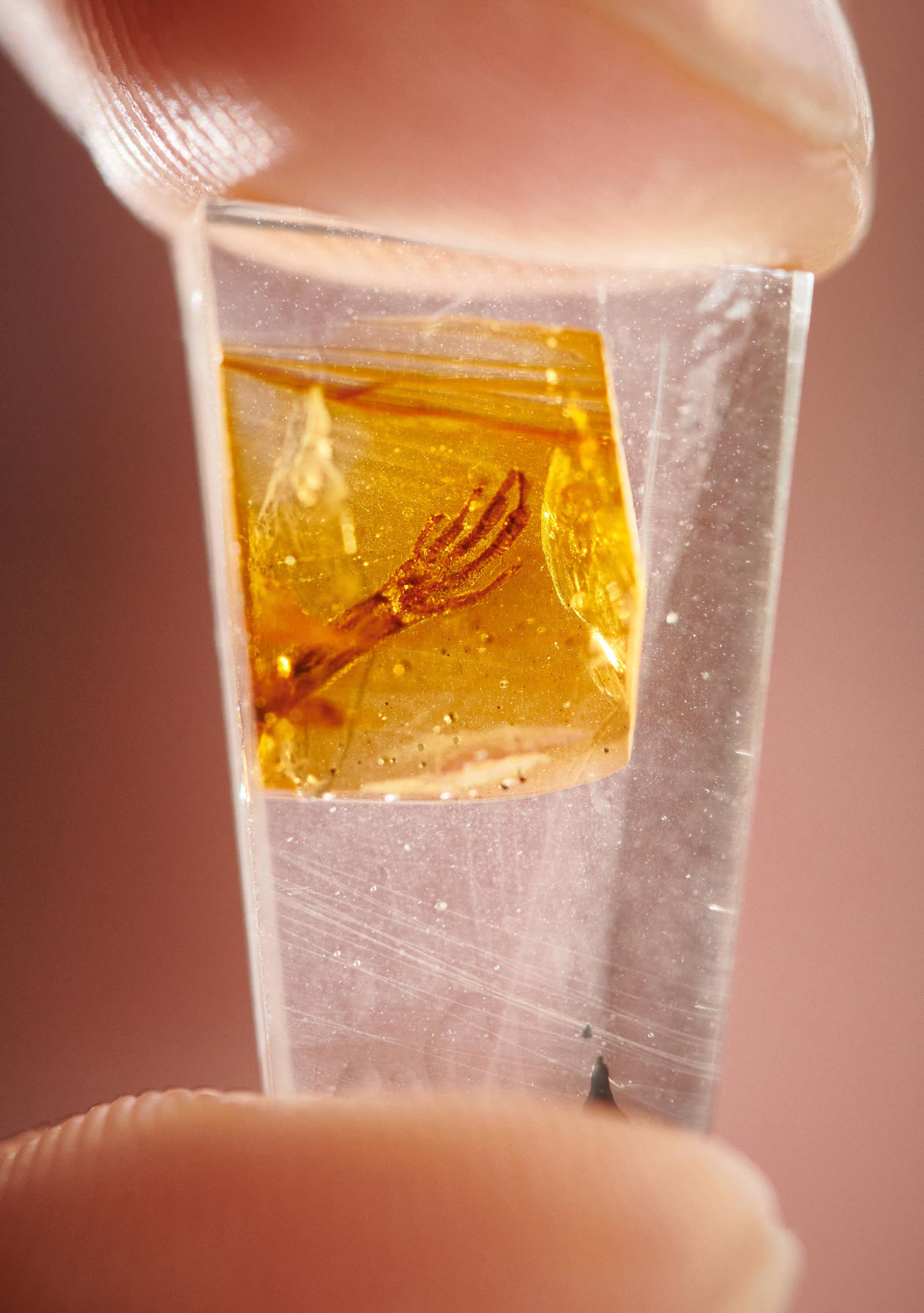
Amber is considered an excellent preservative. Small animals can be enclosed in a drop of tree resin that hardens over time. A team of geoscientists from the University of Bonn has now examined an unusual find from the Dominican Republic: The tiny forefoot of a lizard of the genus Anolis is enclosed in a piece of amber only about two cubic centimeters in size. Anolis species still exist today.
Vertebrate inclusions in amber are very rare
The Stuttgart State Museum of Natural History has entrusted the exhibit to the paleontologists of the University of Bonn for examination. “Vertebrate inclusions in amber are very rare, the majority are insect fossils,” says Barthel. The scientists used the opportunity to investigate the fossilization of the seemingly very well preserved vertebrate fragment. Since 2018 there is a joint research project of the University of Bonn with the German Research Foundation, which contributes to the understanding of fossilization using experimental and analytical approaches. The present study was also conducted within the framework of this project.
The researchers had thin sections prepared for microscopy at the Institute for Evolutionary Biology at the University of Bonn. The claws and toes are very clearly visible in the honey-brown amber mass, almost as if the tree resin had only recently dripped onto them — yet the tiny foot is about 15 to 20 million years old.
Scans in the micro-computer tomograph of the Institute for Geosciences revealed that the forefoot was broken in two places. One of the fractures is surrounded by a slight swelling. “This is an indication that the lizard had perhaps been injured by a predator,” says Barthel. The other fracture happened after the fossil was embedded — exactly at the place where a small crack runs through the amber.
Amber did not protect from environmental influences
The analysis of a thin section of bone tissue using Raman spectroscopy revealed the state of the bone tissue. The mineral hydroxyapatite in the bone had been transformed into fluoroapatite by the penetration of fluorine. Barthel: “This is surprising, because we assumed that the surrounding amber largely protects the fossil from environmental influences.” However, the small crack may have encouraged chemical transformation by allowing mineral-rich solutions to find their way in. In addition, Raman spectroscopy shows that collagen, the bone’s elastic component, had largely degraded. Despite the seemingly very good state of preservation, there was actually very little left of the original tissue structure.
“We have to expect that at least in amber from the Dominican Republic, macromolecules are no longer detectable,” says the supervisor of the study, Prof. Dr. Jes Rust from the Institute for Geosciences. It was not possible to detect more complex molecules such as proteins, but final analyses are still pending. The degradation processes in this amber deposit are therefore very advanced, and there is very little left of the original substance.
Acids in tree resin attack bone
Amber is normally considered an ideal preservative: Due to the tree resin, we have important insights into the insect world of millions of years. But in the lizard’s bone tissue, the resin might even have accelerated the degradation processes: Acids in the tree secretion have probably attacked the apatite in the bone — similar to tooth decay.
Reference: “Fluoridation of a lizard bone embedded in Dominican amber suggests open-system behavior” by H. Jonas Barthel, Denis Fougerouse, Thorsten Geisler and Jes Rust, 26 February 2020, PLOS ONE.
DOI: 10.1371/journal.pone.0228843
Never miss a breakthrough: Join the SciTechDaily newsletter.
Follow us on Google and Google News.
2 Comments
The Professor’s comment “We have to expect that at least in amber from the Dominican Republic, macromolecules are no longer detectable,” seems to discount all amber samples from this source.
Such a dismissive attitude after examining one speciment, doesn’t seem reasonable. Especially since that speciment was able to become contaminated from outside the amber.
Does the same degradation occur (in amber from the Dominican Republic) when a specimen is completely enclosed in amber with no cracks to allow any foreign chemicals in? An unbroken seal may allow for more complete preservation of tissues.
Wish I had a way to edit spelling. Specimen, not speciment. 😉