
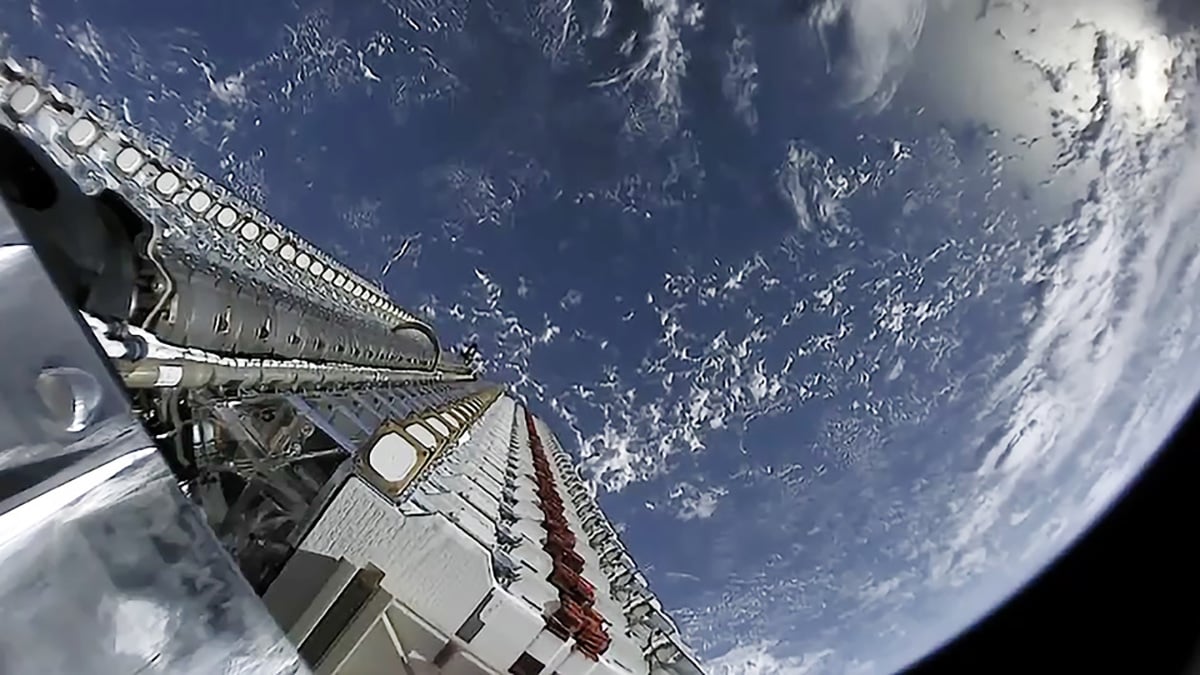
When internet-providing satellites — now being launched by the thousands — reach the end of their service life, the remnants from their incineration in Earth’s atmosphere will initiate chemical reactions that deplete stratospheric ozone.
When outdated satellites re-enter Earth’s atmosphere and disintegrate, they release small aluminum oxide particles that erode the Earth’s ozone layer. A recent study reveals that the presence of these particles has surged eightfold from 2016 to 2022 and is expected to keep rising with the growing number of satellites in low-Earth orbit.
The 1987 Montreal Protocol successfully regulated ozone-damaging CFCs to protect the ozone layer, shrinking the ozone hole over Antarctica with recovery expected in the next fifty years. However, the unexpected increase in aluminum oxides could interrupt the progress made in ozone recovery in the coming decades.
Of the 8,100 objects in low Earth orbit, 6,000 are Starlink satellites launched in the last few years. Demand for global internet coverage is driving a rapid ramp-up of launches of small communication satellite swarms. SpaceX is the front runner in this enterprise, with permission to launch another 12,000 Starlink satellites and as many as 42,000 planned. Amazon and other companies around the globe are also planning constellations ranging from 3,000 to 13,000 satellites, the authors of the study said.
Internet satellites in low Earth orbit are short-lived, at about five years. Companies must then launch replacement satellites to maintain internet service, continuing a cycle of planned obsolescence and unplanned pollution.
Aluminum oxides spark chemical reactions that destroy stratospheric ozone, which protects Earth from harmful UV radiation. The oxides don’t react chemically with ozone molecules, instead triggering destructive reactions between ozone and chlorine that deplete the ozone layer. Because aluminum oxides are not consumed by these chemical reactions, they can continue to destroy molecule after molecule of ozone for decades as they drift down through the stratosphere.
Yet little attention has yet been paid to pollutants formed when satellites fall into the upper atmosphere and burn. Earlier studies of satellite pollution largely focused on the consequences of propelling a launch vehicle into space, such as the release of rocket fuel. The new study, by a research team from the University of Southern California Viterbi School of Engineering, is the first realistic estimate of the extent of this long-lived pollution in the upper atmosphere, the authors said.
“Only in recent years have people started to think this might become a problem,” said Joseph Wang, a researcher in astronautics at the University of Southern California and corresponding author of the new study. “We were one of the first teams to look at what the implication of these facts might be.”
The study was published in the open-access AGU journal Geophysical Research Letters, which publishes high-impact, short-format reports with immediate implications spanning all Earth and space sciences.
Sleeping Threat
Because it’s effectively impossible to collect data from a spacecraft that’s burning up, previous studies used analyses of micrometeoroids to estimate potential pollution. But micrometeoroids contain very little aluminum, the metal that makes up 15% to 40% of the mass of most satellites, so these estimates didn’t apply well to new “swarm” satellites.
To get a more accurate picture of pollution from satellite re-entry, the researchers modeled the chemical composition of and bonds within satellites’ materials as they interact at molecular and atomic levels. The results gave the researchers an understanding of how the material changes with different energy inputs.
In 2022, reentering satellites increased aluminum in the atmosphere by 29.5% over natural levels, the researchers found. The modeling showed that a typical 250-kilogram (550-pound) satellite with 30% of its mass being aluminum will generate about 30 kilograms (66 pounds) of aluminum oxide nanoparticles (1-100 nanometers in size) during its reentry plunge. Most of these particles are created in the mesosphere, 50-85 kilometers (30-50 miles) above Earth’s surface.
The team then calculated that, based on particle size, it would take up to 30 years for the aluminum oxides to drift down to stratospheric altitudes, where 90% of Earth’s ozone is located.
The researchers estimated that by the time the currently planned satellite constellations are complete, every year, 912 metric tons of aluminum (1,005 U.S. tons) will fall to Earth. That will release around 360 metric tons (397 U.S. tons) of aluminum oxides per year to the atmosphere, an increase of 646% over natural levels.
Reference: “Potential Ozone Depletion From Satellite Demise During Atmospheric Reentry in the Era of Mega-Constellations” by José P. Ferreira, Ziyu Huang, Ken-ichi Nomura and Joseph Wang, 11 June 2024, Geophysical Research Letters.
DOI: 10.1029/2024GL109280
This work was funded by NASA.
Never miss a breakthrough: Join the SciTechDaily newsletter.
Follow us on Google and Google News.
6 Comments
Have these mixtures of aluminum oxides and chlorine been found in the real atmosphere, not in modeled ones?
I’m so tired of these chicken little stories.
These aren’t chicken little stories. You’re just desensitized to the very real fact that we are wrecking our planet.
“The 1987 Montreal Protocol successfully regulated ozone-damaging CFCs to protect the ozone layer, shrinking the ozone hole over Antarctica with recovery expected in the next fifty years.”
This is delusional, wishful thinking. If one looks at the size and ‘depth’ of the so-called ozone ‘hole,’ it is evident that recent ozone depletions are little different from what they were in the 1990s, just after the Montreal Protocol was created.
See “Annual Records”: https://ozonewatch.gsfc.nasa.gov/
“The oxides don’t react chemically with ozone molecules, instead triggering destructive reactions between ozone and chlorine that deplete the ozone layer.”
Where is the chlorine coming from? The Montreal Protocol (1987) was supposed to address that issue.
As 2/3 of the planet is covered with salty water, I would guess it is coming from that salt. Radiation should cause the salt to separate into sodium and chloride.