

Future space telescopes are being designed for easier servicing, focusing on overcoming challenges such as remote locations and limited fuel.
New methods include safe proximity operations and efficient trajectory planning to potentially extend the lifespan of missions like the James Webb and Gaia.
Space Telescope Serviceability Advances
Space telescopes are becoming more sustainable thanks to new designs focused on serviceability. Researchers have developed a maintenance plan for future space observatories, drawing insights from missions like the James Webb Space Telescope and the European Space Agency’s Gaia.
“Although the next generation of large space telescopes are being designed with serviceability in mind, there are enormous challenges with implementation,” explained Siegfried Eggl, a professor of aerospace engineering at The Grainger College of Engineering, University of Illinois Urbana-Champaign.
Challenges of Servicing Distant Telescopes
One major challenge is distance. Modern telescopes are positioned at the Sun-Earth Lagrange Point L2, roughly a million miles from Earth. Though this location moves in sync with Earth, making it somewhat more accessible, the sheer distance makes transportation both time-consuming and costly. Despite these challenges, the Lagrange Point L2 offers a quiet, low-interference environment that significantly enhances the impact of missions like Gaia, which Eggl believes justifies the effort.
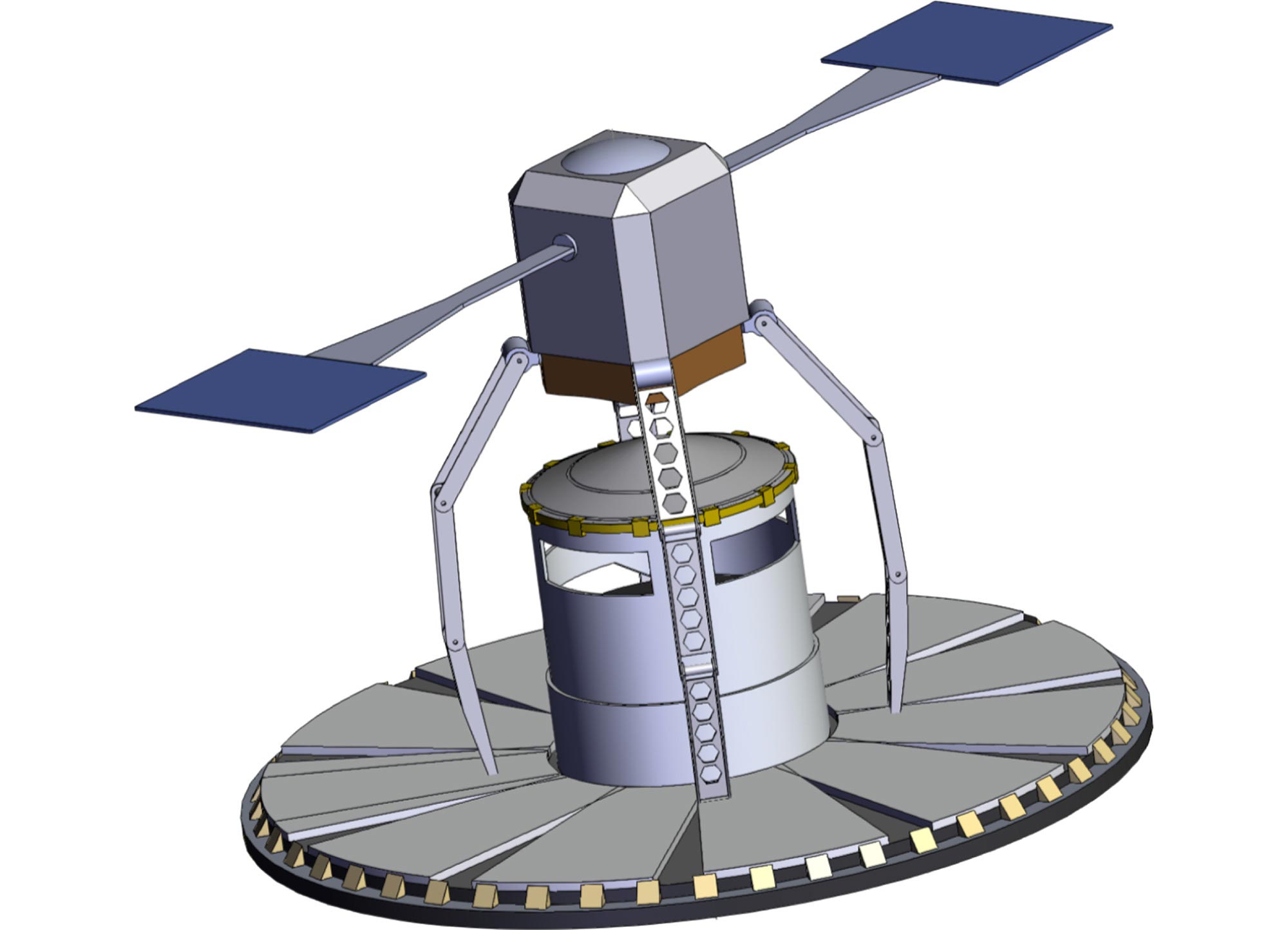
Eggl said, “Gaia is like a rotating cylinder with a solar panel. it is encapsulated, so it hasn’t been damaged, but after a decade out there it’s running low on fuel. Ruthvik Bommena designed a novel concept to add a sort of spider-looking attachment that can extend its life without impeding its data collection. Gaia will be decommissioned soon, so there isn’t enough time to reach it, but the James Webb might still be a possibility because it will be operating for several more years and they may decide to prolong its mission.”
He explained that the James Webb telescope has unshielded, segmented mirrors, some of which have already been damaged when struck by micrometeorites. The entire mirror surface of JWST is six meters in diameter. The next large telescope will be about twice that size.
“We’re trying to stay a step ahead so there is a plan to replace broken mirrors, for example. If we don’t, it’s like buying an expensive sports car, then like throwing it away when it runs out of gas.”
Safe Proximity Operations: Avoiding Damage
Another aspect Bommena is working is safe proximity operations.
“A spacecraft sent to repair or refuel a telescope needs to brake when it reaches it,” Bommena said. “Using the thrusters to slow down would be like pointing a blowtorch at the telescope. You don’t want to do that to a delicate structure like a telescopic mirror. How do we get there without torching the whole thing?”
Robyn Woollands, who is also professor of aerospace engineering at U of I said one of the main goals they achieved with this work was finding a trajectory to get there cheaply without reliance on large, cost-prohibitive rockets.
“Fortunately, getting there is doable because of some hidden highways in our solar system. We have a trajectory that is optimal for the size of spacecraft needed to repair the JWST,” she said.
Novel Techniques for Trajectory Design
Ph.D. student Alex Pascarella developed a novel technique for quick sampling of the solution space that can shorten the computation time.
“The novelty is in how we brought together two separate approaches to trajectory design: dynamical systems theory and optimal control theory,” Pascarella said.
Pascarella said the traditional approach for trajectory design in multibody systems such as the Sun-Earth system, relies on computing the invariant manifolds of an orbit—manifolds are pathways in space that naturally lead the spacecraft to the given orbit. This is a great approach that has been successfully used for decades, both in academic research and real-life applications.
“It becomes a bit challenging when you are trying to rendezvous with a target spacecraft at a specific location in space/time instead of reaching a target orbit and you are dealing with a low-thrust spacecraft whose engine operates for long stretches of time as opposed to a spacecraft with more powerful thrusters that operate for very shorts bursts.
“Our technique is based on a slightly different idea. We first investigate the solution space by propagating a sample of solutions—either without any thrust or with a very simple thrust control law—and we take note of how close they pass to our desired destination,” Pascarella said.
He added that because the type of orbit they are trying to reach spawns manifolds, they know at least some of their initial guesses will come close to the desired orbit.
“After we create a map of initial solutions, we use optimal control theory to generate optimal end-to-end trajectories,” Pascarella said. “Optimal control allows us to find trajectories that depart near Earth, and rendezvous with our space telescope in the least amount of time. The initial sampling of the solution space is fundamental—optimal control problems are notoriously difficult to solve, so we need a decent initial guess to work with.”
Towards Practical Implementation
Eggl said the plan to repair/refuel Gaia is a complete design that can be implemented. For the James Webb telescope, more engineering is needed.
Reference: “Mission design for space telescope servicing at Sun–Earth L2” by Alex Pascarella, Ruthvik Bommena, Siegfried Eggl and Robyn Woollands, 22 August 2024, Acta Astronautica.
DOI: 10.1016/j.actaastro.2024.08.031
This work was supported by NASA and the Aerospace Corporation.
Never miss a breakthrough: Join the SciTechDaily newsletter.
Follow us on Google and Google News.