
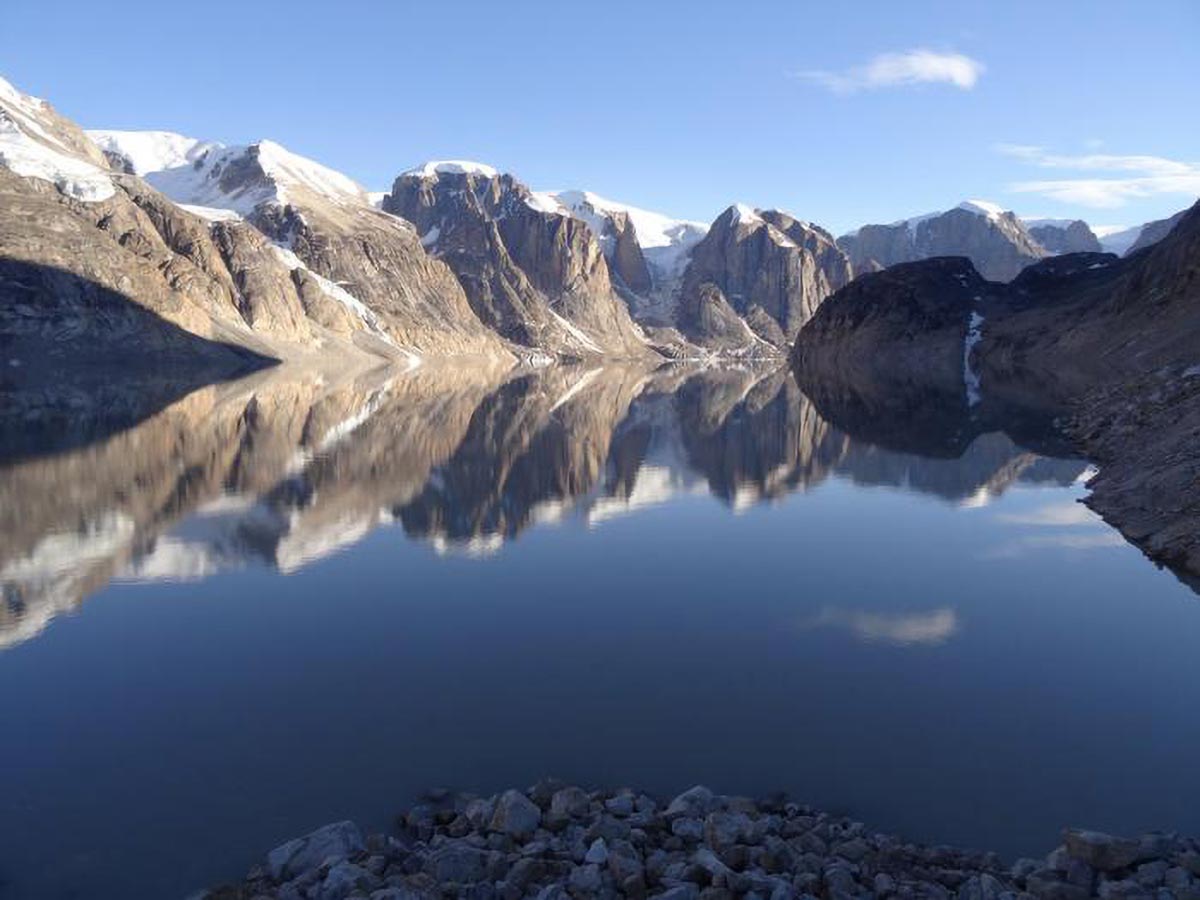
Scientists have, for the first time, observed a massive glacial lake outburst in East Greenland, releasing over 3,000 billion liters of meltwater within weeks.
For the first time, scientists have documented a massive glacial lake outburst in East Greenland, during which over 3,000 billion liters of meltwater were released within just a few weeks. This rare natural flooding event, observed by researchers from the University of Copenhagen, sheds new light on the immense and potentially dangerous forces unleashed by glacial meltwater.
To put it in perspective, imagine an enormous mountain lake holding enough water to equal three times Denmark’s annual water consumption, suddenly breaking free. That’s what occurred when the massive Catalina Lake in East Greenland released 3.4 cubic kilometers (3,000 billion liters) of meltwater into the Scoresby Sound fjord.
The enormous volume places this event among the top three largest of its kind ever documented. The meltwater outburst flood occurred between September 23 and October 11, during which the lake’s water level plummeted 154 meters. The dramatic phenomenon was observed for the first time in real-time using satellite imagery by scientists from the University of Copenhagen’s Niels Bohr Institute.
“We have previously found traces of similar outburst floods, but due to polar night and clouds obstructing the potential for satellite observations, this is the first time that researchers have been able to monitor an event and measure the water volumes in real-time,” explains Niels Bohr Institute climate researcher Aslak Grinsted.
Threatens millions of people
The outburst flood in East Greenland occurred because meltwater from Catalina Lake had been accumulating over the past twenty years. The lake is situated in a valley blocked by the massive Edward Bailey Glacier. As the lake filled, the water began to lift the glacier, carving a 25-kilometer-long tunnel beneath the ice, through which the water eventually burst into the world’s largest fjord, Scoresby Sound.
This phenomenon, where a glacial lake gradually fills and then releases its water in a sudden flood, is known as a Glacial Lake Outburst Flood (GLOF). Such events have become increasingly frequent over the last three decades due to rising global temperatures and climate change.
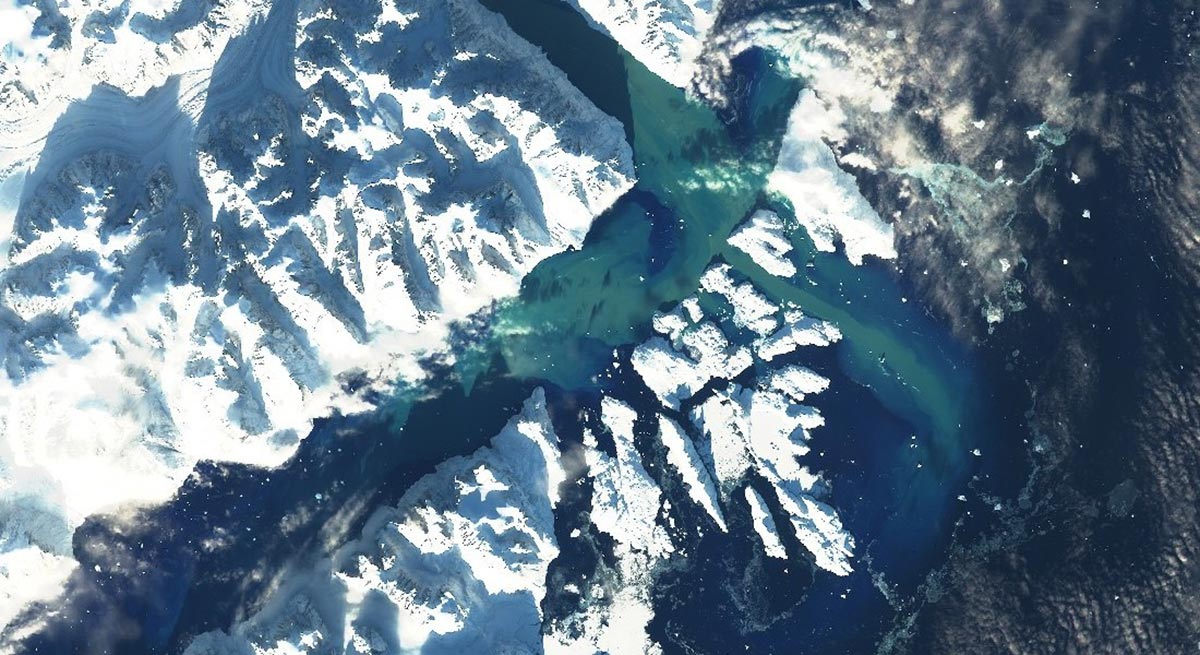
“The danger from glacier-dammed lakes is increasing due to global warming. It’s vital to improve our understanding of this phenomenon to issue timely warnings should there be an imminent risk,” says Grinsted.
While glacial lake outburst floods can be catastrophic in densely populated areas like the Himalayas, where they often destroy villages, this particular outburst caused no harm due to Greenland’s sparse population. However, a 2023 study concluded that 15 million people worldwide live under the threat of deadly glacial floods.
“I expect that we will witness outbursts from even larger ice-dammed lakes as Greenland’s ice sheet retreats in coming centuries. At the end of the last Ice Age, Lake Missoula had an outburst that was 2,500 times larger than the recent Catalina event. To understand these massive forces, we must study the largest outbursts when they occur,” says Aslak Grinsted.
Comparable to the energy of the world’s largest nuclear power plant
The energy released by glacial lake outburst floods is staggering.
“In this case, the energy released by the glacier flood was equivalent to the output of the world’s largest nuclear power plant running at full capacity for 22 days,” explains Aslak Grinsted.
According to the researcher, it’s worth considering how to harness the immense energy of such natural phenomena as a source of green energy. In theory, the energy released from the Catalina Lake event could have continuously provided 50 megawatts of electricity, enough to meet the needs of a small town. However, in this instance, the nearest settlement is 180 kilometers away and inhabited by a mere 350 residents – posing a significant technological challenge for energy utilization.
“As with many other natural resources in Greenland, infrastructure is a problem. But if a brilliant engineer could figure out how to harness these meltwater outbursts, there’s enormous power and energy potential in them,” concludes Grinsted.
Never miss a breakthrough: Join the SciTechDaily newsletter.
Follow us on Google and Google News.
35 Comments
“…, the massive Catalina Lake in East Greenland released 3.4 cubic kilometers …. of meltwater into the Scoresby Sound fjord.”
To put that into perspective, the AI Large Language Model, Copilot, tells me that EACH of the several massive floods from glacial Lake Missoula that carved out the Channeled Scablands in Washington State involved 2,100 cubic kilometers. While “3,000 billion liters” looks like a big number (I’m sure that is why the author(s) used those units.) it is only about 0.16% of each of the floods resulting from the Lake Missoula ice-dam failures.
And so would you have used “gallons” instead of “liters” so it sounds not so big? Remember, these people are from Europe where they use the “METRIC” system of measurement; and there is no “gallon” equivalent, just “liters,” which is roughly a “quart”.
1 liter is roughly 3.785 gallons. So, roughly 792.61 billion gallons. The U.S. is one of only 3 countries that don’t use the metric system. And your U.S. gallon is smaller than an imperial gallon which is equal to 4.546 liters. That would be 659.92 billion gallons. No wonder you went to quarts.
Slight correction on your math.
I am sure that you meant to say that ONE U.S. gallon equals 3.785 liters. And ONE Imperial gallon is equal to 4.546 Liters. ONE Imperial gallon is equal to 4.803 quarts or 1.20095 U.S.gallons.
One U.S.gallon is equal to 4 quarts, which is why we stick with our system of liquid measurement.
1 Imperial gallon also equals 4 quarts (8 pints), which is something we found useful before the USA. Drink more than 8 pints of beer and one would tend to fall off one’s horse when riding home from the pub. In the USA one would have to dink 10 pints to achieve the same effect, and that’s metric.
Is it possible to filter the ocean water and use it to replace the groundwater in places like California? Always wondered about this.
If you type 1 liter to gallon into google’s search bar, you’ll discover that 1 liter is equal to 0.264 us liquid gallons; specifically 0.264172 gal is equal to 1 liter. I don’t know where on any modern planet or information source you found “1 liter is roughly 3.785 gallons.” You’re information is entirely wrong. Saying there are 3.785 liters in 1 gallon is what you meant, and completely accurate. Technically it is 3.78541 liters in a gallon, but nobody is overly concerned about the leftover 0.00041 that get left out of the general equation.
Actually, I think you’ve got that first conversion turned around. There are 3.785 liters in a U.S. gallon.
What makes you think that I was objecting to the use of a metric measure? After all, I used metric for context: “3.4 cubic kilometers” My objection was to using units that unnecessarily makes the number greater than 10. I stayed with cubic kilometers to better compare with the units used by the article.
Three billion is such a huge number that few if any people can comprehend it. It is just a large number that might as well be infinity.
Well, again, “most people” use the metric system! More proof that we in U.S. are “exceptional” (ly strange)!
Why do you suppose that companies selling computer hard drives would characterize one as having a capacity of 3 terabytes rather than 3,000 billion bytes? They don’t have an agenda, they just want to be succinct.
I find 3x 10 power nine a more useful way of dealing with numbers, especially when changing foreign currency for Dong in Vietnam.
Actually, what is called “scientific notation” is my preference for displaying numbers also. However, not all the readers here (and some of the authors) are familiar with the exponential notation.
No worries, global warming is a myth. Ask the Ochre OGRE, the perverted of truth
Commentators are the brilliant ones. They know, they know, what’s up. You wrote about it too, the resource now I understand what certain people were trying to do. It’s crazy out here but, God is still in Control
That was during the last Ice Age. Yes, things were more dire back then. The biblical account of Noah and the Great Flood is probably what that was.
Thought, how much is the melting ice affecting the AMOC
Perfect answer to my question.
Thank you 👍🏼
Clyde, how does the size of Lake Missoula out flow matter. These a symptoms of rapid glacial retreat NOW!
I think it matters when I see numbers presented that have associated units that create numbers so large as to be incomprehensible. People can’t subjectively appreciate a billion or trillion. It gets ‘translated’ to ‘a big number.’ I suspect that making big numbers is a way to spin the presentation to exaggerate the effect and thus being able to make claims such as “unprecedented” and thus becoming useful to scare readers to support action.
The point of my example of context is that the “3,000 billion liters” was mentioned 5-times in the article. I’d say that the author(s) were really trying to emphasize that. My ‘context’ is to make the point that the current glacial retreat, while large, pales in comparison to what happened during the last glacial retreat. I’d say it is of academic interest, but not an existential threat nor even a candidate for the Guinness Book of Records.
So. It should all be clear to us now.
Greenland: The Riviera of The North Atlantic!…
Not hardly! However, not the immediate existential crisis implied by some, either.
What is an existential crisis?
Why does an immediate crisis have to existential?
“Existential” usually refers to an internal turmoil related to the meaning (if any) of existence. The way I used it implies a threat to one’s very existence. I’ll let you figure out if you are concerned about continuing to exist.
It’s called making a comparison. Hence his saying “to put that in perspective.”
The largest of this type took place in the Great lakes region from lake Michigan to Eastern edge of lake Erie, that flood washed away top soil All the way to the Gulf of Americas
Let’s face it folks;
“EXTINCTION IS NATURAL”
“thousand billion”
If only there were a word for that… 🤦🏻♀️
The normal term is gigaton. The outflow was weeks long and involved 3000 gigatons of water. There are 5m gigatons of ice on Greenland.
Have a look at the Surface Mass Balance chart for Greenland. It is published daily. The gain is often 100 gigatons in a day. The total mass is heading nowhere, up or down. It was warmer in the 1920’s when the estimated SMB was lower than now. Too much ado about a spit in the bucket. Observing it was cool, however.
The “normal word” for “thousand billion” is “trillion.”
Three teraliters
What an idiot to say “Let’s harness that for green energy”…. That’s all we need are MORE ‘machinery’ and human footprints out there all over the prestine natural water environment spewing crap to gain for humans rather than letting nature just be nature. Jeez
So. It should all be clear to us now.
Greenland: The Riviera of The North Atlantic!…
“3,000 billion”
You mean 3 trillion?
Agreed stop throwing infrastructure and then leaving it.