
Close Menu
    Facebook X (Twitter) Instagram
    SciTechDaily
    • Biology
    • Chemistry
    • Earth
    • Health
    • Physics
    • Science
    • Space
    • Technology
    Facebook X (Twitter) Pinterest YouTube RSS
    SciTechDaily
    Home»Earth»Yale Researchers Find a Soft Spot in the Nazca Plate
    Earth

    Yale Researchers Find a Soft Spot in the Nazca Plate

    By Jim Shelton, Yale UniversityDecember 3, 20152 Comments2 Mins Read
    Facebook Twitter Pinterest Telegram LinkedIn WhatsApp Email Reddit
    Share
    Facebook Twitter LinkedIn Pinterest Telegram Email Reddit
    Yale Researchers Find a Soft Spot in the Nazca Plate
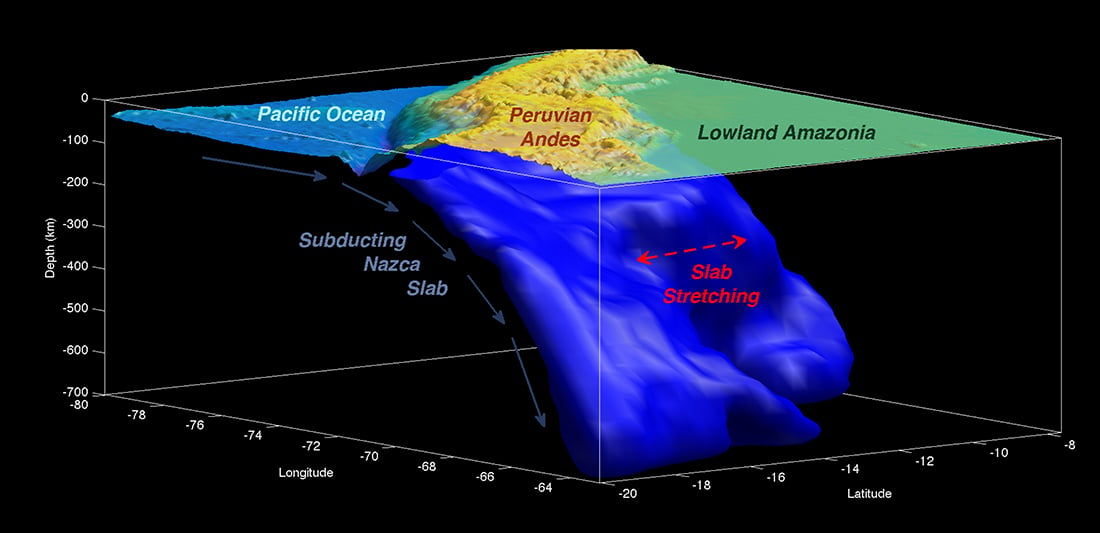
    Researchers found that part of the Nazca Plate weakened and deformed as it bent and slid under the adjoining South American Plate. Image by Lara Wagner / Carnegie Institution for Science

    Using land-based seismic stations, researchers from Yale University found that part of the Nazca Plate weakened and deformed as it bent and slid under the adjoining South American Plate.

    The Earth’s tectonic plates may be more flexible than previously thought as they slide underneath each other and dive deep below the surface, according to new observations from an international geophysics team.

    Researchers studying the Nazca Plate, which is located beneath Peru, found that part of the slab weakened and deformed as it bent and slid under the adjoining South American Plate. The data came from land-based seismic stations that show how seismic waves move through structures deep underground.

    The research appears in the journal Nature Geoscience. The lead author is former Yale graduate student Caroline Eakin, who is now at the University of Southampton. Other authors are Maureen Long of Yale; Lara Wagner of the Carnegie Institution for Science; Alissa Scire, Susan Beck, and George Zandt of the University of Arizona; and Hernando Tavera of the Instituto Geofisico del Perú.

    Reference: “Internal deformation of the subducted Nazca slab inferred from seismic anisotropy” by Caroline M. Eakin, Maureen D. Long, Alissa Scire, Susan L. Beck, Lara S. Wagner, George Zandt and Hernando Tavera, 23 November 2015, Nature Geoscience.
    DOI: 10.1038/ngeo2592


    Never miss a breakthrough: Join the SciTechDaily newsletter.
    Follow us on Google and Google News.

    Earth Science Geology Geophysics Geoscience Tectonic Plates Yale University
    Share. Facebook Twitter Pinterest LinkedIn Email Reddit

    Related Articles

    Earth’s Strangest Magnetic Era: Scientists Decode the Ediacaran Mystery

    Challenging Previous Theory: Mantle Heat Rejuvenated Earth’s Crust 3 Billion Years Ago

    Craton Deception: Geologists Challenge Conventional View of Earth’s Continental History and Stability

    “Great Unconformity” Puzzle: Geologists Dig Into Grand Canyon’s Mysterious Gap in Time

    Unusual Melting May Affect Key Processes Deep Within the Earth

    Arctic Sea Ice Loss is Impacting Atlantic Ocean Water Circulation System

    Temperature of Ancient Seas May Shape Global Climate

    Flat-Slab Subduction in South America Mirrors Formation of Rocky Mountains

    Unusual Indian Ocean Earthquakes May Signal Tectonic Breakup

    2 Comments

    1. Brian Wills on December 4, 2015 3:59 am

      How is this proof of a sliding ‘plate’? Is it not more like small area’s… localized melting perhaps? Where is there proof of any plate sliding.. Earthquakes are occuring more or less in the same area’s time after time.. how does that support your theory?

      Reply
    2. katesisco on April 26, 2026 8:03 am

      AS Robin Cook proposes, a complete civilization could have been preserved in a plate ‘fold’ as it dived under the adjacent plate.

      Reply
    Leave A Reply Cancel Reply

    • Facebook
    • Twitter
    • Pinterest
    • YouTube

    Don't Miss a Discovery

    Subscribe for the Latest in Science & Tech!

    Trending News

    The Strange “Spacetime Crystal” That Can Suddenly Turn Into a Black Hole

    The Surprising Way Asteroids May Have Helped Life Begin on Earth

    Vast Hidden Structure Discovered Under Miles of Ice in East Antarctica

    A Surprising Discovery Suggests Autism Is Not One Condition

    New Alzheimer’s Discovery Could Change How Scientists Fight the Disease

    Yale Discovery Overturns Long-Held “Evolutionary Dead End” Theory

    UCLA Scientists Uncover a “Hidden Weakness” in Some of the World’s Deadliest Cancers

    Humpback Whale Stuns Scientists With 15,000 Kilometer Journey Across Oceans

    Follow SciTechDaily
    • Facebook
    • Twitter
    • YouTube
    • Pinterest
    • Newsletter
    • RSS
    SciTech News
    • Biology News
    • Chemistry News
    • Earth News
    • Health News
    • Physics News
    • Science News
    • Space News
    • Technology News
    Recent Posts
    • Food Waste Becomes a Powerful Carbon Trap in Climate Breakthrough
    • Battery-Free Artificial Photosynthesis Turns Sunlight, Water, and CO2 Into Fuel
    • How Ancient People Moved a 6-Ton Stone 700 Kilometers to Stonehenge
    • Scientists Finally See How Antibodies Really Attack Viruses
    • The Unexpected Gut Health Risk of Cutting Out Sugar
    Copyright © 1998 - 2026 SciTechDaily. All Rights Reserved.
    • Science News
    • About
    • Contact
    • Editorial Board
    • Privacy Policy
    • Terms of Use

    Type above and press Enter to search. Press Esc to cancel.