
Close Menu
    Facebook X (Twitter) Instagram
    SciTechDaily
    • Biology
    • Chemistry
    • Earth
    • Health
    • Physics
    • Science
    • Space
    • Technology
    Facebook X (Twitter) Pinterest YouTube RSS
    SciTechDaily
    Home»Earth»Challenging Previous Theory: Mantle Heat Rejuvenated Earth’s Crust 3 Billion Years Ago
    Earth

    Challenging Previous Theory: Mantle Heat Rejuvenated Earth’s Crust 3 Billion Years Ago

    By Rebecca Owen, American Geophysical UnionApril 29, 2024No Comments3 Mins Read
    Facebook Twitter Pinterest Telegram LinkedIn WhatsApp Email Reddit
    Share
    Facebook Twitter LinkedIn Pinterest Telegram Email Reddit
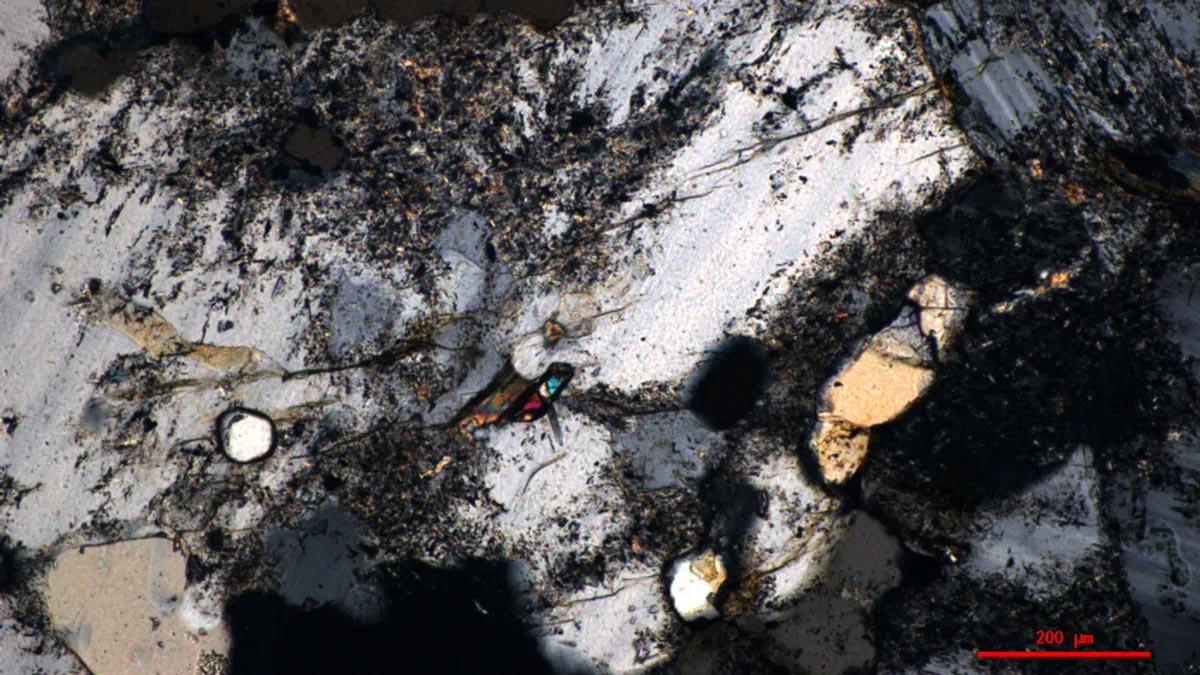
    Zircon Embedded in Granitoids
    To learn more about the history of Earth’s crust, researchers studied particles of zircon embedded in granitoids (seen here under a microscope) from China’s southwest Yangtze Block. Credit: Wei Wang

    Information from igneous zircon molecules gives researchers new insight into the workings of the inner Earth.

    Little is known about the nature and evolution of Earth’s continental crust before a few billion years ago because cratons, or stable swaths of the lithosphere more than 2–3 billion years old, are relatively rare.

    Zircon’s Role in Geological History

    However, cratons are home to tiny particles of zircon, which contain multiple isotope systems such as uranium, hafnium, oxygen, or lead and offer one way of looking billions of years into the past.

    Detrital zircons, found in sediment that has been weathered out of rock, can hold more continuous records of Earth’s history than igneous zircon formed from molten rock or magma. But because detrital zircons lack the petrogenetic information about the source rocks they came from, they may suggest artificially young ages as well as incorrect hafnium isotopes for ancient rocks.

    In a new study, scientists focused on intact igneous zircon.

    Historical Isotope Fluctuations and Geological Theories

    Previous research suggested that during the transition from the Paleoarchean to Mesoarchean era, around 3 billion years ago, there was an increase in hafnium isotopic ratios located in both detrital and igneous zircons.

    This increase is thought to be a result of crustal rejuvenation, in which newer magma is injected into older crustal rocks. It is widely theorized that this increase also marks the transition from an immobile crust and mantle to a period of more volatile plate movement.

    Challenging Traditional Geological Beliefs

    The new study, which examined igneous zircon and other geochemical properties of granitoid rock in China’s southwest Yangtze Block, a craton dated as being more than 3 billion years old, challenges this theory. Researchers suggest that the crustal rejuvenation occurring globally in this era was a result of increased mantle temperatures rather than widespread tectonic activity.

    Implications for Continental Crust Development

    Data gleaned from analyzing the isotopes in igneous zircon suggested that younger magma flowed into the existing continental crust, causing mantle rock to melt and hot magma to pool at the crust-mantle boundary. Some of this partially melted magma would have cooled into granitoids like those in the southwest Yangtze Block. This process may have played a significant role in continental crust growth and offers new possible explanations for the origins of the tectonic configurations of the Earth we know today.

    Reference: “Continental Crust Rejuvenation Across the Paleo-Mesoarchean Transition Resulted From Elevated Mantle Geotherms” by Gui-Mei Lu, Yi-Gang Xu, Wei Wang, Christopher J. Spencer, Guangyu Huang and Nick M. W. Roberts, 10 April 2024, Geophysical Research Letters.
    DOI: 10.1029/2024GL108715

    Never miss a breakthrough: Join the SciTechDaily newsletter.
    Follow us on Google and Google News.

    American Geophysical Union Geology Geophysics Geoscience Tectonic Plates
    Share. Facebook Twitter Pinterest LinkedIn Email Reddit

    Related Articles

    “A Total Surprise” – Geologists Uncover New Origin Story for Deadly Seattle Fault

    Craton Deception: Geologists Challenge Conventional View of Earth’s Continental History and Stability

    “Great Unconformity” Puzzle: Geologists Dig Into Grand Canyon’s Mysterious Gap in Time

    Archean “Water World” – Early Earth’s Hot Mantle May Have Led to a Vast Global Ocean

    Yale Researchers Find a Soft Spot in the Nazca Plate

    New Model Reveals Spreading Continents Kick-Started Plate Tectonics

    Geophysicists Detect Evidence of Large Amounts of Water in Earth’s Mantle

    Study Reveals Ancient Impact of Massive Asteroid

    Unusual Indian Ocean Earthquakes May Signal Tectonic Breakup

    Leave A Reply Cancel Reply

    • Facebook
    • Twitter
    • Pinterest
    • YouTube

    Don't Miss a Discovery

    Subscribe for the Latest in Science & Tech!

    Trending News

    Monster Storms on Jupiter Unleash Lightning Beyond Anything on Earth

    Scientists Create “Liquid Gears” That Spin Without Touching

    The Simple Habit That Could Help Prevent Cancer

    Millions Take These IBS Drugs, But a New Study Finds Serious Risks

    Scientists Unlock Hidden Secrets of 2,300-Year-Old Mummies Using Cutting-Edge CT Scanner

    Bread Might Be Making You Gain Weight Even Without Eating More Calories

    Scientists Discover Massive Magma Reservoir Beneath Tuscany

    Europe’s Most Active Volcano Just Got Stranger – Here’s Why Scientists Are Rethinking It

    Follow SciTechDaily
    • Facebook
    • Twitter
    • YouTube
    • Pinterest
    • Newsletter
    • RSS
    SciTech News
    • Biology News
    • Chemistry News
    • Earth News
    • Health News
    • Physics News
    • Science News
    • Space News
    • Technology News
    Recent Posts
    • Scientists Were Wrong About This Strange “Rule-Breaking” Particle
    • Webb Space Telescope Uncovers Unexpected Ice Clouds on a Jupiter-Like World
    • 289-Million-Year-Old Reptile Mummy Reveals Origin of Human Breathing System
    • New Brain Discovery Challenges Long-Held Theory of Teenage Brain Development
    • Sharks Are Overheating as Warming Oceans Push Them to the Edge
    Copyright © 1998 - 2026 SciTechDaily. All Rights Reserved.
    • Science News
    • About
    • Contact
    • Editorial Board
    • Privacy Policy
    • Terms of Use

    Type above and press Enter to search. Press Esc to cancel.