
Close Menu
    Facebook X (Twitter) Instagram
    SciTechDaily
    • Biology
    • Chemistry
    • Earth
    • Health
    • Physics
    • Science
    • Space
    • Technology
    Facebook X (Twitter) Pinterest YouTube RSS
    SciTechDaily
    Home»Science»Folding the Future: How Origami Modules Are Redefining Construction
    Science

    Folding the Future: How Origami Modules Are Redefining Construction

    By University of MichiganApril 29, 2024No Comments4 Mins Read
    Facebook Twitter Pinterest Telegram LinkedIn WhatsApp Email Reddit
    Share
    Facebook Twitter LinkedIn Pinterest Telegram Email Reddit
    Foldable Origami With Uniform Thickness To Create Load Bearing Structures
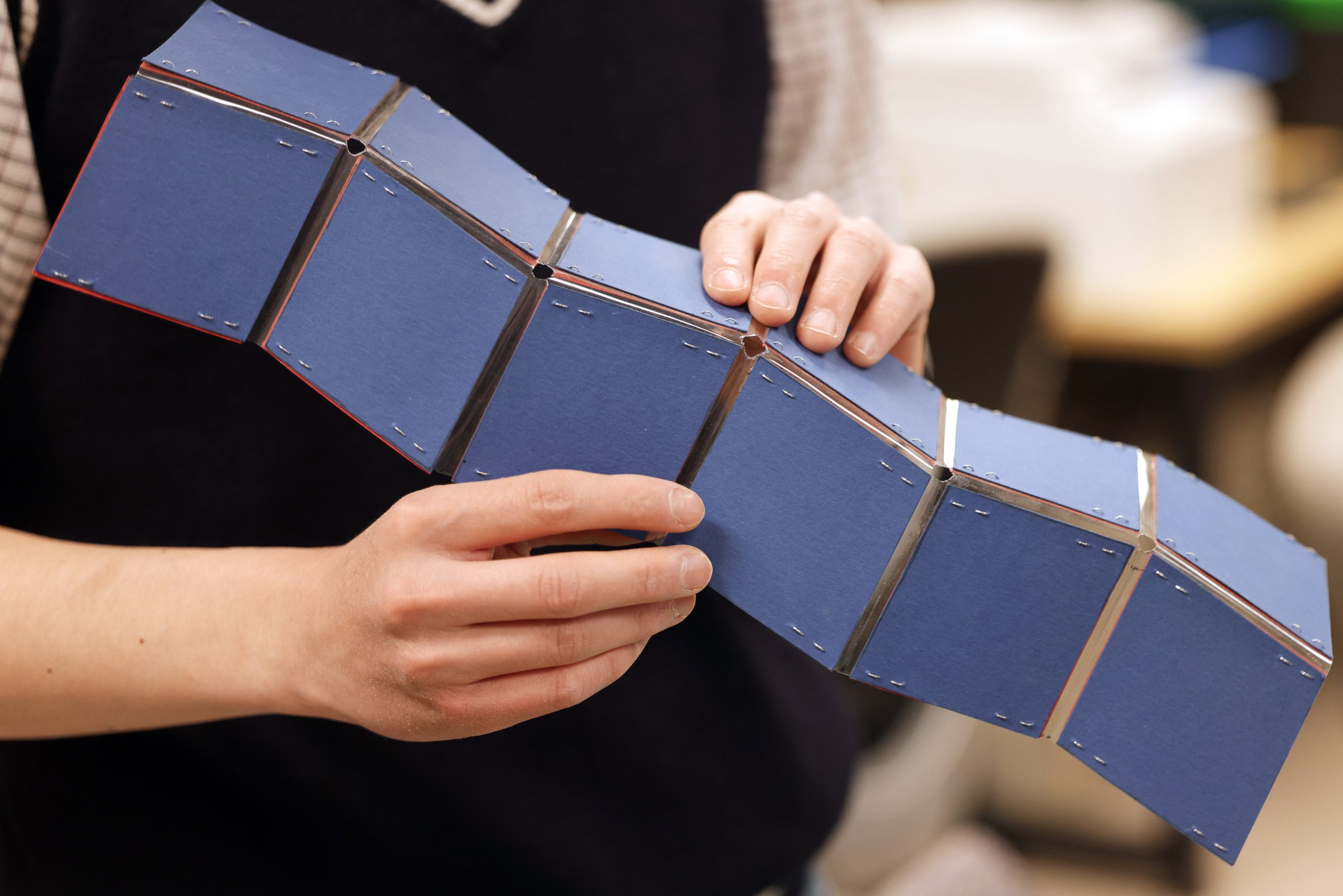
    Yi Zhu, a Research Fellow in Mechanical Engineering, holds an origami design that is capable of folding up into something that could fit into a pocket and capable of expanding out into something much longer. Credit: Brenda Ahearn/University of Michigan, College of Engineering, Communications and Marketing

    Foldable origami with thick panels opens a world of possibilities.

    For the first time, engineers at the University of Michigan have shown that load-bearing structures, such as bridges and shelters, can be constructed using origami modules. These versatile components are capable of folding compactly and morphing into various shapes.

    It’s an advance that could enable communities to quickly rebuild facilities and systems damaged or destroyed during natural disasters, or allow for construction in places that were previously considered impractical, including outer space. The technology could also be used for structures that need to be built and then disassembled quickly, such as concert venues and event stages.

    Advancements in Origami Construction

    “With both the adaptability and load-carrying capability, our system can build structures that can be used in modern construction,” said Evgueni Filipov, an associate professor of civil and environmental engineering and of mechanical engineering, and a corresponding author of the study in Nature Communications.

    Principles of the origami art form allow for larger materials to be folded and collapsed into small spaces. And with modular building systems gaining wider acceptance, the applications for components that can be stored and transported with ease have grown.
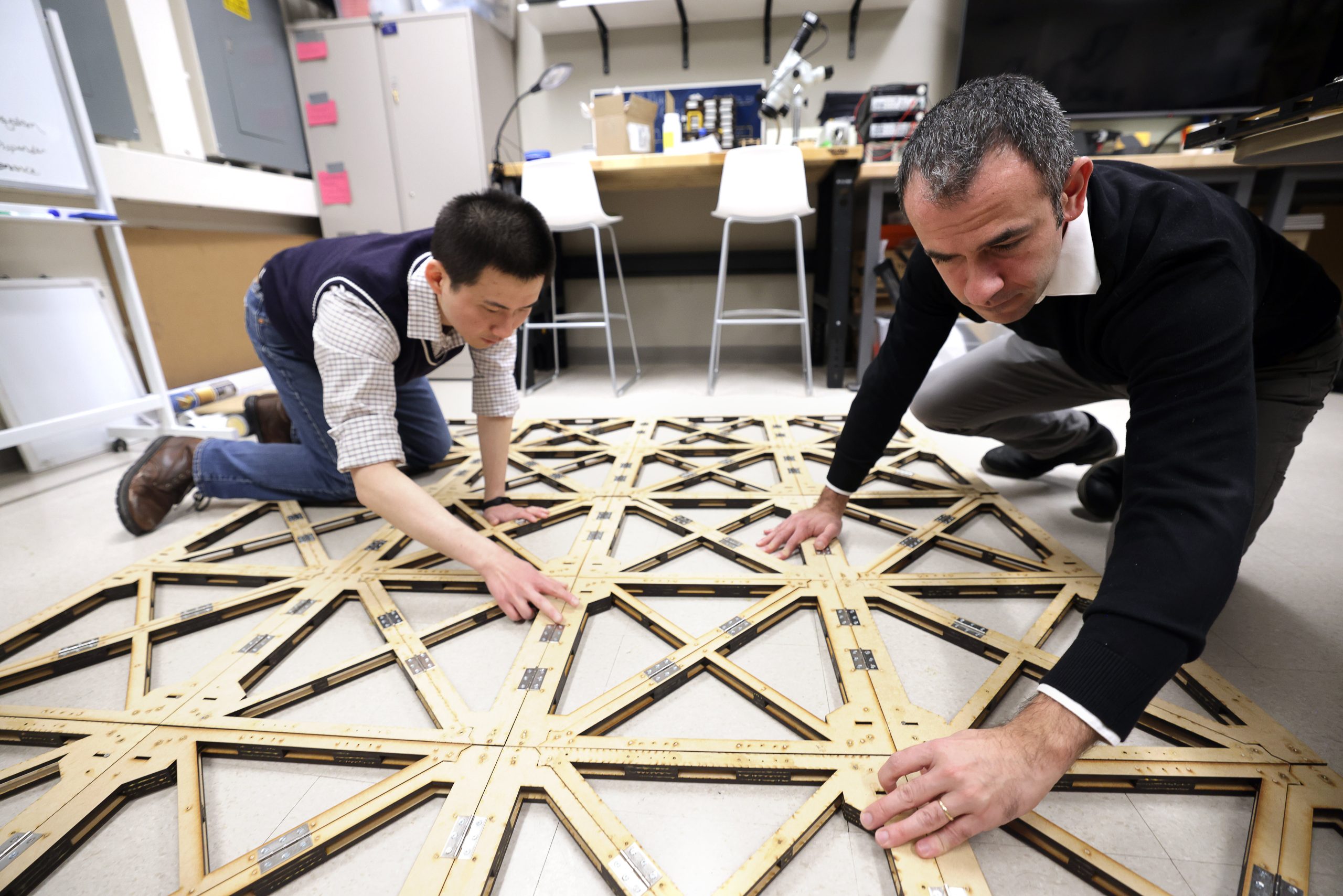
    Yi Zhu and Evgueni Filipov Working in Lab
    From left, Yi Zhu, a Research Fellow in Mechanical Engineering, and Evgueni Filipov, an associate professor in both Civil and Environmental Engineering and Mechanical Engineering, working in his lab in the George G. Brown Laboratories Building. Filipov and Zhu are applying principles of origami to create Modular and Uniformly Thick Origami (MUTO) for large-scale, load-carrying, adaptable structures. These can be used to create temporary structures such as stages or concert venues as well as to build structures such as buildings or bridges to be used in response to natural disasters. Credit: Brenda Ahearn/University of Michigan, College of Engineering, Communications and Marketing

    Researchers have struggled for years to create origami systems with the necessary weight capacities while keeping the ability to quickly deploy and reconfigure. U-M engineers have created an origami system that solves that problem. Examples of what the system can create include:

    • A 3.3-foot-tall column that can support 2.1 tons of weight while itself weighing just over 16 pounds, and with a base footprint of less than 1 square foot.
    • A package that can unfold from a 1.6-foot-wide cube to deploy into different structures, including: a 13-foot-long walking bridge, a 6.5-foot-tall bus stop, and a 13-foot-tall column.

    A New Approach to Origami Design

    A key to the breakthrough came in the form of a different design approach provided by Yi Zhu, research fellow in mechanical engineering and first author of the study.

    “When people work with origami concepts, they usually start with the idea of thin, paper-folded models—assuming your materials will be paper-thin,” Zhu said. “However, in order to build common structures like bridges and bus stops using origami, we need mathematical tools that can directly consider thickness during the initial origami design.”

    Foldable Origami To Create Load Bearing Structures
    Evgueni Filipov, an associate professor in both Civil and Environmental Engineering and Mechanical Engineering, demonstrates different folds and structures with a small model in his lab. Credit: Brenda Ahearn/University of Michigan, College of Engineering, Communications and Marketing

    To bolster weight-bearing capacity, many researchers have attempted to thicken their paper-thin designs in varying spots. U-M’s team, however, found that uniformity is key.

    “What happens is you add one level of thickness here, and a different level of thickness there, and it becomes mismatched,” Filipov said. “So when the load is carried through these components, it starts to cause bending.

    “That uniformity of the component’s thickness is what’s key and what’s missing from many current origami systems. When you have that, together with appropriate locking devices, the weight placed upon a structure can be evenly transferred throughout.”

    In addition to carrying a large load, this system—known as the Modular and Uniformly Thick Origami-Inspired Structure system—can adapt its shapes to become bridges, walls, floors, columns, and many other structures.

    Reference: “Large-scale modular and uniformly thick origami-inspired adaptable and load-carrying structures” by Yi Zhu, and Evgueni T. Filipov, 15 March 2024, Nature Communications.
    DOI: 10.1038/s41467-024-46667-0

    U-M’s research has been helped along by use of its Sequentially Working Origami Multi-Physics Simulator (SWOMPS). It’s a simulator that accurately predicts the behaviors or large-scale origami systems. Developed at U-M, the system has been available to the public since 2020.

    The research was funded by the U.S. National Science Foundation and the Automotive Research Center.

    Never miss a breakthrough: Join the SciTechDaily newsletter.
    Follow us on Google and Google News.

    Civil Engineering Construction Engineering Origami University of Michigan
    Share. Facebook Twitter Pinterest LinkedIn Email Reddit

    Related Articles

    Victorian Mystery Solved: How the World’s Largest Building Was Constructed in Just 190 Days

    5.6x More Damage-Resistant: Princeton Engineers Develop New Super-Tough Cement

    Satellites to the Rescue: Cutting-Edge Tech Detects Infrastructure Issues Before They Become Disasters

    Princeton Scientists Develop Passive Mechanism To Cool Buildings in the Summer and Warm Them in the Winter

    Revolution in Material Science: Scientists Construct Nanoparticle Quasicrystal With DNA

    A “Silent Hazard” Is Lurking Underneath Our Major Global Cities – Subterranean Climate Change Threatens Urban Stability

    Applying a Special Type of Bacteria to Concrete Increases Its Strength by 30%

    Steel or Timber? New Tools Help Builders Reduce Carbon Footprint of Truss Structures

    2,050-Year-Old Roman Tomb Inspires Durable and Sustainable Building Materials for the Future

    Leave A Reply Cancel Reply

    • Facebook
    • Twitter
    • Pinterest
    • YouTube

    Don't Miss a Discovery

    Subscribe for the Latest in Science & Tech!

    Trending News

    Even Occasional Binge Drinking May Triple Liver Damage Risk

    Liftoff! NASA’s Artemis II Launch Sends Astronauts Around the Moon for First Time in 50 Years

    Scientists Discover New Way To Eliminate “Zombie Cells” Driving Aging

    This New Quantum Theory Could Change Everything We Know About the Big Bang

    This One Vitamin May Help Protect Your Brain From Dementia Years Later

    Stopping Weight-Loss Drugs Like Ozempic Can Quickly Erase Heart Benefits

    A 500-Million-Year-Old Surprise Is Forcing Scientists to Rethink Spider Evolution

    Coffee and Blood Pressure: What You Need To Know Before Your Next Cup

    Follow SciTechDaily
    • Facebook
    • Twitter
    • YouTube
    • Pinterest
    • Newsletter
    • RSS
    SciTech News
    • Biology News
    • Chemistry News
    • Earth News
    • Health News
    • Physics News
    • Science News
    • Space News
    • Technology News
    Recent Posts
    • This Breakthrough Solar Panel Generates Power From Both Sunlight and Raindrops
    • Greenland’s Ice Is Melting Faster Than Ever, and Scientists Are Alarmed
    • NASA Artemis II Nears Dramatic Moon Flyby With Record-Breaking Moment Ahead
    • Scientists Uncover New Metabolic Effects Beyond Weight Loss of Mounjaro
    • Scientists Create Healing Gel That Could Stop Chronic Wounds From Turning Deadly
    Copyright © 1998 - 2026 SciTechDaily. All Rights Reserved.
    • Science News
    • About
    • Contact
    • Editorial Board
    • Privacy Policy
    • Terms of Use

    Type above and press Enter to search. Press Esc to cancel.