
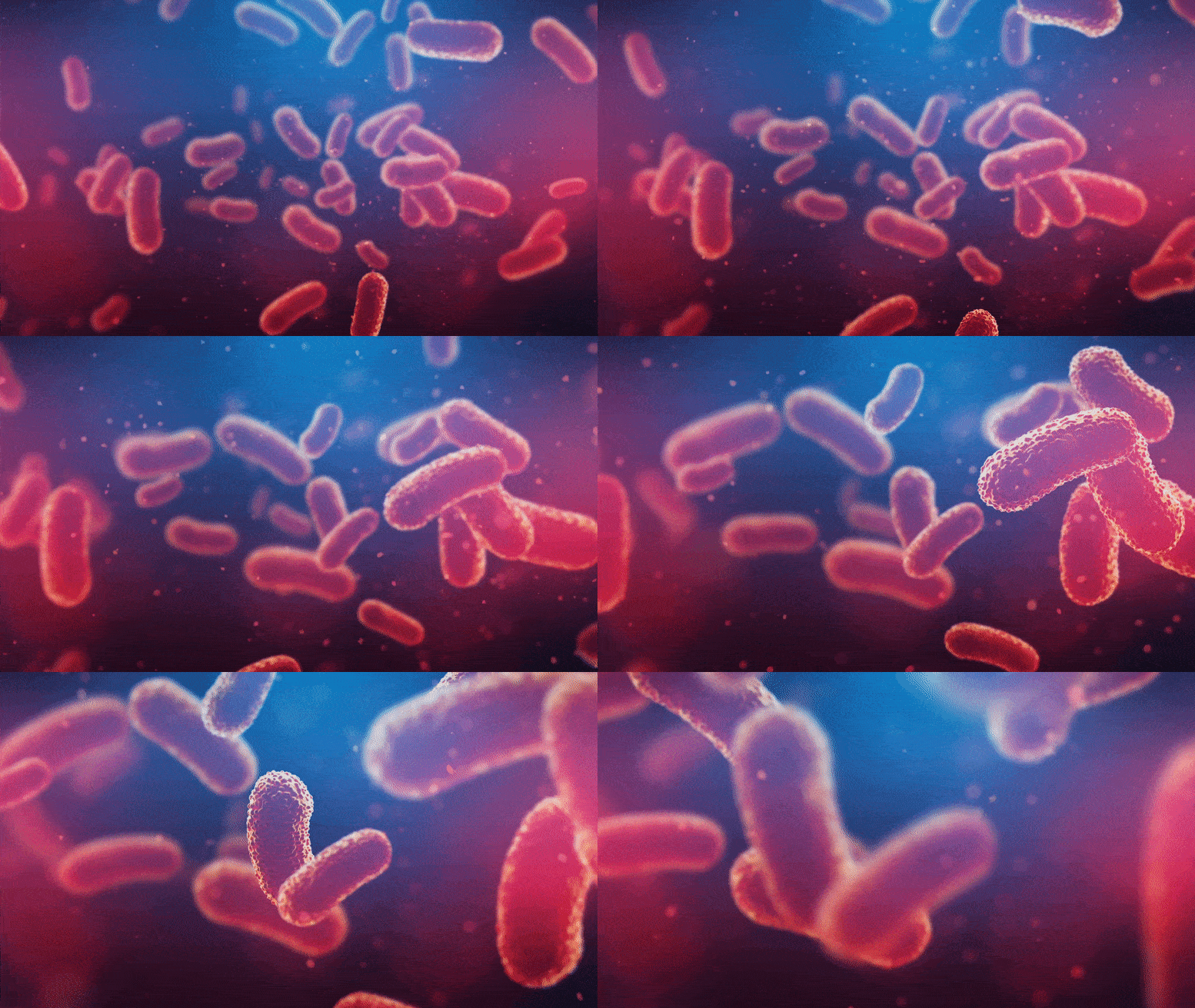
The addition of denitrifying bacteria to recycled coarse aggregate concrete can significantly improve its freeze-thaw resistance.
Concrete is one of the most frequently used construction materials due to its cheap cost, strong compressive strength, and ease of manufacture. However, natural aggregates for mixing with concrete, including sand and gravel, are in limited supply due to accelerating urbanization.
Although recycled materials may be used in lieu of natural materials to create recycled coarse aggregate concrete (RCAC), doing so may cause a number of issues. This is particularly true in colder climates where daily freeze-thaw cycles can damage concrete and compromise its structural integrity often leading to safety issues.
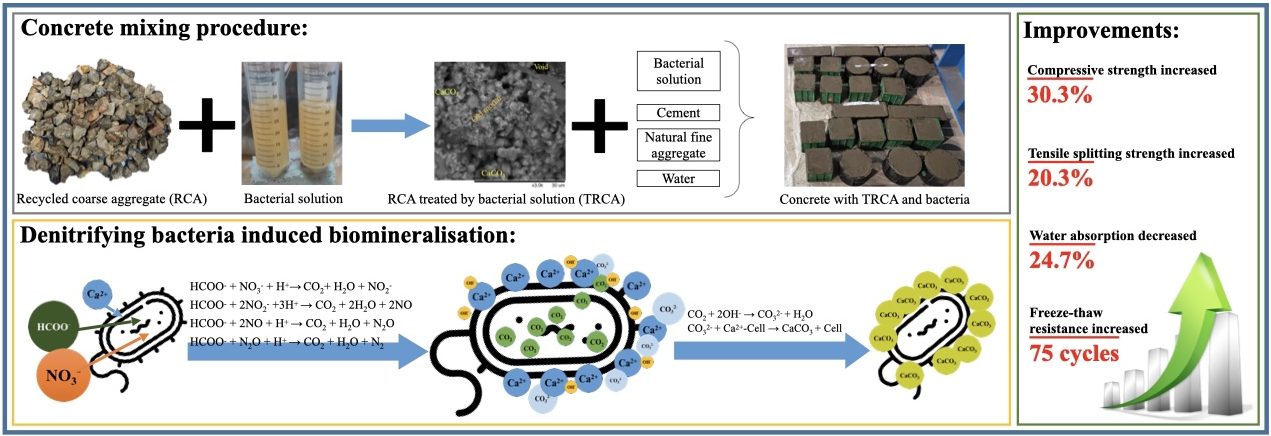
In a study recently published in the Journal of Cleaner Production, scientists from the Department of Civil Engineering at Xi’an Jiaotong-Liverpool University applied denitrifying bacteria to recycled coarse aggregate (RCA) and improved the strength and durability of the concrete. The treated RCAC is ideal for widespread use in cold climates since it can endure 225 freeze-thaw cycles, 75 more than those without treatment.
Traditional methods
Professor Chee Seong Chin, the corresponding author of the paper, says the traditional ways to improve concrete’s freeze-thaw resistance are unsustainable in the long term.
“These methods, such as reducing the water-cement ratio and increasing the chemical admixtures, increase the usage of chemical substances, leaving adverse impacts on sustainability. In comparison, we offer an environmentally friendly solution. Our method uses denitrifying bacteria and doesn’t contain or create poisonous or polluting substances,” he says.
A Decrease in Water Absorption
Reducing water absorption is crucial to enhancing RCAC’s freeze-thaw resistance, explains Professor Chin.
During freeze-thaw cycles, water penetrates the concrete, creating cracks in the structure, and reducing its durability. When the water freezes, it expands. The more water, the more swelling, and the more swelling, the more damage.
“If not treated by bacteria, using RCA in concrete can increase water absorption due to its loose structure and high porosity, whereas denitrifying bacteria can block the holes where water gets in, effectively reducing the free water absorbed inside the concrete by 33%. It prevents the water absorption from outside, thus reducing the swelling from inside,” he says.
A Steadier Structure
In addition, bacteria can also improve the capacity of concrete to resist water-freezing expansion by creating a steadier structure, says Professor Chin.
“The voids and pores of RCAC are filled with calcium carbonate crystals created by bacteria, making the structure denser and decreasing the expansion effect of frozen water.
“Based on our experiment, denitrifying bacteria can improve the compressive strength and tensile splitting strength by 30.3% and 20.3%, respectively.
“Moreover, bacteria consume excess calcium hydroxide during the biomineralization process, making the concrete more frost-resistant. Calcium hydroxide between aggregates and the cement matrix is generally considered negative factors in terms of strength and durability,” he says.
Although this novel method has significantly increased the freeze-thaw resistance of RCAC, further research is needed to enhance the resistance by using nanomaterials or other cementitious materials with bio-mineralization methods, says Professor Chin.
“Future research needs to investigate the economic cost and quantify the environmental impact with a life-cycle assessment,” he adds.
The research team consists of Zuowei Liu, Professor Chee Seong Chin, and Dr. Jun Xia from XJTLU’s Department of Civil Engineering.
Reference: “Novel method for enhancing freeze-thaw resistance of recycled coarse aggregate concrete via two-stage introduction of denitrifying bacteria” by Zuowei Liu, Chee Seong Chin and Jun Xia, 20 April 2022, Journal of Cleaner Production.
DOI: 10.1016/j.jclepro.2022.131159
Never miss a breakthrough: Join the SciTechDaily newsletter.
Follow us on Google and Google News.
1 Comment
“The treated RCAC is ideal for widespread use in cold climates since it can endure 225 freeze-thaw cycles, 75 more than those without treatment.”
What does that equate to? Five Winters? We typically want building to last at least 50 years!