
Close Menu
    Facebook X (Twitter) Instagram
    SciTechDaily
    • Biology
    • Chemistry
    • Earth
    • Health
    • Physics
    • Science
    • Space
    • Technology
    Facebook X (Twitter) Pinterest YouTube RSS
    SciTechDaily
    Home»Earth»Unusual Melting May Affect Key Processes Deep Within the Earth
    Earth

    Unusual Melting May Affect Key Processes Deep Within the Earth

    By Jim Shelton, Yale UniversityDecember 8, 2017No Comments2 Mins Read
    Facebook Twitter Pinterest Telegram LinkedIn WhatsApp Email Reddit
    Share
    Facebook Twitter LinkedIn Pinterest Telegram Email Reddit
    Unusual Melting Behavior May Affect Key Processes Deep Within the Earth
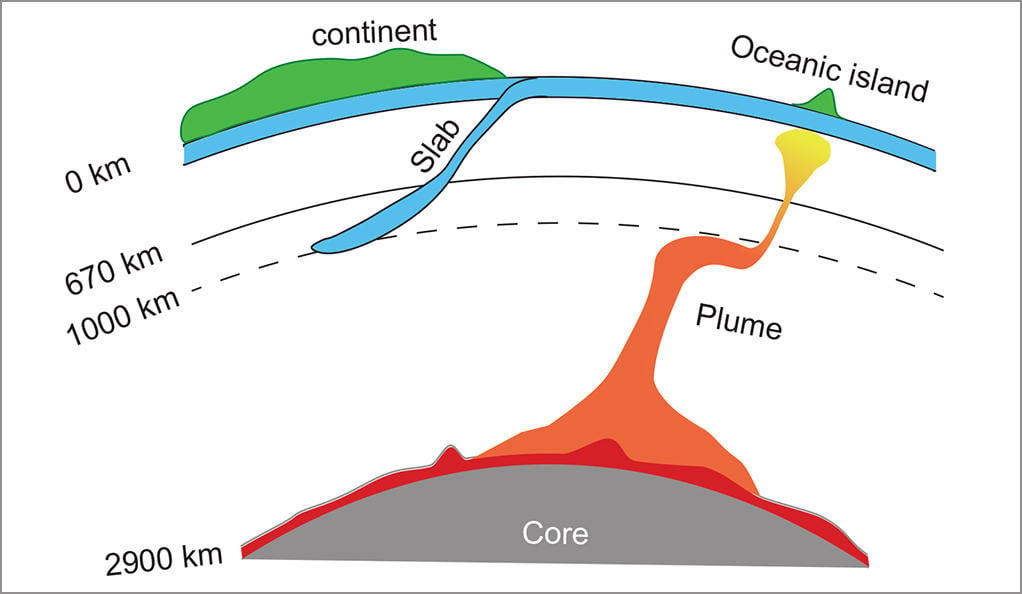
    The peak in viscosity of ferropericlase, the second most abundant mineral in the Earth, at ~1000 km may cause the stagnation of subducting slabs and the deflection of rising plumes. Credit: Jie Deng

    New research from Yale University suggests that the unusual melting behavior of the second most abundant mineral in the Earth may affect key processes deep within the Earth.

    Research by geoscientists at Yale suggests that convection in Earth’s mantle — the slow movement of rocks circulating beneath the surface, caused by heat from inside the Earth — is affected by how ferropericlase melts at high pressures.

    The findings appear online December 8 in the journal Nature Communications.

    “The melting temperature of most materials increases as one increases pressure, and for ferropericlase this is true except at depths between ~1000 and 1500 km (~620 to 930 mi),” said Kanani Lee, the study’s principal investigator and an associate professor of geology and geophysics at Yale.

    Jie Deng, a Yale graduate student, and the paper’s lead author, added, “We use this change in melting behavior to scale how the mantle’s flow responds and found the viscosity of this material would be at a maximum at ~1000 km, corresponding to the peak in melting temperature. This increase in viscosity would cause subducting slabs to stagnate and rising plumes to be deflected at this depth.”

    Plate tectonics drive oceanic slabs deep into the mantle, generating large earthquakes at relatively shallow depths. The slabs continue to sink, but some of them flounder at ~ 1000 km, such as the slabs under Tonga, the Philippines, and Japan.

    Additionally, hot rock rising from near the core-mantle boundary forms conduits, called plumes, that feed some volcanism at the surface. Hawaii and Iceland are such hotspots whose plumes are deflected at ~ 1000 km depth, which may affect the surface expression of volcanism in those locations.

    Reference: “Viscosity jump in the lower mantle inferred from melting curves of ferropericlase” by Jie Deng and Kanani K. M. Lee, 8 December 2017, Nature Communications.
    DOI: 10.1038/s41467-017-02263-z

    The National Science Foundation supported the research.

    Never miss a breakthrough: Join the SciTechDaily newsletter.
    Follow us on Google and Google News.

    Earth Science Geoscience Tectonic Plates Yale University
    Share. Facebook Twitter Pinterest LinkedIn Email Reddit

    Related Articles

    Earth’s Strangest Magnetic Era: Scientists Decode the Ediacaran Mystery

    Yale Researchers Find a Soft Spot in the Nazca Plate

    Temperature of Ancient Seas May Shape Global Climate

    Geophysicists Find Source Behind “Sudden” Tectonic Plate Movements

    New Model Reveals Spreading Continents Kick-Started Plate Tectonics

    Study Reveals How and When Earth Developed Its Rigid Tectonic Plates

    Earthquake Doublets Reveal Changing Speed of the Earth’s Inner Core

    Unusual Indian Ocean Earthquakes May Signal Tectonic Breakup

    Defects in Mantle Rocks Slow Down the Passage of Seismic Waves

    Leave A Reply Cancel Reply

    • Facebook
    • Twitter
    • Pinterest
    • YouTube

    Don't Miss a Discovery

    Subscribe for the Latest in Science & Tech!

    Trending News

    Scientists Call for a Complete Rethink of Alzheimer’s Treatment

    Scientists Identify Molecular Switch That Lets Exercise Reverse Muscle Aging

    Why Your Most Vivid Dreams Might Be the Key to Deep, Restful Sleep

    A Bright Star Hid a Massive Secret for 50 Years: Mystery of Gamma Cassiopeiae Finally Solved

    Scientists Identify Protein That Slows Key Effects of Aging

    Revolutionary Submarine Mysteriously Disappears Without a Trace – Scientists Are Now Preparing for a Bold Return

    Why Drinking More Water Isn’t Enough To Stop Kidney Stones

    New Study Reveals Surprising Effect of Drinking Coffee at Night

    Follow SciTechDaily
    • Facebook
    • Twitter
    • YouTube
    • Pinterest
    • Newsletter
    • RSS
    SciTech News
    • Biology News
    • Chemistry News
    • Earth News
    • Health News
    • Physics News
    • Science News
    • Space News
    • Technology News
    Recent Posts
    • Scientists Uncover Unexpected Behavior Deep Inside Earth’s Mantle
    • 3.5-Billion-Year-Old Rocks Rewrite the Story of Plate Tectonics
    • “These Wrinkles Shouldn’t Exist” – A Geologist’s Hike Uncovers a 180-Million-Year-Old Mystery
    • Why Aging Lungs Turn Mild Infections Into Life-Threatening Illness
    • Lost Bronze Age Mines Unearthed in Spain Transform Bronze Age History
    Copyright © 1998 - 2026 SciTechDaily. All Rights Reserved.
    • Science News
    • About
    • Contact
    • Editorial Board
    • Privacy Policy
    • Terms of Use

    Type above and press Enter to search. Press Esc to cancel.