
Close Menu
    Facebook X (Twitter) Instagram
    SciTechDaily
    • Biology
    • Chemistry
    • Earth
    • Health
    • Physics
    • Science
    • Space
    • Technology
    Facebook X (Twitter) Pinterest YouTube RSS
    SciTechDaily
    Home»Space»Cassini Image of Enceladus Shows Old and New Terrain
    Space

    Cassini Image of Enceladus Shows Old and New Terrain

    By SciTechDailyDecember 21, 2015No Comments1 Min Read
    Facebook Twitter Pinterest Telegram LinkedIn WhatsApp Email Reddit
    Share
    Facebook Twitter LinkedIn Pinterest Telegram Email Reddit
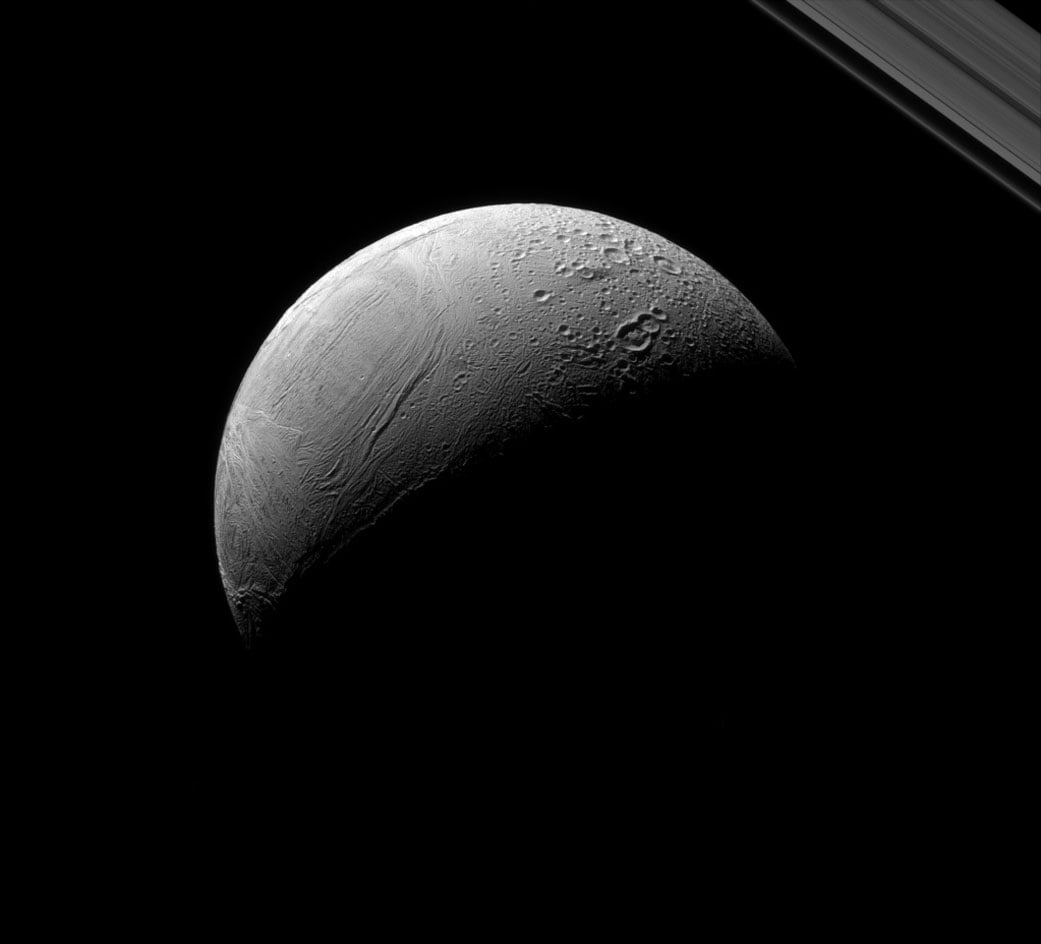
    Cassini Image Enceladus Old and New
    This view looks toward the anti-Saturn side of Enceladus. It displays the contrast between the older and newer terrain on Enceladus. Credit: NASA/JPL-Caltech/Space Science Institute

    This new Cassini image dramatically displays the contrast between the older and newer terrain on Enceladus.

    Newer surfaces (on the left in the image) will not have had time to accumulate craters. But as material sits exposed on the surface, impact scars build up, as in the more heavily cratered area on the top and right. Scientists can use this, along with estimates of how frequently impacts happen, to determine ages of surfaces of solid planets and of moons like Enceladus (313 miles or 504 kilometers across).

    This view looks toward the anti-Saturn side of Enceladus. North on Enceladus is up and rotated 36 degrees to the right. The image was taken in green light with the Cassini spacecraft narrow-angle camera on August 18, 2015.

    The view was acquired at a distance of approximately 85,000 miles (137,000 kilometers) from Enceladus. Image scale is 2,680 feet (818 meters) per pixel.


    Never miss a breakthrough: Join the SciTechDaily newsletter.
    Follow us on Google and Google News.

    Astronomy Cassini-Huygens Mission Enceladus NASA Planetary Science
    Share. Facebook Twitter Pinterest LinkedIn Email Reddit

    Related Articles

    Cassini Flyby Provides New Close-Up of Saturn’s Moon Enceladus

    Cassini Completes Deepest-Ever Dive Through the Icy Plume of Enceladus

    ScienceCasts Video: Close Encounter with Enceladus

    Cassini’s Deepest-Ever Dive Through the Enceladus Plume

    NASA Prepares for Historic Flyby of Icy Saturn Moon Enceladus

    NASA’s Cassini Reveals New Views of Saturn’s Moon Enceladus

    Cassini Spacecraft to Begin Flyby of Saturn’s Moon Enceladus

    Cassini Reveals Global Ocean in Saturn’s Moon Enceladus

    NASA Detects Ocean Inside Saturn’s Moon Enceladus

    Leave A Reply Cancel Reply

    • Facebook
    • Twitter
    • Pinterest
    • YouTube

    Don't Miss a Discovery

    Subscribe for the Latest in Science & Tech!

    Trending News

    Scientists Say Love Follows Mathematical Patterns

    “Zombie Cells” Reveal a Hidden Weakness That Could Help Fight Aging

    Alien Signals May Be Hiding in a Radio Band SETI Has Barely Explored

    Earth’s Hidden Thermostat Has Regulated Climate for 60 Million Years

    This 518-Million-Year-Old Creature Reveals How Spiders Got Their Bite

    Scientists Built a Programmable Chip That Can Slow Light on Command

    The Backyard “Silly Sprinkler” That Cracked One of Physics’ Biggest Puzzles

    This Common Sleep Habit Could Be Making You Gain Weight

    Follow SciTechDaily
    • Facebook
    • Twitter
    • YouTube
    • Pinterest
    • Newsletter
    • RSS
    SciTech News
    • Biology News
    • Chemistry News
    • Earth News
    • Health News
    • Physics News
    • Science News
    • Space News
    • Technology News
    Recent Posts
    • Where on Earth Was This Fossil 200 Million Years Ago?
    • A 25,000-Year-Old Ritual Tradition Was Hidden Beneath This Cave Floor
    • A Hidden Source of Metal-Mining Emissions Could Be 10x Larger Than Estimated
    • Plant Compounds in Berries, Tea, and Cocoa May Support Healthy Brain Aging
    • Scientists Find a Way To Keep Cancer-Fighting T Cells From Burning Out
    Copyright © 1998 - 2026 SciTechDaily. All Rights Reserved.
    • Science News
    • About
    • Contact
    • Editorial Board
    • Privacy Policy
    • Terms of Use

    Type above and press Enter to search. Press Esc to cancel.