
Close Menu
    Facebook X (Twitter) Instagram
    SciTechDaily
    • Biology
    • Chemistry
    • Earth
    • Health
    • Physics
    • Science
    • Space
    • Technology
    Facebook X (Twitter) Pinterest YouTube RSS
    SciTechDaily
    Home»Space»NASA’s Juno Spacecraft Adjusts Flight Path for Jupiter
    Space

    NASA’s Juno Spacecraft Adjusts Flight Path for Jupiter

    By DC Agle, Jet Propulsion LaboratoryFebruary 4, 2016No Comments2 Mins Read
    Facebook Twitter Pinterest Telegram LinkedIn WhatsApp Email Reddit
    Share
    Facebook Twitter LinkedIn Pinterest Telegram Email Reddit
    Juno Spacecraft Adjusts Flight Path for Jupiter
    Juno spacecraft adjusts flight path for Jupiter

    Launched in 2011, the Juno spacecraft will arrive at Jupiter in 2016 to study Jupiter from an elliptical, polar orbit.

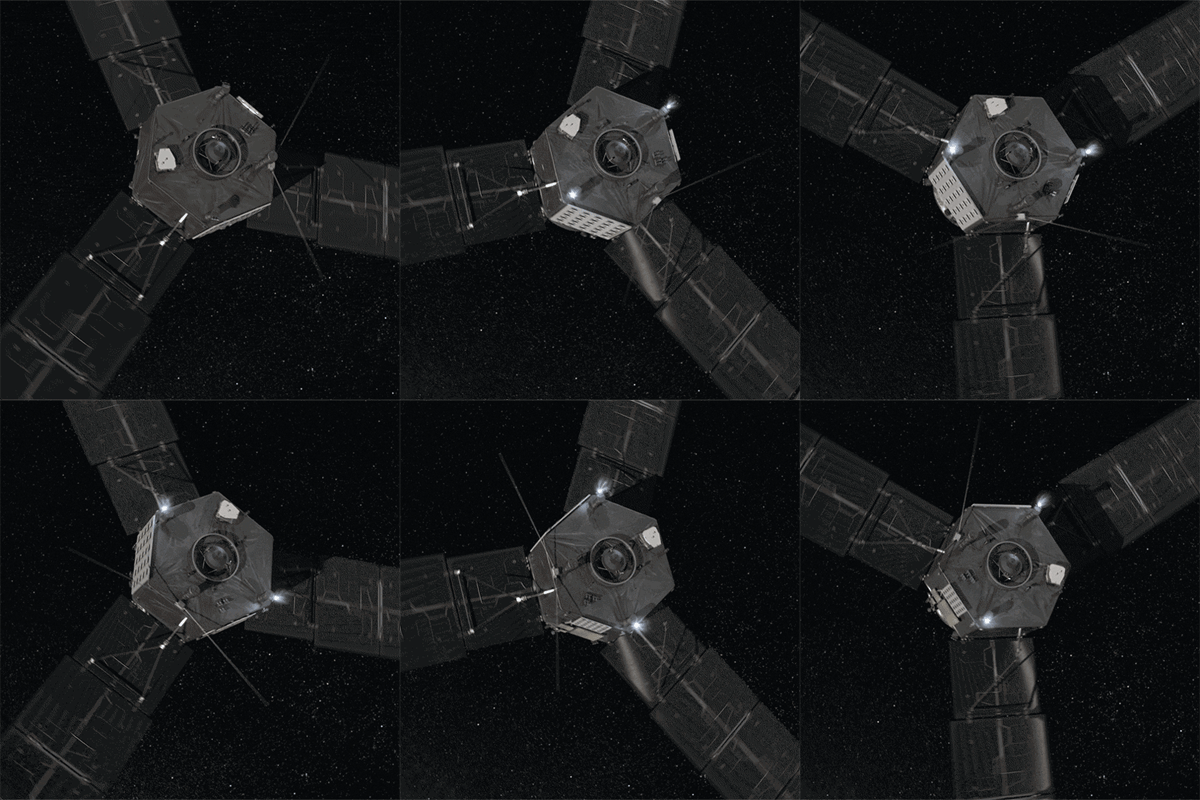
    NASA’s solar-powered Juno spacecraft successfully executed a maneuver to adjust its flight path today, February 3. The maneuver refined the spacecraft’s trajectory, helping set the stage for Juno’s arrival at the solar system’s largest planetary inhabitant five months and a day from now.

    “This is the first of two trajectory adjustments that fine-tune Juno’s orbit around the sun, perfecting our rendezvous with Jupiter on July 4th at 8:18 p.m. PDT [11:18 p.m. EDT],” said Scott Bolton, Juno principal investigator at the Southwest Research Institute in San Antonio.

    The maneuver began at 10:38 a.m. PST (1:38 p.m. EST). The Juno spacecraft’s thrusters consumed about 1.3 pounds (0.6 kilograms) of fuel during the burn, and changed the spacecraft’s speed by 1 foot (0.31 meters), per second. At the time of the maneuver, Juno was about 51 million miles (82 million kilometers) from Jupiter and approximately 425 million miles (684 million kilometers) from Earth. The next trajectory correction maneuver is scheduled for May 31.

    NASA’s Juno Spacecraft Burns for Jupiter
    Launched from Earth in 2011, the Juno spacecraft will arrive at Jupiter in 2016 to study the giant planet from an elliptical, polar orbit. Juno will repeatedly dive between the planet and its intense belts of charged particle radiation, coming only 5,000 kilometers (about 3,000 miles) from the cloud tops at closest approach. Credit: NASA/JPL-Caltech
    NASA’s Juno Mission to Jupiter
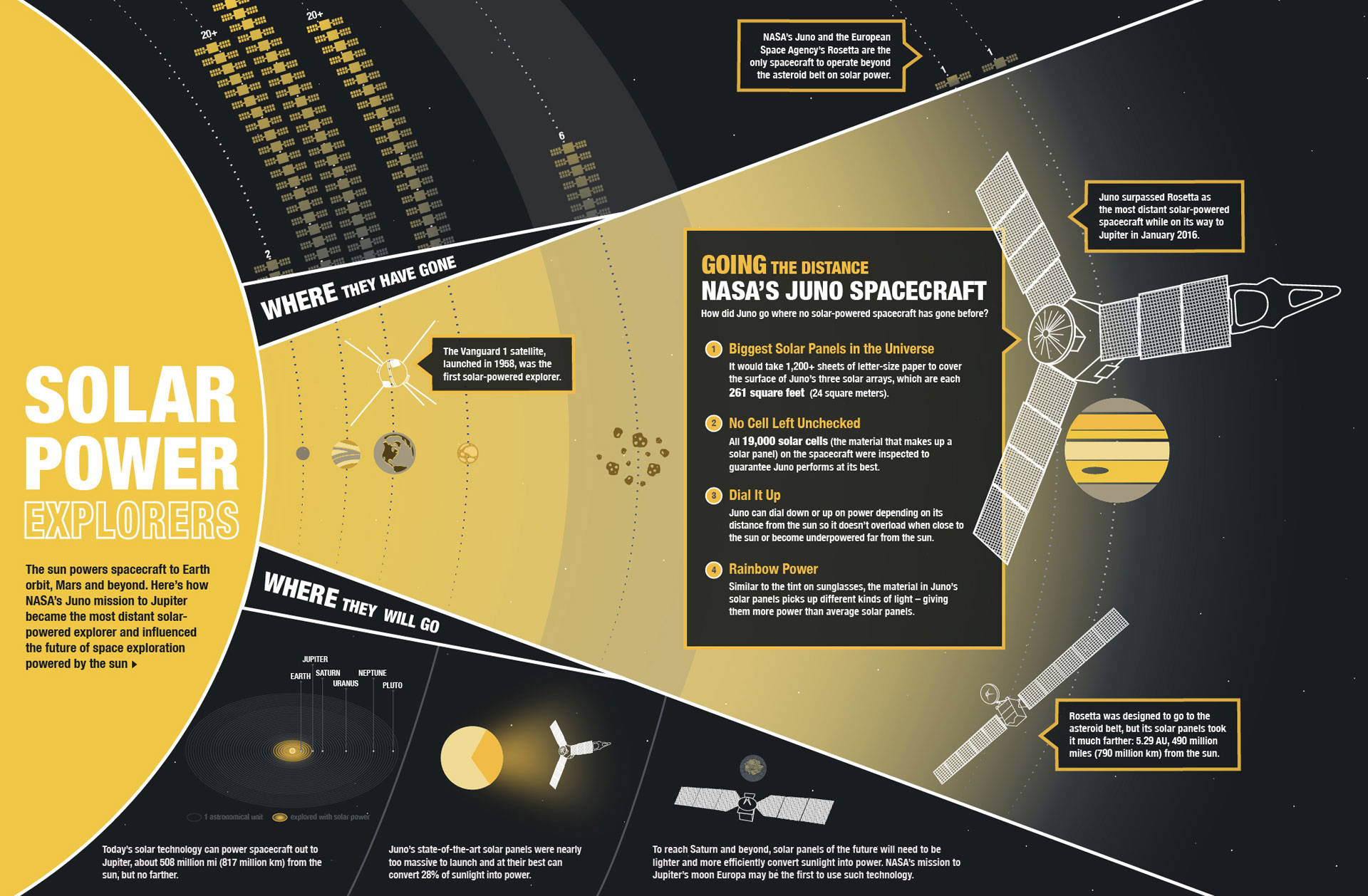
    This graphic shows how NASA’s Juno mission to Jupiter became the most distant solar-powered explorer and influenced the future of space exploration powered by the sun.

    Juno was launched on August 5, 2011. The spacecraft will orbit the Jovian world 33 times, skimming to within 3,100 miles (5,000 kilometers) above the planet’s cloud tops every 14 days. During the flybys, Juno will probe beneath the obscuring cloud cover of Jupiter and study its aurorae to learn more about the planet’s origins, structure, atmosphere and magnetosphere.

    Juno’s name comes from Greek and Roman mythology. The god Jupiter drew a veil of clouds around himself to hide his mischief, and his wife — the goddess Juno — was able to peer through the clouds and reveal Jupiter’s true nature.

    Never miss a breakthrough: Join the SciTechDaily newsletter.
    Follow us on Google and Google News.

    Astronomy Juno Spacecraft Jupiter NASA Planetary Science
    Share. Facebook Twitter Pinterest LinkedIn Email Reddit

    Related Articles

    NASA’s Juno Mission to Continue Its Exciting Journey of Discovery

    NASA’s Juno Spacecraft Makes Its Fourth Flyby Over Jupiter’s Mysterious Cloud Tops

    NASA’s Juno Spacecraft Captures New Image of Jupiter

    Juno Mission Prepares for Jupiter Flyby

    A Billion or More Jupiter-Like Worlds Could Be Orbiting Stars in the Milky Way

    First In-orbit View from NASA’s Juno Spacecraft

    Hubble Telescope Views Vivid Auroras in Jupiter’s Atmosphere

    NASA Juno Mission Trailer – Jupiter: Into the Unknown

    ScienceCasts Video: Close Encounters with Jupiter

    Leave A Reply Cancel Reply

    • Facebook
    • Twitter
    • Pinterest
    • YouTube

    Don't Miss a Discovery

    Subscribe for the Latest in Science & Tech!

    Trending News

    Black Hole Shredded a Massive Star in the Most Powerful Stellar Explosion Ever Seen

    Building the Brain Requires Millions of Dangerous DNA Breaks

    Endless Supply of Cancer-Fighting Immune Cells Unlocked by USC Scientists

    XRISM Reveals Galaxy-Shaping Winds Erupting From a Supermassive Black Hole

    New Molecule Restores the Brain’s Natural Defenses Against Alzheimer’s

    Could Creatine Boost More Than Muscles? It May Also Help Depression

    Scientists Discover a Natural Molecule That Could Help Prevent Vision Loss

    Scientists Thought Royal Jelly Made Queen Bees. They Were Wrong

    Follow SciTechDaily
    • Facebook
    • Twitter
    • YouTube
    • Pinterest
    • Newsletter
    • RSS
    SciTech News
    • Biology News
    • Chemistry News
    • Earth News
    • Health News
    • Physics News
    • Science News
    • Space News
    • Technology News
    Recent Posts
    • Scientists Discover a Hidden Chemical Pathway That Makes City Air Hazy
    • Neanderthals Nearly Vanished 75,000 Years Ago – Then One Group Repopulated Europe
    • AI Detects Hidden Warning Signs Before Major Earthquakes
    • Quantum Mechanics May Not Need Imaginary Numbers After All
    • Scientists Have Found Evidence That Dark Matter May Not Be Playing by the Rules
    Copyright © 1998 - 2026 SciTechDaily. All Rights Reserved.
    • Science News
    • About
    • Contact
    • Editorial Board
    • Privacy Policy
    • Terms of Use

    Type above and press Enter to search. Press Esc to cancel.