
Close Menu
    Facebook X (Twitter) Instagram
    SciTechDaily
    • Biology
    • Chemistry
    • Earth
    • Health
    • Physics
    • Science
    • Space
    • Technology
    Facebook X (Twitter) Pinterest YouTube RSS
    SciTechDaily
    Home»Chemistry»New Technique Sheds Light on the Hidden World of Solvation Shells
    Chemistry

    New Technique Sheds Light on the Hidden World of Solvation Shells

    By Fritz Haber Institute of the Max Planck SocietyOctober 18, 2024No Comments3 Mins Read
    Facebook Twitter Pinterest Telegram LinkedIn WhatsApp Email Reddit
    Share
    Facebook Twitter LinkedIn Pinterest Telegram Email Reddit
    Hidden World of Solvation Shells
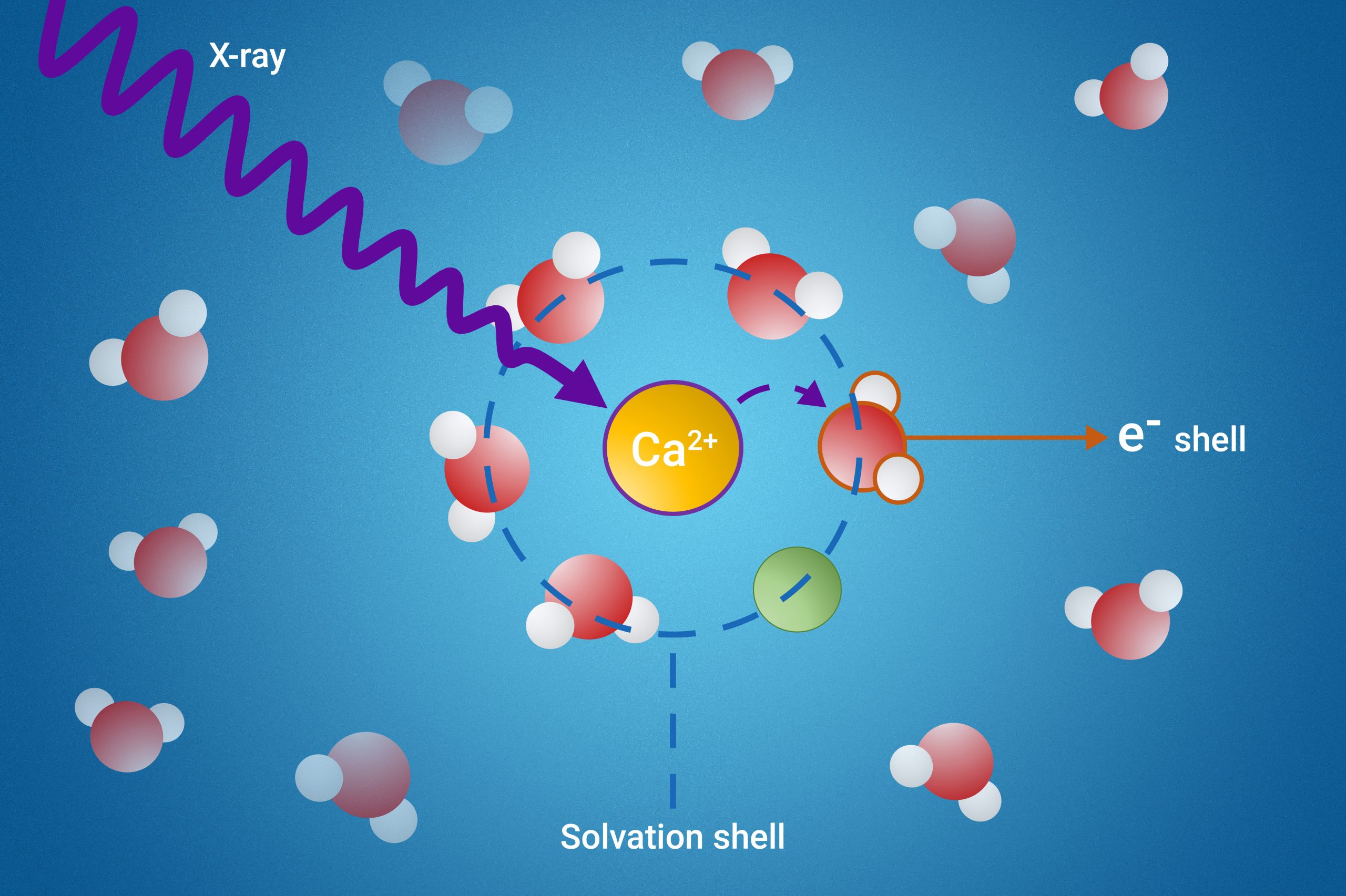
    Scientists have created a new way to study solvation shells, advancing ion behavior research in solutions. Their work uncovers key details about ion pairs and electron energies. Credit: FHI

    Researchers have devised a new technique to study solvation shells, providing insights into ion pair formation and electron binding energies. This discovery is key for advancing knowledge across many scientific areas.

    Researchers from the Fritz Haber Institute, Sorbonne University, and Uppsala University have made a groundbreaking discovery that advances our understanding of ion behavior in solutions. Their findings were recently published in the journal Nature Communications.

    Unveiling the Mysteries of Solvation Shells

    When substances dissolve in a liquid, a “solvation shell” is formed – a layer of solvent molecules that surround the dissolved particles. The solvent molecules that constitute these solvation shells can acquire wildly different properties from the other, “free” solvent molecules.

    However, studying these solvation shells has always been a challenge due to their complex nature and the difficulty to target specifically the solvent molecules making up the solvation shells, but not the many other solvent molecules.

    A New Window into Solvation Shells

    The research team has developed a novel method to probe these elusive solvation shells using a process called resonant intermolecular Coulombic decay (ICD).

    Their method involves exciting the molecules with X-rays and observing how they interact with their neighbors during the decay process. By doing so, the scientists can gain detailed insights into the properties of the solvation shell.

    Key Findings

    1. Ion Pair Formation: The study revealed that a specific ICD process is a powerful indicator of ion pair formation. Ion pairs are pairs of charged particles that are crucial in many chemical reactions.
    2. Electron Binding Energies: The researchers were able to measure the electron binding energies of water molecules in the first solvation shell. This is a significant achievement, as these measurements were previously unattainable.

    Why It Matters

    Understanding solvation shells is essential for a wide range of scientific fields, including chemistry, biology, materials science, atmospheric science, and electrochemistry.

    This new method provides a powerful tool for scientists to study these shells in greater detail, which is of relevance for these broad scientific and engineering fields.

    Reference: “The solvation shell probed by resonant intermolecular Coulombic decay” by Rémi Dupuy, Tillmann Buttersack, Florian Trinter, Clemens Richter, Shirin Gholami, Olle Björneholm, Uwe Hergenhahn, Bernd Winter and Hendrik Bluhm, 13 August 2024, Nature Communications.
    DOI: 10.1038/s41467-024-51417-3

    Never miss a breakthrough: Join the SciTechDaily newsletter.
    Follow us on Google and Google News.

    Materials Science Spectroscopy
    Share. Facebook Twitter Pinterest LinkedIn Email Reddit

    Related Articles

    Unlocking the Mystery of Promethium: The Rare Earth Element Without Stable Isotopes

    A New, Ecofriendly Way To Convert Blue Light to High-Energy Ultraviolet B Light

    New Spectroscopic Method Could Improve Optical Devices

    LCLS X-Ray Laser Captures Electron “Dance”

    “Molecular Levers” Accelerate Reactions

    Forming the Smallest Ice Crystals in the World

    Computer Model Helps Remove Greenhouse Gases From Power Plants

    Scientists Examine Platinum-Based Catalyst Design

    Using X-Ray Imaging to Help Improve Lithium-Sulfur Battery Technology

    Leave A Reply Cancel Reply

    • Facebook
    • Twitter
    • Pinterest
    • YouTube

    Don't Miss a Discovery

    Subscribe for the Latest in Science & Tech!

    Trending News

    Collapsing Plasma May Hold the Key to Cosmic Magnetism

    This Breakthrough Solar Panel Generates Power From Both Sunlight and Raindrops

    Scientists Uncover New Metabolic Effects Beyond Weight Loss of Mounjaro

    Scientists Discover Cancer Tumors Are “Addicted” to This Common Antioxidant

    1,800 Miles Down: Scientists Uncover Mysterious Movements at the Edge of Earth’s Core

    Scientists Discover Hidden “Good Fats” in Green Rice That Could Transform Nutrition

    Your Child’s Clothes Could Contain Toxic Lead, Study Finds

    Researchers Break a 150-Year-Old Math Law With a Surprising Donut Discovery

    Follow SciTechDaily
    • Facebook
    • Twitter
    • YouTube
    • Pinterest
    • Newsletter
    • RSS
    SciTech News
    • Biology News
    • Chemistry News
    • Earth News
    • Health News
    • Physics News
    • Science News
    • Space News
    • Technology News
    Recent Posts
    • The Mystery of the Notes: Why No One Knows How This 120-Year-Old Song Should Sound
    • Scientists Discover 132-Million-Year-Old Dinosaur Tracks on South Africa’s Coast
    • Scientists Uncover the Secret Ingredient Behind the Spark That May Have Started Life on Earth
    • Natural Oils vs. Antibiotics: The Swine Study That Could Change Farming
    • The Biggest Volcanic Event in Earth’s History Transformed an Entire Oceanic Plate
    Copyright © 1998 - 2026 SciTechDaily. All Rights Reserved.
    • Science News
    • About
    • Contact
    • Editorial Board
    • Privacy Policy
    • Terms of Use

    Type above and press Enter to search. Press Esc to cancel.