
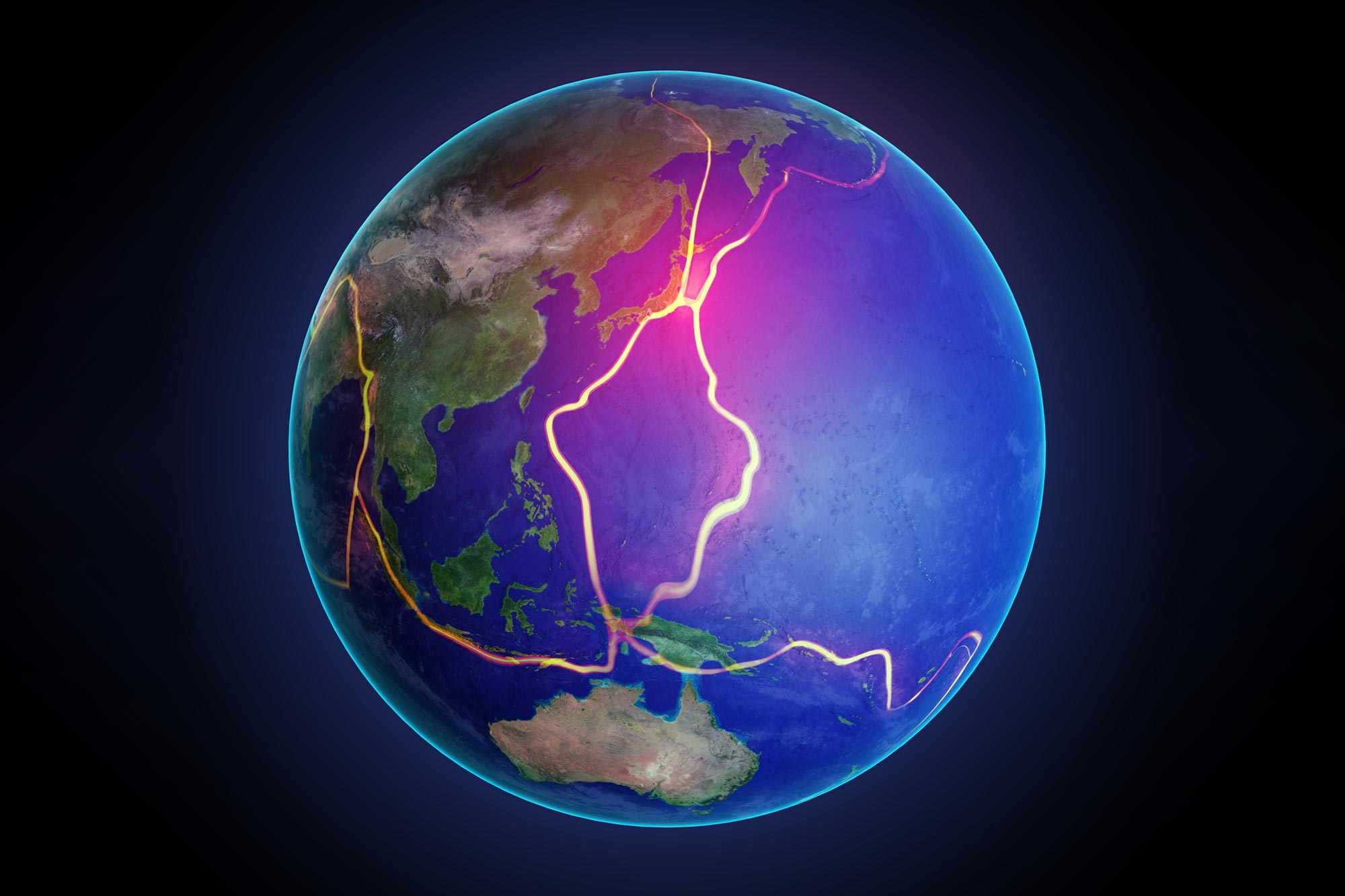
Seismic data reveal that deep mantle volcanism reshaped the oceanic plate beneath the Ontong Java Plateau.
A team led by Lecturer Azusa Shito of Okayama University of Science, working with Associate Professor Akira Ishikawa of the Institute of Science Tokyo and Professor Masako Yoshikawa of Hiroshima University, used seismic wave data to show that the oceanic plate beneath the Ontong Java Plateau was heavily modified during its formation by large-scale volcanic activity.
The Ontong Java Plateau is the largest oceanic plateau on Earth, and the findings were published in Geophysical Research Letters.
Ancient volcanism reshaped oceanic crust
The Ontong Java Plateau (OJP), located in the Pacific Ocean, formed around 110 to 120 million years ago through massive submarine volcanic eruptions. This event is considered the most extensive volcanic episode in Earth’s history and is believed to have significantly disrupted the global environment, possibly contributing to mass extinction events.
Previous research has pointed to a thermochemical plume rising from deep within the mantle as the likely driver of this large-scale volcanism. However, how magma from such deep sources interacted with and altered the structure of existing oceanic plates has not been well understood.
Seismic waves reveal hidden structure
To investigate this, the researchers examined high-frequency seismic signals known as Po and So waves. These waves were recorded using ocean-bottom seismometers placed around the OJP, along with instruments located on nearby oceanic islands. Because Po and So waves travel through oceanic plates, their behavior provides detailed information about the plate’s internal structure.
Normally, Po and So waves form when P and S waves scatter repeatedly through layered structures within the plate, allowing them to travel long distances. Around the Ontong Java Plateau, however, the team observed an unusual pattern. Po waves moved through the plate efficiently, while So waves weakened significantly as they traveled.
Volcanic intrusions altered plate structure
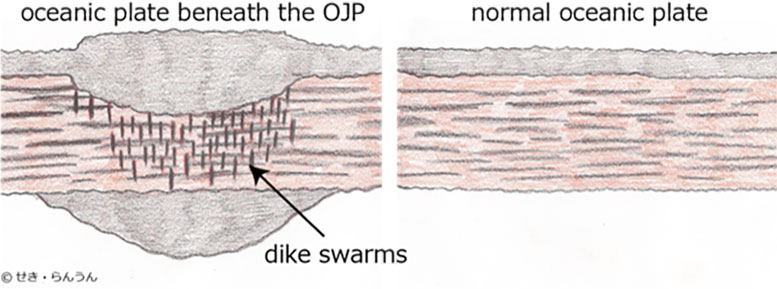
To better understand this pattern, the researchers used seismic waveform modeling to reconstruct the plate’s internal structure. Their analysis indicates that the oceanic plate beneath the OJP consists of a mixed structure where horizontal layers are cut through by vertical dike swarms formed by magma intrusions.
They also found that both Po and So waves move more slowly through this plate compared to typical oceanic plates. Based on these observations, the team proposes that magma rising from a thermal-chemical plume penetrated the plate, forming dike swarms and chemically altering the surrounding rock (i.e. refertilization).
The model proposed in this study, which describes how oceanic plates are altered through combined physical and chemical processes, offers a new framework for understanding how these plates form and evolve over time. By capturing both structural changes and chemical transformations, it provides a more complete picture of the mechanisms shaping oceanic plate development.
Reference: “Dike Swarms in the Oceanic Lithosphere Beneath the Ontong Java Plateau” by Azusa Shito, Daisuke Suetsugu, Akira Ishikawa, Masako Yoshikawa, Takehi Isse, Hajime Shiobara, Hiroko Sugioka, Aki Ito, Yasushi Ishihara, Satoru Tanaka, Masayuki Obayashi, Takashi Tonegawa and Junko Yoshimitsu, 30 September 2025, Geophysical Research Letters.
DOI: 10.1029/2025GL115219
Never miss a breakthrough: Join the SciTechDaily newsletter.
Follow us on Google and Google News.
1 Comment
This event was a result the PacManImpact.site