
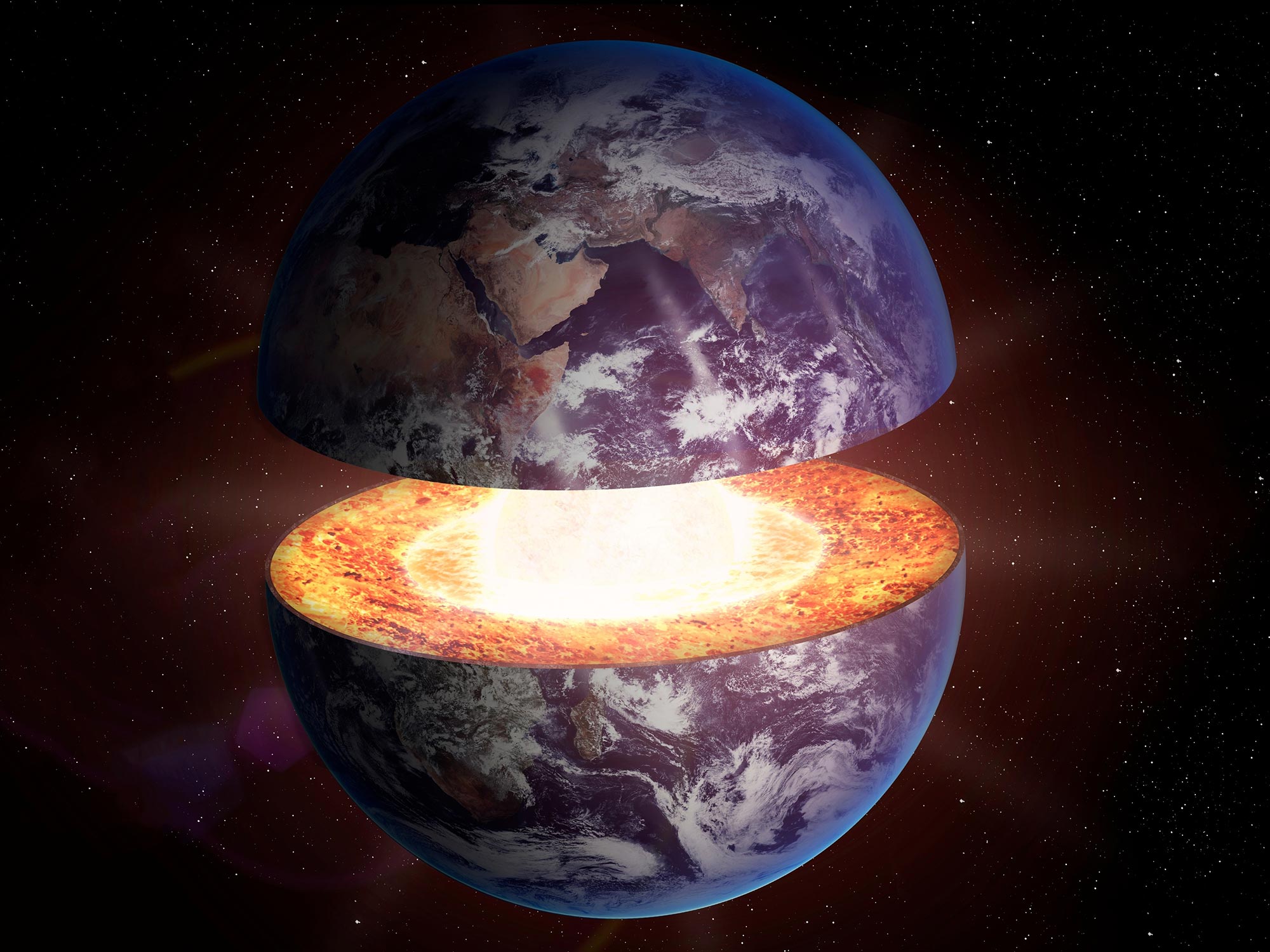
New research reveals that only the oldest and fastest-sinking oceanic plates can transport water deep into Earth’s mantle, due to the unique heat-transferring properties of the mineral olivine.
Because of the way the mineral olivine conducts heat through radiation, only oceanic tectonic plates that are more than 60 million years old and moving downward at speeds greater than 10 centimeters per year are able to stay cool enough to carry water deep into the Earth’s mantle.
This conclusion comes from a team of researchers at the University of Potsdam and the Helmholtz Centre for Geosciences (GFZ) Potsdam, along with international partners. They reached this finding after measuring how transparent olivine is to infrared light under the extreme pressure and temperature conditions found within the Earth’s mantle. Their study was published in Nature Communications.
The Earth’s outer shell, called the lithosphere, is broken into rigid sections known as tectonic plates. These plates float on top of the hotter, more flexible mantle beneath them. When two plates collide, the denser one sinks into the mantle in a process called subduction. The plate that sinks is referred to as a “slab.” Oceanic plates are typically denser than continental ones, largely due to their high content of olivine, a mineral that makes up about 80 percent of oceanic lithosphere.

Olivine is also the predominant mineral in the Earth’s outer shell, representing 60% of the upper mantle (40-410 km of depth). While subducting, the cold slabs are progressively heated by the warm ambient mantle through heat diffusion, a process that involves heat conduction and heat radiation. Understanding slab heating processes is fundamental to explaining the occurrence of deep earthquakes, and the presence of water at more than 600 km of depth.
Infrared Transparency of Olivine: A Groundbreaking Measurement
“We measured, for the first time, the transparency of olivine inside the Earth,” says geodynamicist Enrico Marzotto from the Institute of Geosciences of the University of Potsdam. “These measurements demonstrate that olivine is infrared transparent even at the extreme pressure and temperature conditions of Earth’s interior.”
The heat transport by radiation accounts for approximately 40 percent of the total heat diffused in the olivine-rich upper mantle. Therefore, radiative thermal conductivity plays an important role in slab heating and can have far-reaching effects on the density and the rigidity of the subducting plates, and their capacity to carry water into Earth’s interior.
With two-dimensional slab thermal evolution models, the team could show that the rapid heating enhanced by radiative heat transport induces the breakdown of water-bearing minerals at shallower depth.
“This could potentially explain the occurrence of earthquakes in the slab at more than 70 kilometers of depth,” says Marzotto. “Consequently, only slabs that are more than 60 million years old and sinking faster than 10 centimeters per year, remain sufficiently cold to transport the water-bearing minerals down to the Mantle Transition Zone (MTZ) in 410 to 660 kilometers.”
The MTZ is considered the largest water reservoir on our planet, potentially containing up to three times more water than the Earth’s oceans.
“Our study also provides numerical tools to compute the lifetime of thermal anomalies in the mantle and their geodynamic behavior,” adds Enrico Marzotto. These anomalies can be hot (like the plumes rising from the Earth’s deep mantle) or cold (like the subducting slabs).
Reference: “Olivine’s high radiative conductivity increases slab temperature by up to 200K” by Enrico Marzotto, Alexander Koptev, Sergio Speziale, Monika Koch-Müller, Nada Abdel-Hak, Sarah B. Cichy and Sergey S. Lobanov, 1 July 2025, Nature Communications.
DOI: 10.1038/s41467-025-61148-8
Never miss a breakthrough: Join the SciTechDaily newsletter.
Follow us on Google and Google News.
2 Comments
The study of researchers provides numerical tools to compute the lifetime of thermal anomalies in the mantle and their geodynamic behavior.
VERY GOOD.
Please ask the researchers to think deeply:
Is there a similar mechanism between the thermal anomalies in the mantle and the thermal anomalies received by Earth’s objects from the sun?
If researchers are interested in this, please visit https://zhuanlan.zhihu.com/p/1916783850291466914 (If the link is available).
The linked, peer-reviewed article erroneously states that the Stephen-Boltzman Law is a function of the third power, whereas it should be stated as a function controlled by the absolute temperature raised to the 4th power! I’m sure everything else is correct.
They state, “The agreement with the optical data of ref. 25 indirectly testifies to the reliability of our measurements.”
I would suggest that they use a VIS-IR spectroscopic ellipsometer to determine the complex refractive index of their olivine samples at multiple wavelengths, and extract the imaginary, extinction (absorption) coefficient for comparison with the literature data they used.
Pure olivine (>90%) is known by the rock name, dunite. It is more likely that the upper mantle is a peridotite, which means that the olivine is 40-90%. They need to take into account that while the olivine may be ‘transparent’ to IR photons, the other minerals, particularly chromite, will not be. They don’t explain in their paper how they account for the ‘shadowing’ effect of the other minerals in a slab.