
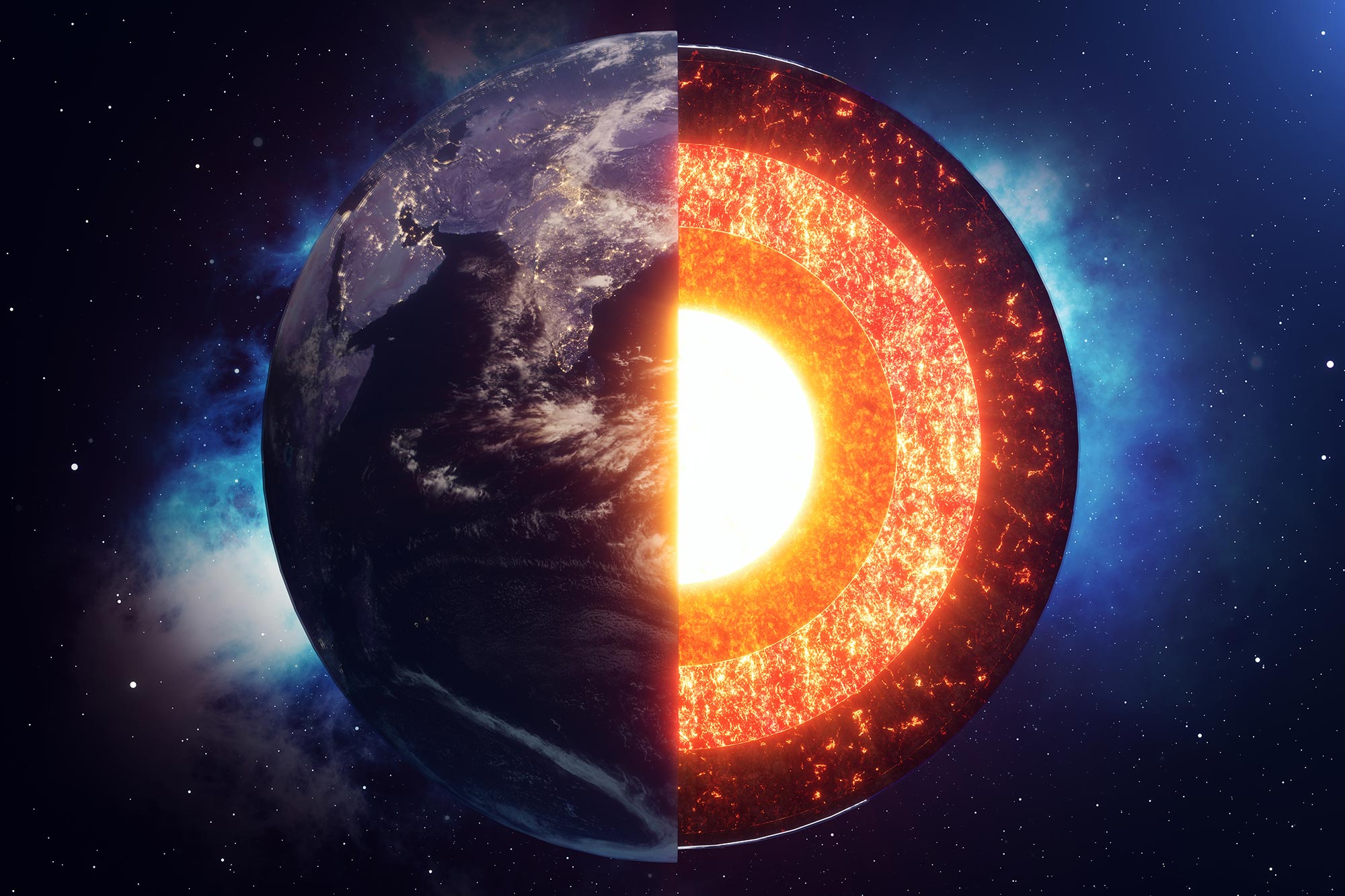
A Rutgers researcher and collaborators have linked unusual geological anomalies to Earth’s molten origins and its unique habitability.
For many years, researchers have struggled to understand two enormous and puzzling formations hidden deep within Earth. Their immense size and unusual traits make them difficult to reconcile with traditional ideas about how the planet developed.
A recent study in Nature Geoscience, led by Rutgers geodynamicist Yoshinori Miyazaki along with several colleagues, presents a compelling new interpretation of these structures and how they may have influenced Earth’s long-term habitability.
These formations, called large low-shear-velocity provinces and ultra-low-velocity zones, rest at the boundary between the mantle and the core nearly 1,800 miles below the surface. Large low-shear-velocity provinces are vast regions of extremely hot and dense rock, with one located beneath Africa and the other beneath the Pacific Ocean. Ultra-low velocity zones appear as thin, molten patches that sit directly on the core, resembling pools of lava. Both types significantly slow down seismic waves, indicating that their chemical makeup differs from the surrounding mantle.
“These are not random oddities,” said Miyazaki, an assistant professor in the Department of Earth and Planetary Sciences in the Rutgers School of Arts and Sciences. “They are fingerprints of Earth’s earliest history. If we can understand why they exist, we can understand how our planet formed and why it became habitable.”
A Planet Born From a Magma Ocean
According to Miyazaki, Earth was once enveloped in a global magma ocean billions of years ago. As the planet cooled, scientists expected the mantle to develop into distinct layers of different chemical compositions, much like how frozen juice separates into a sugary layer and a watery layer. However, seismic observations reveal that this kind of clear layering never formed. Instead, large-low shear velocity provinces and ultra-low velocity zones accumulated as irregular clusters near the bottom of the mantle.
“That contradiction was the starting point,” Miyazaki said. “If we start from the magma ocean and do the calculations, we don’t get what we see in Earth’s mantle today. Something was missing.”
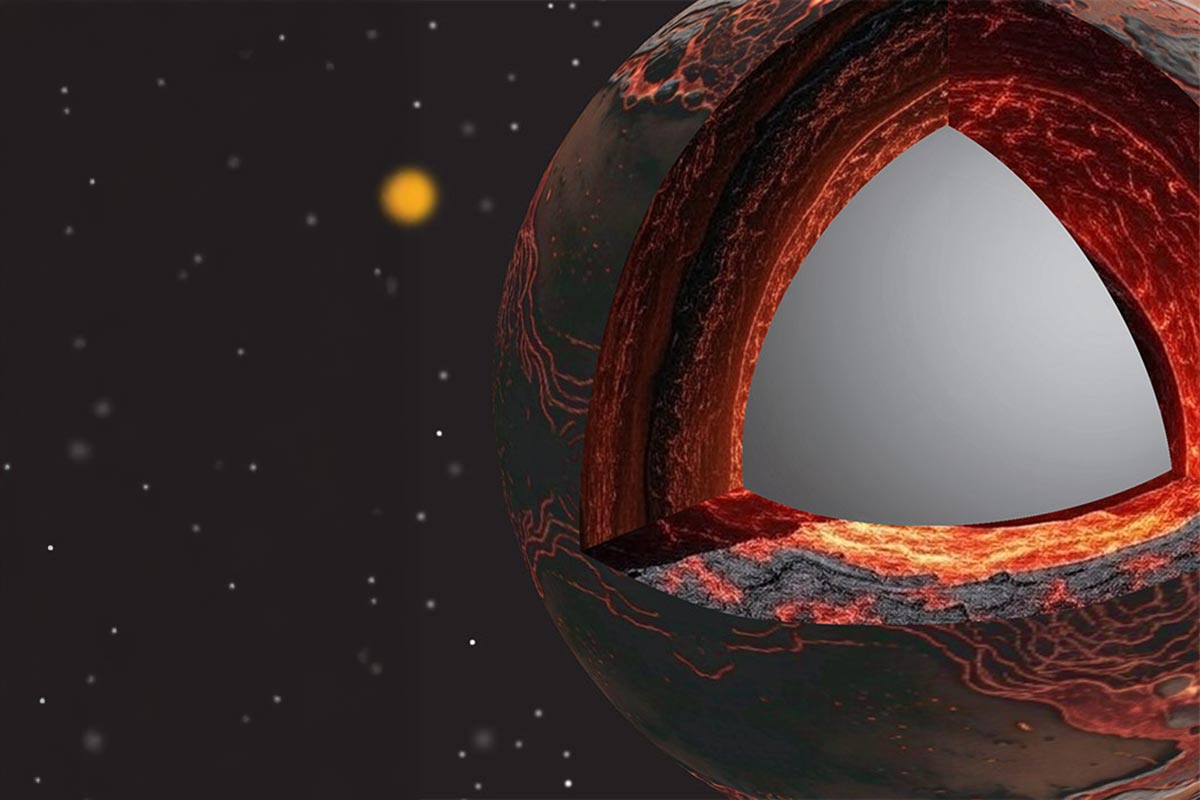
His collaborators concluded the missing piece is the core itself. Their model suggests that over billions of years, elements such as silicon and magnesium leaked from the core into the mantle, mixing with it and preventing strong chemical layering. This infusion could explain the strange composition of large low-shear-velocity provinces and ultra-low-velocity zones, which can be seen as solidified remnants of what the scientists termed a “basal magma ocean” contaminated by core material.
“What we proposed was that it might be coming from material leaking out from the core,” Miyazaki said. “If you add the core component, it could explain what we see right now.”
\Implications for Earth’s Evolution and Habitability
The discovery is about more than deep-Earth chemistry, Miyazaki said. Core-mantle interactions may have influenced how Earth cooled, how volcanic activity unfolded, and even how the atmosphere evolved. That could help explain why Earth has oceans and life, while Venus is a scorching greenhouse and Mars is a frozen desert.
“Earth has water, life, and a relatively stable atmosphere,” Miyazaki said. “Venus’ atmosphere is 100 times thicker than Earth’s and is mostly carbon dioxide, and Mars has a very thin atmosphere. We don’t fully understand why that is. But what happens inside a planet, that is, how it cools, how its layers evolve, could be a big part of the answer.”
By integrating seismic data, mineral physics, and geodynamic modeling, the study reconceived large low-shear velocity provinces and ultra-low-velocity zones as vital clues to Earth’s formative processes. The structures may even feed volcanic hotspots such as Hawaii and Iceland, linking the deep Earth to its surface.
“This work is a great example of how combining planetary science, geodynamics, and mineral physics can help us solve some of Earth’s oldest mysteries,” said Jie Deng of Princeton University, a co-author of the study. “The idea that the deep mantle could still carry the chemical memory of early core–mantle interactions opens up new ways to understand Earth’s unique evolution.”
Building on that idea, the researchers say each new piece of evidence helps fill in gaps in Earth’s early history, turning scattered clues into a clearer picture of its evolution.
“Even with very few clues, we’re starting to build a story that makes sense,” Miyazaki said. “This study gives us a little more certainty about how Earth evolved, and why it’s so special.”
Reference: “Deep mantle heterogeneities formed through a basal magma ocean contaminated by core exsolution” by Jie Deng, Yoshinori Miyazaki, Qian Yuan and Zhixue Du, 12 September 2025, Nature Geoscience.
DOI: 10.1038/s41561-025-01797-y
The study was funded by the U.S. National Science Foundation.
Never miss a breakthrough: Join the SciTechDaily newsletter.
Follow us on Google and Google News.