
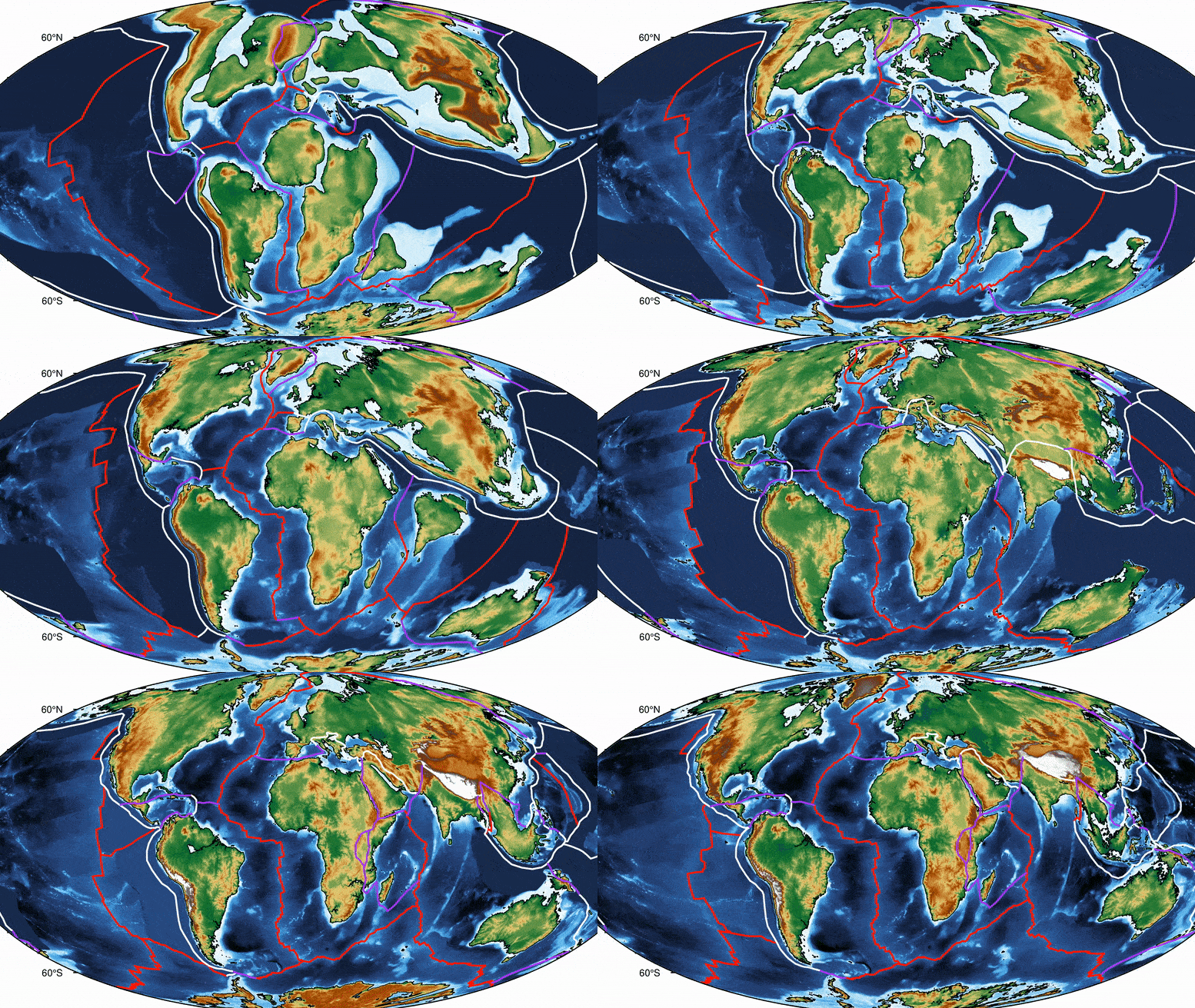
An advanced digital tool can assist us in comprehending the past and forecasting the evolution of the Earth’s surface.
The interplay of climate, tectonic activity, and the passage of time result in formidable forces that shape the appearance of our planet. The gentle erosion caused by rivers only adds to this, making what appears to be an unchanging rock in reality a continuously evolving surface.
However, our grasp of this intricate process has been limited, at best.
Scientists have published new research revealing a detailed and dynamic model of the Earth’s surface over the past 100 million years.
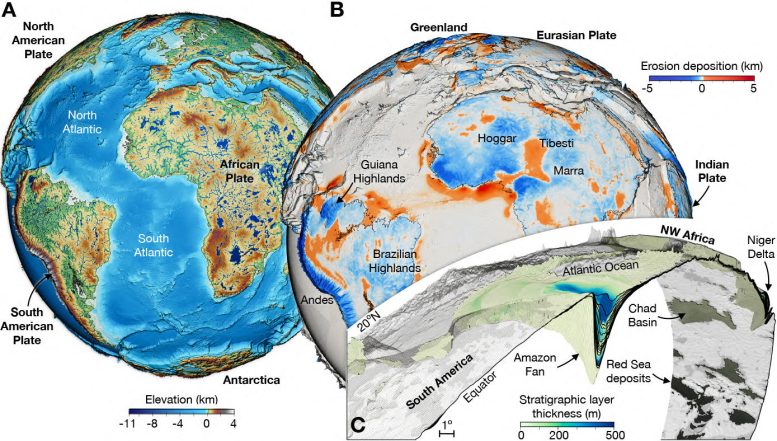
Working with scientists in France, University of Sydney geoscientists have published this new model in the prestigious journal Science.
For the first time, it provides a high-resolution understanding of how today’s geophysical landscapes were created and how millions of tonnes of sediment have flowed to the oceans.
Lead author Dr. Tristan Salles from the University of Sydney School of Geosciences, said: “To predict the future, we must understand the past. But our geological models have only provided a fragmented understanding of how our planet’s recent physical features formed.
Animation of landscape dynamics model over the past 100 million years showing landscape erosion and sediment deposition. Credit: Dr. Tristan Salles, The University of Sydney
“If you look for a continuous model of the interplay between river basins, global-scale erosion, and sediment deposition at high resolution for the past 100 million years, it just doesn’t exist. So, this is a big advance. It’s not only a tool to help us investigate the past but will help scientists understand and predict the future, as well.”
Using a framework incorporating geodynamics, tectonic and climatic forces with surface processes, the scientific team has presented a new dynamic model of the past 100 million years at high resolution (down to 10 kilometers), broken into frames of a million years.
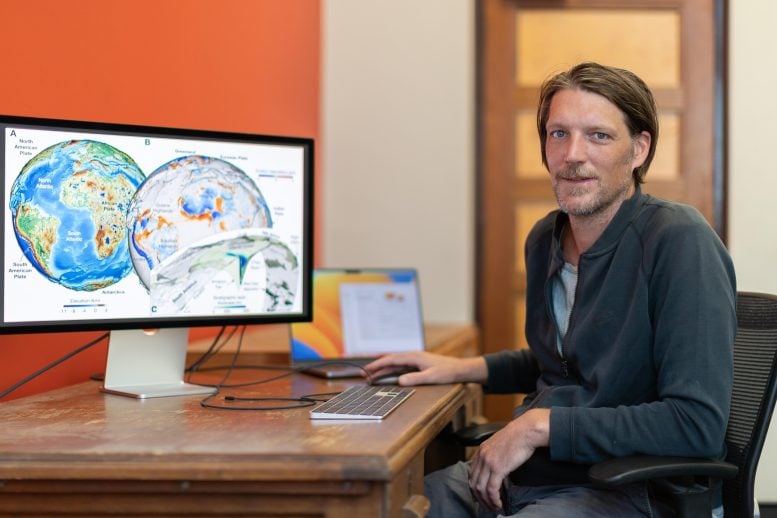
Second author Dr. Laurent Husson from Institut des Sciences de la Terre in Grenoble, France, said: “This unprecedented high-resolution model of Earth’s recent past will equip geoscientists with a more complete and dynamic understanding of the Earth’s surface.
“Critically, it captures the dynamics of sediment transfer from the land to oceans in a way we have not previously been able to.”
World map animation of landscape evolution over past 100 million years. Credit: Dr. Tristan Salles, The University of Sydney
Dr. Salles said that understanding the flow of terrestrial sediment to marine environments is vital to comprehend present-day ocean chemistry.
“Given that ocean chemistry is changing rapidly due to human-induced climate change, having a more complete picture can assist our understanding of marine environments,” he said.
The model will allow scientists to test different theories as to how the Earth’s surface will respond to changing climate and tectonic forces.
Further, the research provides an improved model to understand how the transportation of Earth sediment regulates the planet’s carbon cycle over millions of years.
“Our findings will provide a dynamic and detailed background for scientists in other fields to prepare and test hypotheses, such as in biochemical cycles or in biological evolution.”
Reference: “Hundred million years of landscape dynamics from catchment to global scale” by Tristan Salles, Laurent Husson, Patrice Rey, Claire Mallard, Sabin Zahirovic, Beatriz Hadler Boggiani, Nicolas Coltice and Maëlis Arnould, 2 March 2023, Science.
DOI: 10.1126/science.add2541
The study was funded by the Australian Government and the Australian Research Council.
Authors Dr. Salles, Dr. Claire Mallard, and Ph.D. student Beatriz Hadler Boggiani are members of the EarthColab Group and Associate Professor Patrice Rey and Dr. Sabin Zahirovic are part of the EarthByte Group. Both groups are in the School of Geosciences at the University of Sydney.
The research was undertaken in collaboration with French geoscientists from CNRS, France, Université Lyon, and ENS Paris.
Never miss a breakthrough: Join the SciTechDaily newsletter.
Follow us on Google and Google News.