

A new study reveals that the Earth’s inner core is undergoing a structural transformation.
A new study by USC scientists, published in Nature Geoscience, reveals structural changes near the Earth’s inner core, suggesting its surface may be shifting.
While scientists have long debated changes in the inner core, most research has focused on its rotation rather than structural variations.
John Vidale, Dean’s Professor of Earth Sciences at the USC Dornsife College of Letters, Arts and Sciences and principal investigator of the study, said the researchers “didn’t set out to define the physical nature of the inner core.”
“What we ended up discovering is evidence that the near surface of Earth’s inner core undergoes structural change,” Vidale said. The finding sheds light on the role topographical activity plays in rotational changes in the inner core that have minutely altered the length of a day and may relate to the ongoing slowing of the inner core.
Redefining the inner core
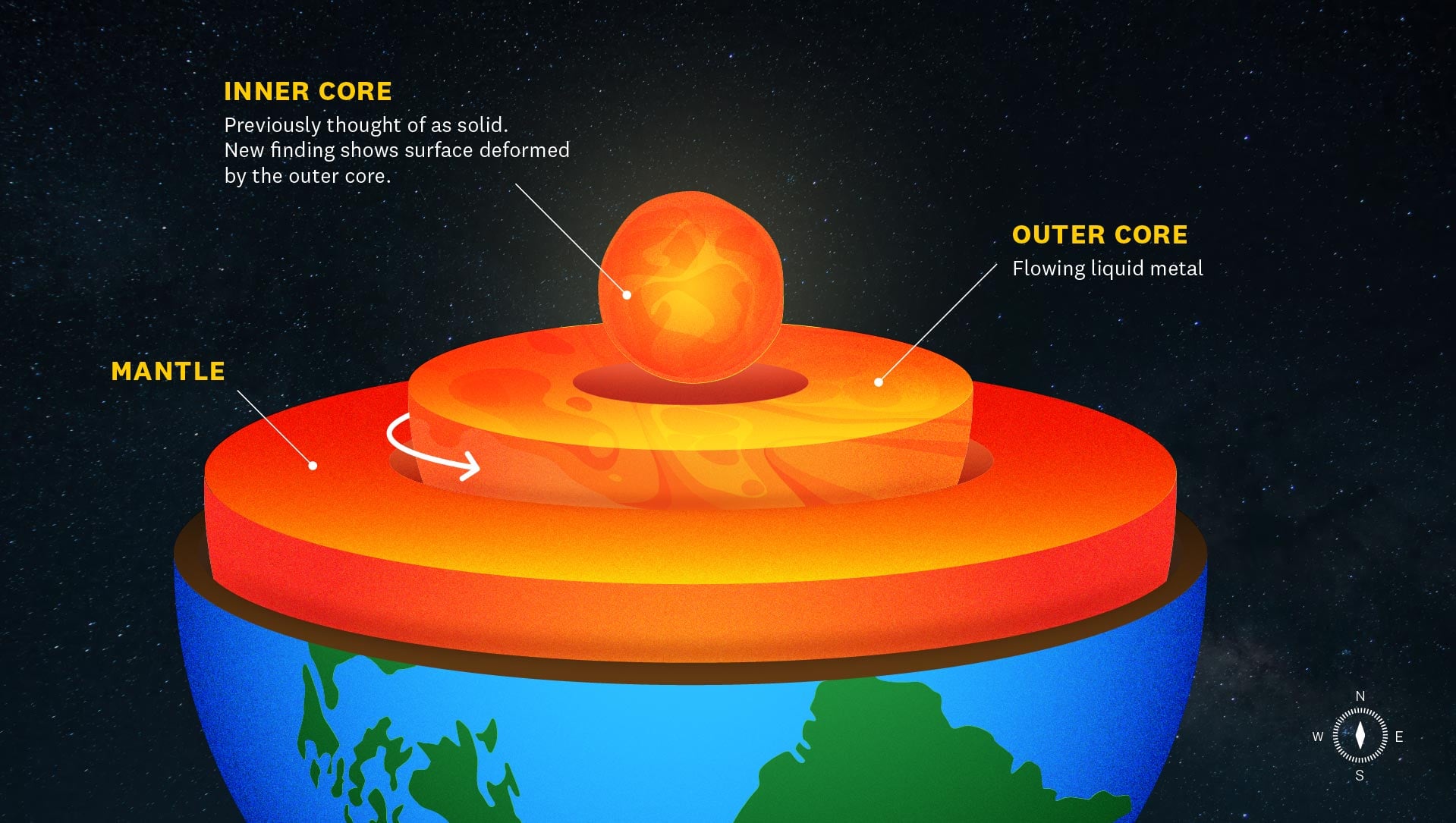
Located 3,000 miles below the Earth’s surface, the inner core is anchored by gravity within the molten liquid outer core. Until now the inner core was widely thought of as a solid sphere.
The original aim of the USC scientists was to further chart the slowing of the inner core. “But as I was analyzing multiple decades’ worth of seismograms, one dataset of seismic waves curiously stood out from the rest,” Vidale said. “Later on, I’d realize I was staring at evidence the inner core is not solid.”
The study utilized seismic waveform data — including 121 repeating earthquakes from 42 locations near Antarctica’s South Sandwich Islands that occurred between 1991 and 2024 — to give a glimpse of what takes place in the inner core. As the researchers analyzed the waveforms from receiver-array stations located near Fairbanks, Alaska, and Yellowknife, Canada, one dataset of seismic waves from the latter station included uncharacteristic properties the team had never seen before.
“At first the dataset confounded me,” Vidale said. It wasn’t until his research team improved the resolution technique did it become clear the seismic waveforms represented additional physical activity of the inner core.
Deformed inner core
The physical activity is best explained as temporal changes in the shape of the inner core. The new study indicates that the near surface of the inner core may undergo viscous deformation, changing its shape and shifting at the inner core’s shallow boundary.
The clearest cause of the structural change is interaction between the inner and outer core. “The molten outer core is widely known to be turbulent, but its turbulence had not been observed to disrupt its neighbor the inner core on a human timescale,” Vidale said. “What we’re observing in this study for the first time is likely the outer core disturbing the inner core.”
Vidale said the discovery opens a door to reveal previously hidden dynamics deep within Earth’s core, and may lead to better understanding of Earth’s thermal and magnetic field.
Reference: “Annual-scale variability in both the rotation rate and near surface of Earth’s inner core” by John E. Vidale, Wei Wang, Ruoyan Wang, Guanning Pang and Keith Koper, 10 February 2025, Nature Geoscience.
DOI: 10.1038/s41561-025-01642-2
This research was supported by the National Science Foundation (EAR-2041892), the National Natural Science Foundation of China (42394114), the National Key R&D Program of China (Grant 2022YFF0503203), and the Key Research Program of the Institute of Geology & Geophysics (IGGCAS-201904, IGGCAS-202204).
Never miss a breakthrough: Join the SciTechDaily newsletter.
Follow us on Google and Google News.
5 Comments
Geophysics might be a bigger baloney than even climatology. All conjecture.
Both of those are of course accepted science, precisely because they are not baloney and work to uncover facts such as in the article. Geophysics is especially interesting since geobiology successfully study the split between biology and geology – the biology of the metabolic core and the pre-LUCA genetic code evolution agree with the environmental geology of deep ocean hydrothermal vents.
“The main topics of research are the study of climate variability, mechanisms of climate changes and modern climate change.[2][3] This topic of study is regarded as part of the atmospheric sciences and a subdivision of physical geography, which is one of the Earth sciences. Climatology includes some aspects of oceanography and biogeochemistry.” – Climatology, Wikipedia
“Geophysicists, who usually study geophysics, physics, or one of the Earth sciences at the graduate level, complete investigations across a wide range of scientific disciplines. The term geophysics classically refers to solid earth applications: Earth’s shape; its gravitational, magnetic fields, and electromagnetic fields ; its internal structure and composition; its dynamics and their surface expression in plate tectonics, the generation of magmas, volcanism and rock formation.[3] However, modern geophysics organizations and pure scientists use a broader definition that includes the water cycle including snow and ice; fluid dynamics of the oceans and the atmosphere; electricity and magnetism in the ionosphere and magnetosphere and solar-terrestrial physics; and analogous problems associated with the Moon and other planets.[3][4][5][6][7][8]” – Geophysics, Wikipedia
“Geobiology applies the principles and methods of biology, geology, and soil science to the study of the ancient history of the co-evolution of life and Earth as well as the role of life in the modern world.[2]” – Geobiology. Wikipedia
Our home planet truly is a fascinating place.
1,000 miles from the core. That sounds about right. Any theory about the interior of the Earth is always speculative. However, some things can be readily observed on the surface. The most prominent is the position of the geomagnetic poles. Around 1400 AD they were both on the same meridian about 1200 miles from the core. About 1955 they had spread apart and were about 1000 miles from the core. Then they suddenly began to close the gap like a steel trap and will be on the same meridian again around 2026 and the source about 1200 miles deep after a sudden upward surge, mostly in the last 30 years.
This was found by assuming that the magnetic field had a common cause, a cause that is evident of or is the product of a release if an incredible amount of energy, probably nuclear. The raw data came from the NOAA website where it was buried in plain sight. I added an extra column on a spreadsheet to find the angular spread.
As far as the popular model of the Earth is concerned, it makes a pretty picture or model for elementary children but makes no allowance for the incredible varying torque forces parallel to the polar axis that result from the rotation of the Earth.
It’s a neat experimental technique of using two nearby sets of seismographs along great circle arcs, one where the sources will barely touch the core and one where they go deeper [their figure 1.].