
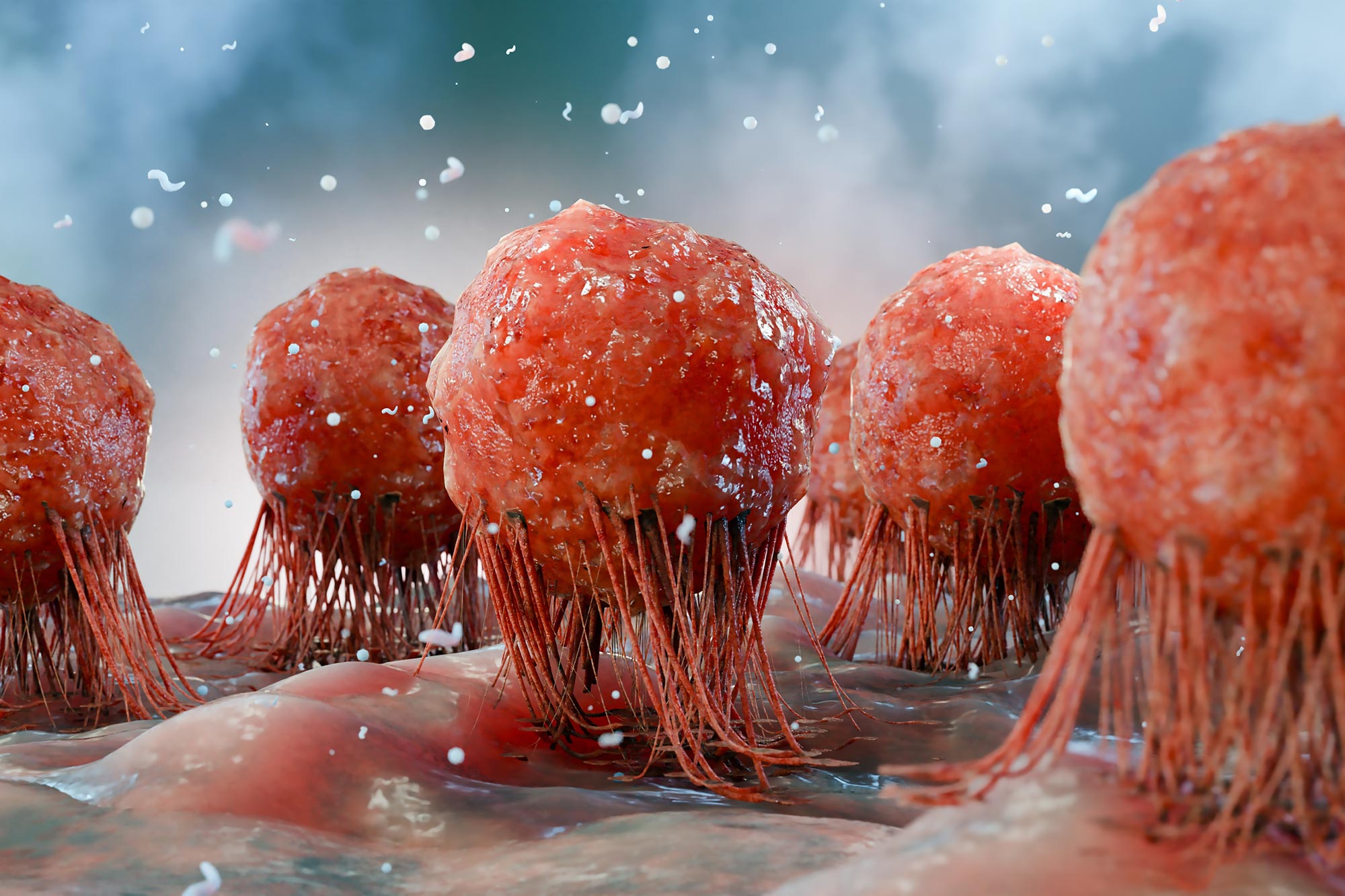
Cancer cells may be exploiting a common antioxidant as fuel, revealing a potential weakness that future therapies could target.
Cancer cells may be tapping into an unexpected energy source: an antioxidant long associated with protecting healthy cells. Researchers have discovered that tumors appear to be “addicted” to glutathione, a molecule widely known for preventing cellular damage, which they use as a key fuel source. The discovery not only challenges conventional thinking about antioxidants but also highlights a possible new target for cancer treatment.
The study, published March 18 in Nature, comes from scientists at the Wilmot Cancer Institute at the University of Rochester, led by Isaac Harris, PhD. The work was carried out by Fabio Hecht, PhD, and Marco Zocchi, PhD, in Harris’s lab in the Department of Biomedical Genetics.
How Cancer Cells Adapt to Scarcity
Tumors often grow in environments where nutrients are limited. Even so, cancer cells have developed efficient ways to capture and use available resources.
Glutathione, a powerful antioxidant that Harris has studied for years, has now emerged as one of those resources. The researchers found that cancer cells can break it down and use it as fuel.
“Cancer cells and normal cells potentially use different food sources,” Harris explained, “and we discovered how cancer cells, specifically, break down this antioxidant and use it as fuel.”
This role is unexpected. Scientists have long focused on glutathione for its ability to protect cells from damage, not as something that can support tumor growth.
“Maybe we need to re-examine the pantry that cancer relies on and look at things that we never thought could actually be used as food for tumors,” Harris said. “There are additional complex metabolites that others are looking at, so we’re potentially opening a whole new interest into how cancer cells acquire nutrients and how to block that activity. It’s a really exciting time.”
What is glutathione?
The body produces glutathione naturally, and it is also widely sold as a dietary supplement. It is often promoted for its health benefits, but the National Cancer Institute has issued more cautious guidance about how nutrients and supplements may relate to cancer.
“It’s important to understand how cancer hijacks certain substances that we may think of as harmless,” Harris said, emphasizing that antioxidants can be a double-edged sword in some circumstances.
Recent findings support this idea. Last year, Jeevisha Bajaj, PhD, a colleague of Harris, showed that taurine, another antioxidant found in foods, supplements, and energy drinks, can promote the growth of leukemia cells. Her work was also reported in Nature.
Earlier research from the Harris team, in collaboration with Tom Campbell, PhD, and Erin Campbell, PhD, found that a whole-food plant-based diet may reduce nutrients that tumors depend on. That work helped set the stage for the current study, which examines the complex links between antioxidants, metabolism, and cancer.
To investigate further, researchers analyzed breast tumor samples donated to Wilmot’s Biobank. They examined fluid from inside the tumors and found high levels of glutathione, showing that tumors are actively using it.
In preclinical models of breast cancer, blocking the tumor’s ability to use glutathione slowed its growth.
Early evidence suggests this may not be limited to breast cancer. Many tumor types appear to consume glutathione, according to preliminary data.
Bringing Basic Science Closer to the Clinic
Harris stressed that these findings do not mean people should avoid antioxidant-rich foods.
“Eating a balanced diet with fruits and vegetables is important. It can control weight, reduce inflammation, and support a healthy immune system,” Harris said. “But people should be cautious about taking supplements in general, particularly glutathione. Taking a pill that is unregulated by the FDA and has a high concentration of glutathione can present risks.”
The team also used advanced tools to search for ways to block glutathione use in tumors. They identified a promising candidate, a drug first developed nearly a decade ago.
University of Rochester chemist Tom Driver, PhD, and biochemist Joshua Munger, PhD, are now working to refine this drug and identify the specific proteins that allow tumors to process glutathione. Future research will also test combinations of anticancer drugs alongside dietary strategies that may improve outcomes.
The long-term goal is to create treatments that destroy cancer cells while leaving healthy cells unharmed.
“Even though glutathione was discovered 100 years ago, we are finding completely new aspects to its biology,” Harris said. “There is a lot left to understand but we’re hopeful we can translate these discoveries to new therapies.”
Reference: “Catabolism of extracellular glutathione supplies cysteine to support tumours” by Fabio Hecht, Marco Zocchi, Emily T. Tuttle, Nathan P. Ward, Fatemeh Alimohammadi, Amal Afzal Khan, Veronica C. Gomes, Bradley Smith, Jennifer J. Twardowski, Bradley N. Mills, Kevin A. Welle, Sina Ghaemmaghami, Zhuoran Zhou, Yuhan Gan, Yun Pyo Kang, Juliana Cazarin, Zamira G. Soares, Mete Emir Ozgurses, Huiping Zhao, Colin Sheehan, Guillaume Cognet, Lila D. Munger, Dhvani Trivedi, Gloria Asantewaa, Sara K. Blick-Nitko, Jason J. Zoeller, Ying Chen, Vasilis Vasiliou, Bradley M. Turner, Stephano S. Mello, Brian J. Altman, Alexander Muir, Jonathan L. Coloff, Joshua Munger, Gina M. DeNicola and Isaac S. Harris, 18 March 2026, Nature.
DOI: 10.1038/s41586-026-10268-2
Several sources funded the research, including the Wilmot Cancer Institute, the American Association for Cancer Research and Breast Cancer Research Foundation, Breast Cancer Coalition of Rochester, American Cancer Society, and the National Institutes of Health.
Never miss a breakthrough: Join the SciTechDaily newsletter.
Follow us on Google and Google News.
18 Comments
I’m a survivor of BC and skin cancer. I have several granddaughters and it’s important for them to be informed.
My history of BC
Paternal Grandmother
Mother
Me
Daughter
This issue was studied 25 years ago in multiple myeloma and was discovered that glutathione was protecting the cancer cells. IV vitamin C was found to significantly reduce glutathione and improve efficacy of arsenic trioxide in treatment of multiple myeloma.
Thanks very much for adding that aspect. I never had a chance to learn more about how IV vit C actually assists. My grandmother had the pioneering book from the 1970s which I read in the 80s.
I am shocked reading this, I take Glutathione ‘and’ Taurine! This is terrifying!! I take several other herbs, minerals, and vitamins, I wonder which other ones I shouldn’t be taking?! I guess tho that they don’t “cause” cancer, they only feed it if you have it? I hope and pray they don’t cause it, I don’t know but I do know I won’t be taking them anymore!
I am in the same frenzy right now
I hope some wealthy donors fund this research, because the current regime isn’t going to.
Regime? Enjoy your afterlife, knucklehead.
WTF, you MAGAt A-Hat?!? Do you think your cult leader reigns supreme in the afterlife, as well. The devil will be making room for you and your life-denying friends.
Yes this has been known.. that glutathione is a nutrient for cancer cells along with glucose.. those are practically the only molecules it can use for fuel.. Dr. Seyfried of Boston University has been researching this for 25 years or more following on the discoveries of Otto Warburg.. Dr. Seyfried is huge YouTube in dozens of podcasts..
I’d need to see a specific citation to this claim, which may be confusing glutamine for glutathione. Seyfried does mention the latter, very passingly, in his magnum opus book and in a paper, but not in direct connection to cancer specifically as a metabolic source.
Is there enough glutathione in the body to make a difference here?
Hi I don’t eat carbs at all and eat Rainbow diet fruit and vegetables and drink clear water also have no sugar salt I keep clean diet and exercise daily throughout the day during my daily living activities and walk everywhere possible drive as less and ride my bike daily shops and back safely when I can.
I have only have fever and slight eczema during winter months. I am 47 years old and 60kg and 186cm tall right now I am going through menopause and it’s rough some days but I’m going through it and managing the symptoms
Then you are eating glutathione. I’m not sure how much that matters though, as gluthathione is enzymatically broken into its constituent molecules during digestion.
I take liposomal glutathione because it is absorbed directly and passes easily into the blood stream and then into cells easily …. In fact I specifically chose this formulation because of the fact that the regular “reduced” glutathione is broken down and not absorbed properly
Hi I don’t eat carbs at all and eat Rainbow diet fruit and vegetables and drink clear water also have no sugar salt I keep clean diet and exercise daily throughout the day during my daily living activities and walk everywhere possible drive as less and ride my bike daily shops and back safely when I can.
I have only have fever and slight eczema during winter months. I am 47 years old and 60kg and 186cm tall right now I am going through menopause and it’s rough some days but I’m going through it and managing the symptoms. It’s hard for women my age however I swear by rainbow diet rather than supplements.
You need to see a dietician soon, pls take care
Cancer biology and treatment is complicated and sometimes counter intuitive. Glutamine, a precursor to glutathione, and glutathione both support the immune system and white blood cells which counters cancer growth. During chemotherapy, cyclic use before chemo may stimulate tumor cell growth but improve chemo efficacy because chemo only kills the cells in active growth phase. It depends on context. But it’s all speculation.
This is bad news.. it seems like there will never be a cure for cancer. There are just too many. Seems like everything we think we are eating, exercising, and etc it ends up being a problem. It really makes you feel hopeless at times. I think the best thing in life is to make sure your right with GOD and live your life, Because we leaving this world one way or another. So ponder that.