
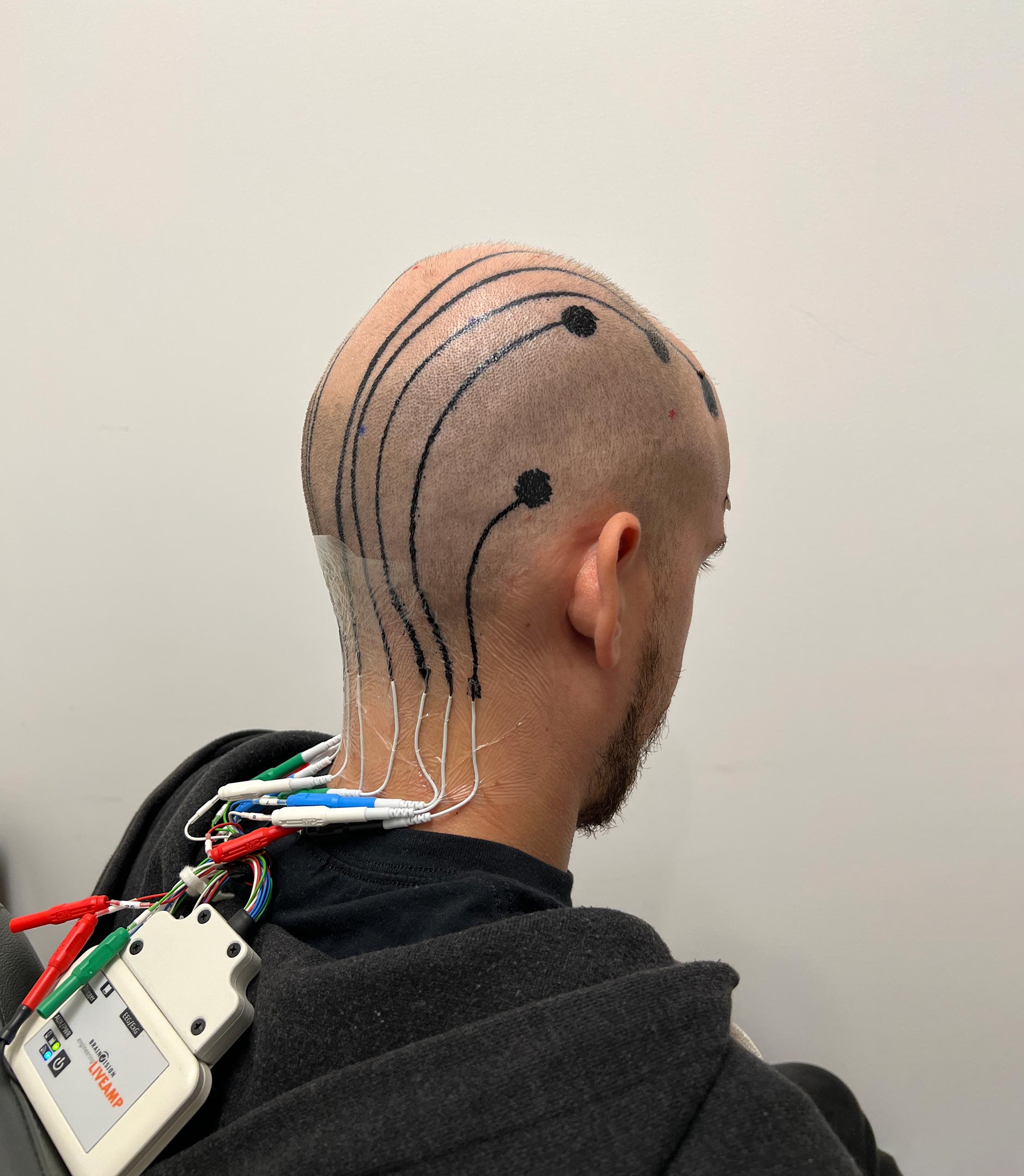
Researchers have developed a liquid ink that can be printed directly onto the scalp to monitor brain activity, offering a less intrusive alternative to traditional EEG setups.
This ink enables the creation of e-tattoos that accurately track brainwaves and maintain connectivity over extended periods. These innovations could drastically change the application of brain-computer interface technologies, making them more comfortable and efficient for users.
Innovative Liquid Ink for Brain Activity Monitoring
For the first time, scientists have developed a groundbreaking liquid ink that can be printed directly onto a patient’s scalp to monitor brain activity. Published on December 2 in the journal Cell Biomaterials, this innovative technology presents a simpler, more efficient alternative to traditional methods for tracking brainwaves and diagnosing neurological conditions. It also holds significant promise for advancing non-invasive brain-computer interface technologies.
“Our innovations in sensor design, biocompatible ink, and high-speed printing pave the way for future on-body manufacturing of electronic tattoo sensors, with broad applications both within and beyond clinical settings,” says Nanshu Lu, co-corresponding author and researcher at the University of Texas at Austin.
Revolutionizing EEG With E-Tattoos
Electroencephalography (EEG) is an important tool for diagnosing a variety of neurological conditions, including seizures, brain tumors, epilepsy, and brain injuries. During a traditional EEG test, technicians measure the patient’s scalp with rulers and pencils, marking over a dozen spots where they will glue on electrodes, which are connected to a data-collection machine via long wires to monitor the patient’s brain activity. This setup is time consuming and cumbersome, and it can be uncomfortable for many patients, who must sit through the EEG test for hours.
Lu and her team have been pioneering the development of small sensors that track bodily signals from the surface of human skin, a technology known as electronic tattoos, or e-tattoos. Scientists have applied e-tattoos to the chest to measure heart activities, on muscles to measure how fatigued they are, and even under the armpit to measure components of sweat.
Overcoming Challenges
In the past, e-tattoos were usually printed on a thin layer of adhesive material before being transferred onto the skin, but this was only effective on hairless areas.
“Designing materials that are compatible with hairy skin has been a persistent challenge in e-tattoo technology,” Lu says. To overcome this, the team designed a type of liquid ink made of conductive polymers. The ink can flow through hair to reach the scalp, and once dried, it works as a thin-film sensor, picking up brain activity through the scalp.
Using a computer algorithm, the researchers can design the spots for EEG electrodes on the patient’s scalp. Then, they use a digitally controlled inkjet printer to spray a thin layer of the e-tattoo ink on to the spots. The process is quick, requires no contact, and causes no discomfort in patients, the researchers said.
Comparing E-Tattoos and Traditional EEG
The team printed e-tattoo electrodes onto the scalps of five participants with short hair. They also attached conventional EEG electrodes next to the e-tattoos. The team found that the e-tattoos performed comparably well at detecting brainwaves with minimal noise.
After six hours, the gel on the conventional electrodes started to dry out. Over a third of these electrodes failed to pick up any signal, although most the remaining electrodes had reduced contact with the skin, resulting in less accurate signal detection. The e-tattoo electrodes, on the other hand, showed stable connectivity for at least 24 hours.
Additionally, researchers tweaked the ink’s formula and printed e-tattoo lines that run down to the base of the head from the electrodes to replace the wires used in a standard EEG test. “This tweak allowed the printed wires to conduct signals without picking up new signals along the way,” says co-corresponding author Ximin He of the University of California, Los Angeles.
The team then attached much shorter physical wires between the tattoos to a small device that collects brainwave data. The team said that in the future, they plan to embed wireless data transmitters in the e-tattoos to achieve a fully wireless EEG process.
Potential Impact on Brain-Computer Interface Devices
“Our study can potentially revolutionize the way non-invasive brain-computer interface devices are designed,” says co-corresponding author José Millán of the University of Texas at Austin. Brain-computer interface devices work by recording brain activities associated with a function, such as speech or movement, and use them to control an external device without having to move a muscle.
Currently, these devices often involve a large headset that is cumbersome to use. E-tattoos have the potential to replace the external device and print the electronics directly onto a patient’s head, making brain-computer interface technology more accessible, Millán says.
Reference: “On-scalp printing of personalized electroencephalography e-tattoos” by Luize Scalco de Vasconcelos, Yichen Yan, Pukar Maharjan, Satyam Kumar, Minsu Zhang, Bowen Yao, Hongbian Li, Sidi Duan, Eric Li, Eric Williams, Sandhya Tiku, Pablo Vidal, R. Sergio Solorzano-Vargas, Wen Hong, Yingjie Du, Zixiao Liu, Fumiaki Iwane, Charles Block, Andrew T. Repetski, Philip Tan, Pulin Wang, Martín G. Martín, José del R. Millán, Ximin He and Nanshu Lu, 2 December 2024, Cell Biomaterials.
DOI: 10.1016/j.celbio.2024.100004
Never miss a breakthrough: Join the SciTechDaily newsletter.
Follow us on Google and Google News.