
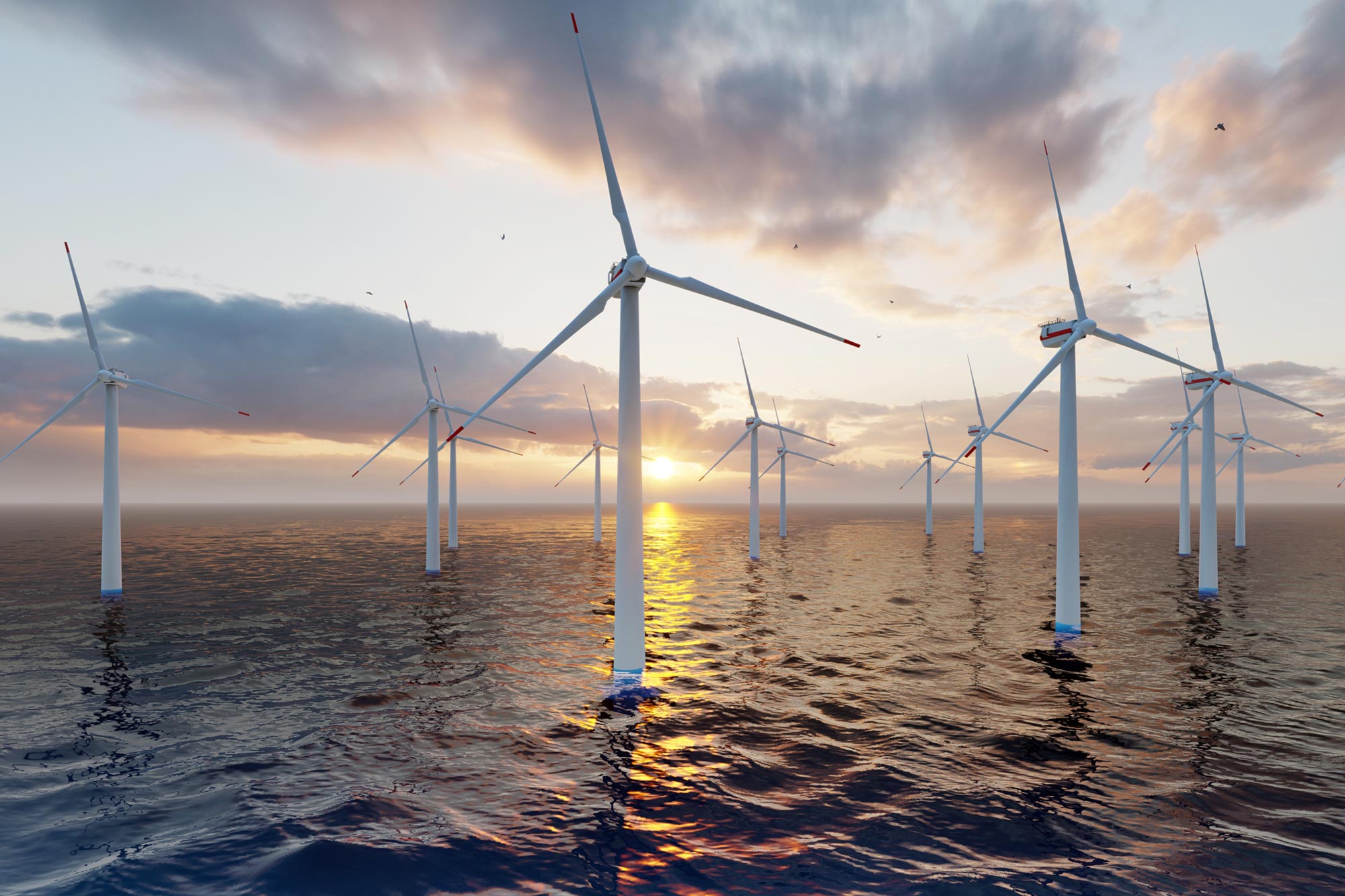
Offshore wind farms are changing sediment flow and carbon storage in the North Sea, with major impacts in the German Bight.
Offshore wind energy is central to the European Union’s renewable strategy, with plans to boost North Sea capacity more than tenfold by 2050.
New research from Helmholtz-Zentrum Hereon shows that expanding wind farms can significantly change how sediments move and settle over large areas and long periods. The German Bight appears to be especially affected. The findings are published in Nature Communications Earth & Environment.
Particles in the North Sea are constantly in motion. They come from seabed material stirred up by waves and currents, as well as sediments carried in from the Atlantic Ocean through the English Channel and from rivers. These particles repeatedly settle and are stirred up again until they eventually collect as mud in calmer waters. Offshore wind turbines act as obstacles both above and below the surface. They influence how the water layers form and reduce current speeds across wide parts of the sea.
Wind Farms Alter Ocean Dynamics
These changes play a key role in determining where mud and organic material travel and settle. Researchers at Hereon found that existing wind farms are already shifting sediment distribution across the North Sea. Each year, this redistribution involves as much as 1.5 million tons of mud and the carbon it contains.
A portion of these sediments comes from the remains of marine plants and animals. This material includes particulate organic carbon (POC), which sinks to the seafloor and can remain stored for centuries. Because of this, the seafloor acts as a carbon sink, helping oceans capture and store carbon and reduce the impacts of climate change.
Modeling Sediment Redistribution and Carbon Storage
To study these processes, the team developed a new computer model that integrates atmospheric conditions, waves, ocean currents, and sediment transport in the North Sea. The model builds on earlier Hereon research into how offshore turbines affect air and water movement.
“Our simulations suggest that these amounts will accumulate increasingly over the coming decades as offshore wind farms expand. This could affect the long-term functioning of the ecosystem and carbon storage in the North Sea,” says the study’s lead author, Jiayue Chen, from the Hereon Institute of Coastal Systems – Analysis and Modeling. Notably, about 52 percent of the total sediment redistribution occurs in the German Bight.
“This highlights this region as particularly affected.” As a next step, the researchers plan to investigate how these changes specifically affect particularly sensitive coastal areas like the Wadden Sea, which relies on a continuous supply of sediment to compensate for rising sea levels. They are also examining how these effects influence the role of the ocean as a carbon sink.
“With an improved understanding of sediment distribution and carbon storage in the North Sea, we can assess long-term risks to coastal stability, navigational safety in shipping, and the functioning of ecosystems in the German Bight,” says Jiayue Chen. “Our findings provide a valuable foundation for the sustainable expansion of offshore wind energy and help decision-makers in politics, business, and industry to plan new wind farms in an environmentally friendly way.”
Reference: “Sediment transport pathways and organic carbon burial impacted by offshore wind farms in shelf seas” by Jiayue Chen, Nils Christiansen, Lucas Porz, Bo Miao, Mengyao Ma, Corinna Schrum and Wenyan Zhang, 14 March 2026, Communications Earth & Environment.
DOI: 10.1038/s43247-026-03390-6
Never miss a breakthrough: Join the SciTechDaily newsletter.
Follow us on Google and Google News.
7 Comments
Stupidest ,worst idea in the history of the United States but look who was president brain dead Biden
More Big Fossil lies
thanks for this
When your local power company makes plans, they contract for energy delivery months in advance. They have to contract production and transmission, to get it to your local grid. It’s produced and there, and paid for whether it’s used at the moment. There is no storage on the grid. There is no viable option today. Electricity distribution is immediate demand/supply. When your wind stops, all a sudden, the back-up has to be there, right now. So, it is, in the form of your conventional, reliable source you contracted for months ago. That’s why wind power is redundant, almost net useless production. I learned that from our energy customer as a former wind farm manager.
More reason to understand disruption of ocean dynamics at scale. Wind farms were a disaster and a mistake, as is the blindness in the idea to mine nodules from the ocean floor. We are only at the beginning of a disaster that might upend the actual production of sea life, and fisheries as we have cone to depend upon it. Alas.
The article didn’t say that the impact was positive or negative — only that more study was needed. It could very well be that more sediment is deposited, much of which is carbon, so it could be good. Let’s wait to see what the science says, before we condemn offshore wind. And we need to remember that the power generated is clean and displaces more dirty fossil fuels.
Interestingly, you suggest, “Let’s wait to see what the science says” but then assert that “the power generated is clean and displaces more dirty fossil fuels.” Which is it? Do we have all the answers or should we be skeptical of the claims that advocate for major changes based on things that need more study?