

Close Menu
    Facebook X (Twitter) Instagram
    SciTechDaily
    • Biology
    • Chemistry
    • Earth
    • Health
    • Physics
    • Science
    • Space
    • Technology
    Facebook X (Twitter) Pinterest YouTube RSS
    SciTechDaily
    Home»Health»Why Women Feel More Pain: Groundbreaking Study Reveals Key Biological Clue
    Health

    Why Women Feel More Pain: Groundbreaking Study Reveals Key Biological Clue

    By Kelly Johnston, University of CalgaryMarch 29, 20251 Comment3 Mins Read
    Facebook Twitter Pinterest Telegram LinkedIn WhatsApp Email Reddit
    Share
    Facebook Twitter LinkedIn Pinterest Telegram Email Reddit
    Fibromyalgia Chronic Pain Concept
    Women may feel more chronic pain due to different immune responses and higher leptin levels, highlighting the need for sex-specific treatments.

    Researchers at the University of Calgary have uncovered biological differences between the sexes in how chronic pain is experienced.

    A new study led by Dr. Tuan Trang, a professor at the University of Calgary, offers insight into why women are disproportionately affected by chronic pain. According to a 2019 report from the Canadian Pain Task Force, chronic pain is more common in females across all age groups, including children, compared to males.

    “Both males and females experience pain, but the biological pathways they use are different,” explains Trang, who holds appointments in the Faculty of Veterinary Medicine and the Cumming School of Medicine. “Our study identifies a unique immune-cell-driven process that differs between the sexes.”
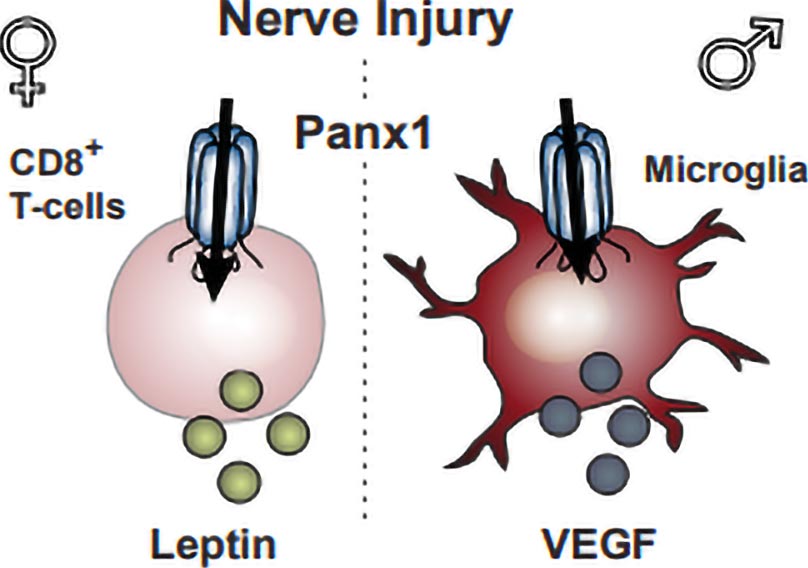
    Nerve Injury Pain Graphic
    In female rodents, researchers found injury to a nerve releases leptin, a hormone which is associated with heightened pain sensitivity. Credit: Fan et al., Neuron 2025

    Neuropathic Pain and Allodynia Explained

    Published in Neuron, the research focused on neuropathic pain, a type of pain caused by damage to the nerves or nervous system. One particularly difficult-to-treat symptom of neuropathic pain is allodynia, where non-painful stimuli like light touch, mild temperatures, or even clothing can cause severe pain.

    Using rodent models, the researchers found that in both male and female animals, pain signals travel through pannexin 1 (Panx1) channels. However, the type of immune cell involved in that signaling differs by sex. In females, activating Panx1 also triggers the release of leptin, a hormone linked to increased pain sensitivity, helping explain why women may be more vulnerable to chronic pain.

    Tuan Trang
    Tuan Trang in his lab at the Cumming School of Medicine, University of Calgary. Credit: Riley Brandt, University of Calgary

    “Injury to a nerve can be debilitating,” says Trang. “We know that a lot of preclinical research has been in male subjects. Consequently, treatments were often developed from a male-based understanding and may not be very effective in females.”

    Leptin’s Link to Female Pain Sensitivity

    Heightened levels of leptin in females experiencing chronic pain have been recorded in studies before. Trang notes that as far back as the 1980s, researchers who were working with human blood samples found that female patients experiencing chronic pain had higher levels of leptin in their blood than those who did not have chronic pain.

    “In the clinic, we’ve known for many years that women are more likely than men to suffer from chronic pain, and it’s often hard to know why some people respond to treatment and others don’t,” says Dr. Lori Montgomery, MD ‘03, pain clinician and clinical associate professor at the CSM. “Both sex and gender are important factors that need a lot more investigation, but this latest research might prove to be one of the ways that we can personalize treatment for patients so that it’s more likely to be effective.

    Reference: “Divergent sex-specific pannexin-1 mechanisms in microglia and T cells underlie neuropathic pain” by Churmy Y. Fan, Brendan B. McAllister, Sierra Stokes-Heck, Erika K. Harding, Aliny Pereira de Vasconcelos, Laura K. Mah, Lucas V. Lima, Nynke J. van den Hoogen, Sarah F. Rosen, Boram Ham, Zizhen Zhang, Hongrui Liu, Franz J. Zemp, Regula Burkhard, Markus B. Geuking, Douglas J. Mahoney, Gerald W. Zamponi, Jeffrey S. Mogil, Shalina S. Ousman and Tuan Trang, 31 January 2025, Neuron.
    DOI: 10.1016/j.neuron.2025.01.005

    Funding: Canadian Institutes of Health Research, Natural Sciences and Engineering Research Council of Canada, Donna and Rod Evans

    Never miss a breakthrough: Join the SciTechDaily newsletter.
    Follow us on Google and Google News.

    Chronic Pain Immune Cells Nerve Cells Neuroscience University of Calgary
    Share. Facebook Twitter Pinterest LinkedIn Email Reddit

    Related Articles

    New Non-Addictive Compound Alleviates Pain Without Sedation

    Antipsychotic Drug Opens New Pathway To Beat Chronic Pain

    Treating Chronic Pain With Sound Plus Electrical Body Stimulation

    Generic Drug Hydroxychloroquine Delays Disability for Least Treatable Form of Multiple Sclerosis

    Can a Dangerous Toxin From Anthrax Microbes Quench Pain?

    Natural Painkiller: New Research Advances the Treatment of Chronic Pain

    Scientists Find New Cell Type Implicated in Chronic Pain and Inflammation – Precise, New Target for Treatment

    Pioneering Sensory Neuron Replication: New Technique to Fast-Track Pain Research

    Japanese Researchers Reveal New Mechanism of Pain Control

    1 Comment

    1. Robert Welch on March 29, 2025 3:39 pm

      Because men are a pain in the….

      Reply
    Leave A Reply Cancel Reply

    • Facebook
    • Twitter
    • Pinterest
    • YouTube

    Don't Miss a Discovery

    Subscribe for the Latest in Science & Tech!

    Trending News

    Wasp Colonies Explode Into Violence After Losing Their Queen

    Scientists Create “Living Plastic” That Self-Destructs in Just Six Days

    Your Blood May Carry a 700-Million-Year-Old Secret

    Scientists Discover Some “Zombie Cells” May Actually Help You Live Longer

    Earth May Be Seeding Venus With Life, According to New Research

    What Scientists Found Inside a 117-Year-Old Woman Reveals New Clues to Long Life

    Scientists Discover Mysterious Creature Living in the Great Salt Lake – and It Exists Nowhere Else on Earth

    It’s Alive? Surprising Discovery Changes What We Know About Fog

    Follow SciTechDaily
    • Facebook
    • Twitter
    • YouTube
    • Pinterest
    • Newsletter
    • RSS
    SciTech News
    • Biology News
    • Chemistry News
    • Earth News
    • Health News
    • Physics News
    • Science News
    • Space News
    • Technology News
    Recent Posts
    • A Psychologist Explains Why 40% of People Are Avoiding the News
    • Scientists Discover Alzheimer’s-Linked Proteion’s Surprising Role in Making Memories Last
    • Vitamin D Drug Shows Surprising Promise Against One of the Deadliest Cancers
    • Scientists Crack Major Ammonia Problem With a Platinum Catalyst Breakthrough
    • MIT Engineers Solve a Major Lidar Problem That Has Stumped Researchers for Years
    Copyright © 1998 - 2026 SciTechDaily. All Rights Reserved.
    • Science News
    • About
    • Contact
    • Editorial Board
    • Privacy Policy
    • Terms of Use

    Type above and press Enter to search. Press Esc to cancel.