
Close Menu
    Facebook X (Twitter) Instagram
    SciTechDaily
    • Biology
    • Chemistry
    • Earth
    • Health
    • Physics
    • Science
    • Space
    • Technology
    Facebook X (Twitter) Pinterest YouTube RSS
    SciTechDaily
    Home»Space»Hubble Telescope Views Light Expanding from an Exploded Star
    Space

    Hubble Telescope Views Light Expanding from an Exploded Star

    By NASA's Goddard Space Flight CenterNovember 10, 2017No Comments3 Mins Read
    Facebook Twitter Pinterest Telegram LinkedIn WhatsApp Email Reddit
    Share
    Facebook Twitter LinkedIn Pinterest Telegram Email Reddit
    Hubble Views Light Echo Expanding from Exploded Star
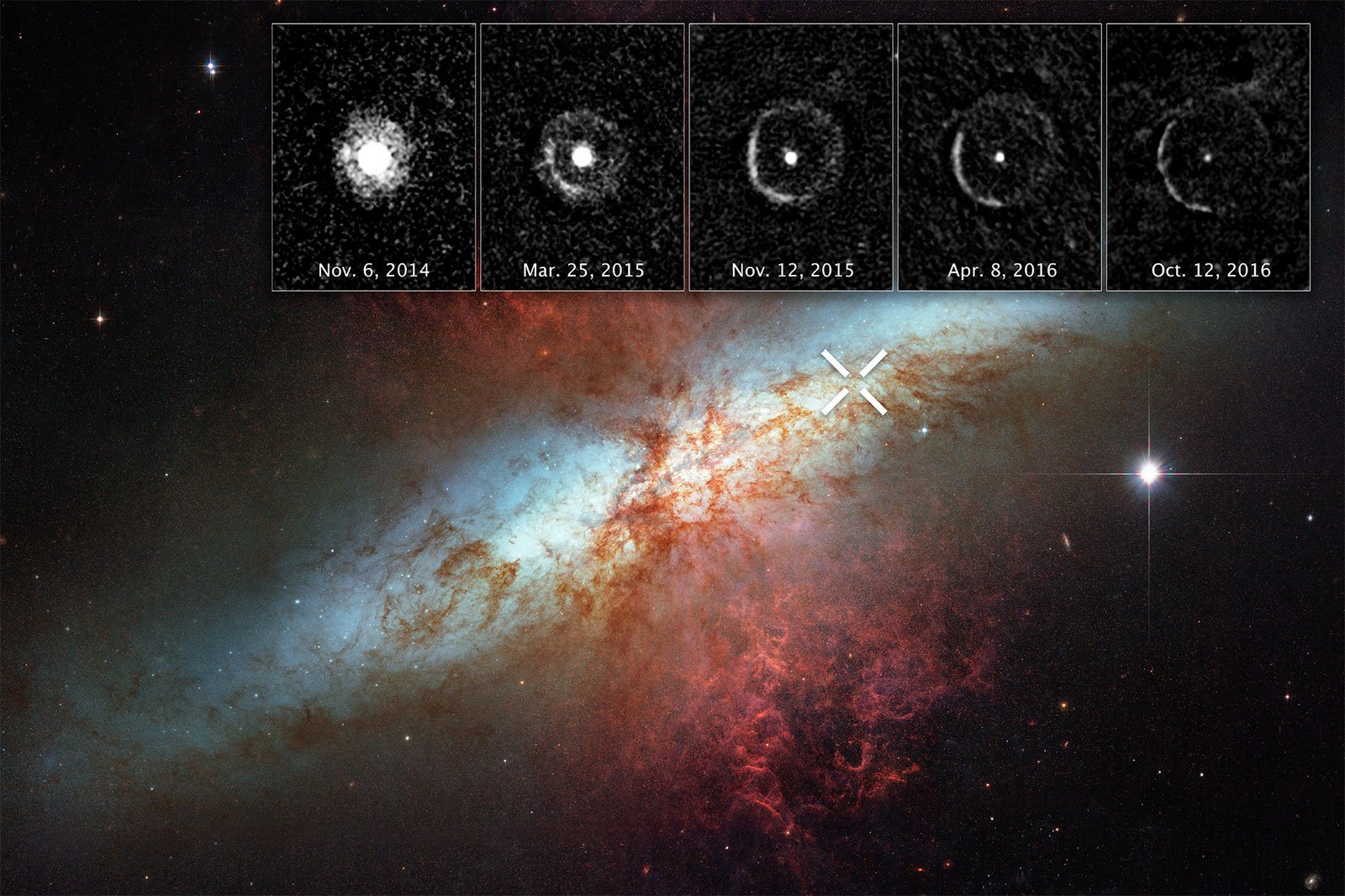
    Over a period of two and a half years, NASA’s Hubble Space Telescope observed the “light echo” of supernova SN 2014J in galaxy M82, located 11.4 million light-years away. Credit: NASA, ESA, and Y. Yang (Texas A&M University and Weizmann Institute of Science, Israel), Acknowledgment: M. Mountain (AURA) and The Hubble Heritage Team (STScI/AURA)

    The Hubble Space Telescope views light from a supernova explosion in the nearby starburst galaxy M82 is reverberating off a huge dust cloud in interstellar space.

    The supernova, called SN 2014J, occurred at the upper right of M82, and is marked by an “X.” The supernova was discovered on January 21, 2014.

    The inset images at top reveal an expanding shell of light from the stellar explosion sweeping through interstellar space, called a “light echo.” The images were taken 10 months to nearly two years after the violent event (November 6, 2014 to October 12, 2016). The light is bouncing off a giant dust cloud that extends 300 to 1,600 light-years from the supernova and is being reflected toward Earth.

    SN 2014J is classified as a Type Ia supernova and is the closest such blast in at least four decades. A Type Ia supernova occurs in a binary star system consisting of a burned-out white dwarf and a companion star. The white dwarf explodes after the companion dumps too much material onto it.

    The image of M82 reveals a bright blue disk, webs of shredded clouds, and fiery-looking plumes of glowing hydrogen blasting out of its central regions.

    Close encounters with its larger neighbor, the spiral galaxy M81, is compressing gas in M82 and stoking the birth of multiple star clusters. Some of these stars live for only a short time and die in cataclysmic supernova blasts, as shown by SN 2014J.

    Located 11.4 million light-years away, M82 appears high in the northern spring sky in the direction of the constellation Ursa Major, the Great Bear. It is also called the “Cigar Galaxy” because of the elliptical shape produced by the oblique tilt of its starry disk relative to our line of sight.

    The M82 image was taken in 2006 by the Hubble Space Telescope’s Advanced Camera for Surveys. The inset images of the light echo also were taken by the Advanced Camera for Surveys.

    The science team members are Y. Yang of Texas A&M University, College Station, and the Weizmann Institute of Science, Rehovot, Israel; P.J. Brown of Texas A&M University, College Station; L. Wang of Texas A&M University, College Station, and Purple Mountain Observatory, China; D. Baade, A. Cikota, F. Patat, and J. Spyromilio of the European Organization for Astronomical Research in the Southern Hemisphere, Garching, Germany; M. Cracraft and W.B. Sparks of the Space Telescope Science Institute, Baltimore, Maryland; P.A. Hoflich of Florida State University, Tallahassee; J. Maund and H.F. Stevance of the University of Sheffield, U.K.; X. Wang of Tsinghua University, Beijing Shi; and J.C. Wheeler of the University of Texas at Austin.

    Never miss a breakthrough: Join the SciTechDaily newsletter.
    Follow us on Google and Google News.

    Astronomy Hubble Space Telescope NASA Goddard Space Flight Center Supernova
    Share. Facebook Twitter Pinterest LinkedIn Email Reddit

    Related Articles

    Hubble Captures the Unusual Shredded Remains of a Massive Cosmic Explosion

    Bizarre, Metallic Star Spotted Hurtling Out of the Milky Way at 2 Million Miles an Hour

    The Hubble Deep Field: Looking Back In Time [Video]

    Hubble Finds First Evidence of Water Vapor in the Atmosphere of Jupiter’s Moon Ganymede

    Cosmic Mystery Deepens: Oddball “See-Through” Galaxy’s Missing Dark Matter

    NASA’s Roman Mission: Using Exploding Stars to Solve the Biggest Cosmic Mysteries

    Magnetic Monsters: Hubble Tracks Down Location of Mysterious Radio Signals From Intergalactic Space

    Astronomers Puzzled After Hubble View of Torrential Outflows From Infant Stars Blows Hole in Current Theories

    Stunning Hubble Images Capture Changing Seasons in Saturn’s Vast and Turbulent Atmosphere

    Leave A Reply Cancel Reply

    • Facebook
    • Twitter
    • Pinterest
    • YouTube

    Don't Miss a Discovery

    Subscribe for the Latest in Science & Tech!

    Trending News

    New Research Challenges Common Exercise Advice for Bone Health

    Avoiding These 3 Health Risks in Midlife Linked to 13 More Years Without Dementia

    Where Were All the Tiny Dinosaurs? Scientists May Finally Have an Answer

    Humanity May Soon Have the Technology To Reach Other Star Systems

    Popular GLP-1 Weight-Loss Drugs Linked to 30% Lower Breast Cancer Risk

    A Deadly Fungus Has Found the Perfect Hiding Place: Human Hair Follicles

    Ancient Neanderthal DNA May Give Some People More Muscle

    How a Low-Fat Vegan Diet Helped People Lose Weight Without Counting Calories

    Follow SciTechDaily
    • Facebook
    • Twitter
    • YouTube
    • Pinterest
    • Newsletter
    • RSS
    SciTech News
    • Biology News
    • Chemistry News
    • Earth News
    • Health News
    • Physics News
    • Science News
    • Space News
    • Technology News
    Recent Posts
    • Scientists Reprogram How Light Travels in Just 74 Femtoseconds
    • Scientists Uncover New Clues to a Long-Standing Bonnethead Shark Mystery
    • Rewriting History: Researchers Uncover a Forgotten Amazon Civilization That May Have Housed 3 Million People
    • Why Arthritis Can Come Back Stronger After Cancer Immunotherapy
    • Dormant Breast Cancer Cells May Hide Inside Protective Cellular “Shields”
    Copyright © 1998 - 2026 SciTechDaily. All Rights Reserved.
    • Science News
    • About
    • Contact
    • Editorial Board
    • Privacy Policy
    • Terms of Use

    Type above and press Enter to search. Press Esc to cancel.