
Close Menu
    Facebook X (Twitter) Instagram
    SciTechDaily
    • Biology
    • Chemistry
    • Earth
    • Health
    • Physics
    • Science
    • Space
    • Technology
    Facebook X (Twitter) Pinterest YouTube RSS
    SciTechDaily
    Home»Health»Combination Antibody Immunotherapy Targets Cancer Resistance
    Health

    Combination Antibody Immunotherapy Targets Cancer Resistance

    By Ziba Kashef, Yale UniversityNovember 21, 2017No Comments2 Mins Read
    Facebook Twitter Pinterest Telegram LinkedIn WhatsApp Email Reddit
    Share
    Facebook Twitter LinkedIn Pinterest Telegram Email Reddit
    New Combination Immunotherapy Targets Cancer Resistance
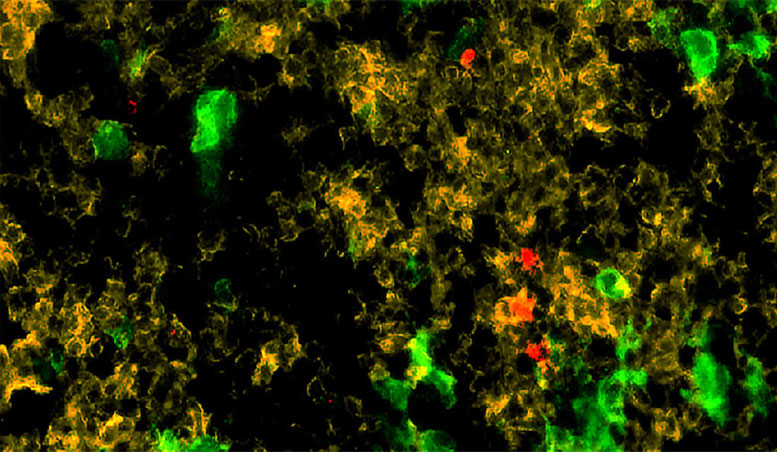
    Image shows infiltration of transplanted human cancer cells (yellow/orange) by two myeloid cell subsets (red and green) in a mouse model treated with combination immunotherapy.

    Cancer immunotherapy drugs have had notable but limited success because in many cases, tumors develop resistance to treatment. But researchers at Yale and Stanford have identified an experimental antibody that overcomes this problem by targeting a wider range of immune cells linked to tumor growth.

    Existing cancer immunotherapies act on only a fraction of the immune cells implicated in the disease. In this study, the research team developed an antibody, KWAR23, to block a different set of immune cells known as myeloid cells. Many of these cells infiltrate tumors, triggering tumor growth, inflammation, and resistance to treatment.

    In both cell culture and in mouse models with human cell membrane proteins, the research team found that the antibody blocked a protein that would otherwise limit the tumor-killing ability of myeloid cells. In combination with an approved cancer immunotherapy drug, the antibody significantly limited tumor cell growth.

    The finding demonstrates a promising combination therapeutic approach to more effectively fight tumors, the researchers said. It will also lead to further research to examine whether the antibody is also effective in reducing more advanced and metastatic cancers.

    Reference: “Anti-SIRPα antibody immunotherapy enhances neutrophil and macrophage antitumor activity” by Nan Guo Ring, Dietmar Herndler-Brandstetter, Kipp Weiskopf, Liang Shan, Jens-Peter Volkmer, Benson M. George, Melanie Lietzenmayer, Kelly M. McKenna, Tejaswitha J. Naik, Aaron McCarty, Yunjiang Zheng, Aaron M. Ring, Richard A. Flavell and Irving L. Weissman, 13 October 2017, PNAS.
    DOI: 10.1073/pnas.1710877114

    Never miss a breakthrough: Join the SciTechDaily newsletter.
    Follow us on Google and Google News.

    Cancer Immunobiology Immunotherapy Medicine Yale University
    Share. Facebook Twitter Pinterest LinkedIn Email Reddit

    Related Articles

    New Antibody-Based Treatment Targets Colorectal Cancer

    Immune Therapy Drug Prolongs Survival in Advanced Lung Cancer Patients

    New Strategy to Better Protect Cancer Patients from the Flu

    Researchers May Have Pinpointed a Strategy for Eliminating Latent HIV

    Antifreeze Protein in Ticks Could Lead to New Antibiotics for Humans

    Neurologists Discover New Method to Fight Glioblastomas

    Yale Researchers Discover New Cancer Cell Vulnerability

    Combination of Immune Stimulating Antibodies Shows Promising Results Against Advanced Melanoma

    New Antibody Drug Boosts the Immune System’s Capacity to Fight Cancer

    Leave A Reply Cancel Reply

    • Facebook
    • Twitter
    • Pinterest
    • YouTube

    Don't Miss a Discovery

    Subscribe for the Latest in Science & Tech!

    Trending News

    NASA’s Voyager 1 Is About to Become the First Spacecraft One Light-Day From Earth

    A Woman Who Lived 30,000 Years Ago Is Changing What We Know About Ice Age Europe

    A Rare Radioactive Element Reveals a Hidden Secret About the Heaviest Atoms

    Breakthrough Cancer Treatment Wipes Out Deadly Brain Tumors in Every Mouse Tested

    Something Remarkable Is Happening to Dogs Living Near Chernobyl’s Nuclear Plant

    Hubble Uncovers a Mysterious 93-Billion-Mile Structure Hiding in a Nearby Star System

    Earth’s Oceans Were Slowly Suffocating Millions of Years Before a Devastating Mass Extinction

    Why Are Men Twice As Likely To Develop Parkinson’s? Scientists Discover a Hidden Clue in the Brain

    Follow SciTechDaily
    • Facebook
    • Twitter
    • YouTube
    • Pinterest
    • Newsletter
    • RSS
    SciTech News
    • Biology News
    • Chemistry News
    • Earth News
    • Health News
    • Physics News
    • Science News
    • Space News
    • Technology News
    Recent Posts
    • Scientists Engineer Rice That Fights Back Against a Devastating Crop Disease
    • Deep-Sea Scientists Capture Extraordinary 4K Footage of a Fish With a See-Through Head
    • Scientists Find That Older Brains React Very Differently to a Night of Poor Sleep
    • A Hidden Substance in Drinking Water May Be Linked to Heart Problems in Children
    • Scientists Find a Clever Way to Read Quantum Information Without Destroying It
    Copyright © 1998 - 2026 SciTechDaily. All Rights Reserved.
    • Science News
    • About
    • Contact
    • Editorial Board
    • Privacy Policy
    • Terms of Use

    Type above and press Enter to search. Press Esc to cancel.