
Close Menu
    Facebook X (Twitter) Instagram
    SciTechDaily
    • Biology
    • Chemistry
    • Earth
    • Health
    • Physics
    • Science
    • Space
    • Technology
    Facebook X (Twitter) Pinterest YouTube RSS
    SciTechDaily
    Home»Health»Yale Researchers Discover New Cancer Cell Vulnerability
    Health

    Yale Researchers Discover New Cancer Cell Vulnerability

    By Yale UniversityJuly 21, 20141 Comment2 Mins Read
    Facebook Twitter Pinterest Telegram LinkedIn WhatsApp Email Reddit
    Share
    Facebook Twitter LinkedIn Pinterest Telegram Email Reddit
    Researchers Discover New Cancer Cell Vulnerability
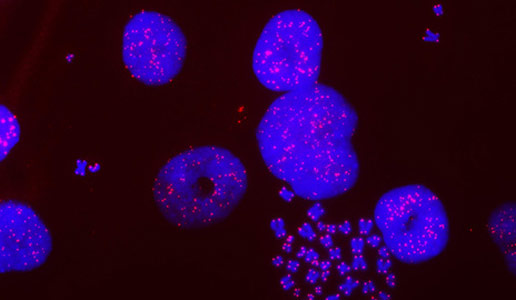
    Chromosomes (in blue) and their telomores (in red). Credit: Narenda Wajepeyee, Yale School of Medicine

    New research from Yale University found that simultaneous inhibition of both telomerase and p21 inhibited tumor growth in mice.

    Yale School of Medicine and Yale Cancer Center researchers have uncovered a genetic vulnerability of cancer cells that express telomerase — an enzyme that drives their unchecked growth — and showed that telomerase-expressing cells depend upon a gene named p21 for their survival.

    The authors found that simultaneous inhibition of both telomerase and p21 inhibited tumor growth in mice. The telomerase enzyme is overexpressed in over 90% of human cancers, but not in normal cells, and expression of telomerase is necessary to initiate and promote cancer growth. In this study, the Yale team, led by first author Romi Gupta and corresponding author Narendra Wajapeyee of the Department of Pathology, showed how new pharmacological drug combinations can be applied to simultaneously target both telomerase and p21 to induce cell death in telomerase-expressing cancer cells.

    Finally, the authors also showed that their approach is also applicable for p53 mutant cancers if telomerase and p21 inhibition are combined with pharmacological restoration of p53 tumor suppressor activity. The study, which could open doors to novel therapies for telomerase inhibition, appears in the Proceedings of the National Academy of Sciences.

    Reference: “Synergistic tumor suppression by combined inhibition of telomerase and CDKN1A” by Romi Gupta, Yuying Dong, Peter D. Solomon, Hiromi I. Wettersten, Christopher J. Cheng, JIn-Na Min, Jeremy Henson, Shaillay Kumar Dogra, Sung H. Hwang, Bruce D. Hammock, Lihua J. Zhu, Roger R. Reddel, W. Mark Saltzman, Robert H. Weiss, Sandy Chang, Michael R. Green and Narendra Wajapeyee, 14 July 2014, PNAS.
    DOI:  10.1073/pnas.1411370111


    Never miss a breakthrough: Join the SciTechDaily newsletter.
    Follow us on Google and Google News.

    Cancer Medicine Telomerase Yale University
    Share. Facebook Twitter Pinterest LinkedIn Email Reddit

    Related Articles

    Combination Antibody Immunotherapy Targets Cancer Resistance

    New Research Shows Cellular Clean-Up Can Also Sweep Away Forms of Cancer

    Crystallizing Discovery Indicates Potential for New Types of Cancer Drugs

    Researchers Pinpoint Molecular Mechanism Behind Breast Cancer Risk

    Yale Researchers Reveal Genes Behind Aggressive Ovarian and Endometrial Cancers

    Yale Study Shows Key Protein In Pancreatic Cancer Growth May Also Be Its Undoing

    Immune Therapy Drug Prolongs Survival in Advanced Lung Cancer Patients

    New Strategy to Better Protect Cancer Patients from the Flu

    A New Paradigm for Cancer Research, One That Focuses on Improving Efficacy and Value

    1 Comment

    1. Madanagopal.V.C. on July 22, 2014 5:00 am

      Telomerase is the tool for longevity and its gradual tapering down over millions of copies,in cell replication ,the cells should suffer a death. This is nothing but a programmed cell death which is very very essential in the embryonic stage and also in scars healing apart from the basic function of telomeres to stunt the growth in evolution slowly moulding the morphology according to the environment and available food. This basic plan would go haywire if induced by some chemicals carcinogenic or radiation,and thereby the telomerase gets produced rapidly increasing unwanted growth in tumours. So it is a right plan to inhibit the production of telomerase apart from killing the cancerous cells by chemo therapy. Thank You.

      Reply
    Leave A Reply Cancel Reply

    • Facebook
    • Twitter
    • Pinterest
    • YouTube

    Don't Miss a Discovery

    Subscribe for the Latest in Science & Tech!

    Trending News

    First-of-Its-Kind Discovery: Homer’s Iliad Found Embedded in a 1,600-Year-Old Egyptian Mummy

    Beyond Inflammation: Scientists Uncover New Cause of Persistent Rheumatoid Arthritis

    A Simple Molecule Could Unlock Safer, Easier Weight Loss

    Scientists Just Built a Quantum Battery That Charges Almost Instantly

    Researchers Unveil Groundbreaking Sustainable Solution to Vitamin B12 Deficiency

    Millions of People Have Osteopenia Without Realizing It – Here’s What You Need To Know

    Researchers Discover Boosting a Single Protein Helps the Brain Fight Alzheimer’s

    World-First Study Reveals Human Hearts Can Regenerate After a Heart Attack

    Follow SciTechDaily
    • Facebook
    • Twitter
    • YouTube
    • Pinterest
    • Newsletter
    • RSS
    SciTech News
    • Biology News
    • Chemistry News
    • Earth News
    • Health News
    • Physics News
    • Science News
    • Space News
    • Technology News
    Recent Posts
    • After Decades, MIT Researchers Capture the First 3D Atomic View of a Mysterious Material
    • Your Favorite Fishing Spot Is Turning Brown – and the Fish Are Changing
    • 380-Million-Year-Old Fish Fossil Reveals Secrets of Life’s First Steps Onto Land
    • Mezcal “Worm” in a Bottle Mystery: DNA Testing Reveals a Surprise
    • Scientists Turn Red Lettuce Green, Unlocking Hidden Nutrients
    Copyright © 1998 - 2026 SciTechDaily. All Rights Reserved.
    • Science News
    • About
    • Contact
    • Editorial Board
    • Privacy Policy
    • Terms of Use

    Type above and press Enter to search. Press Esc to cancel.