
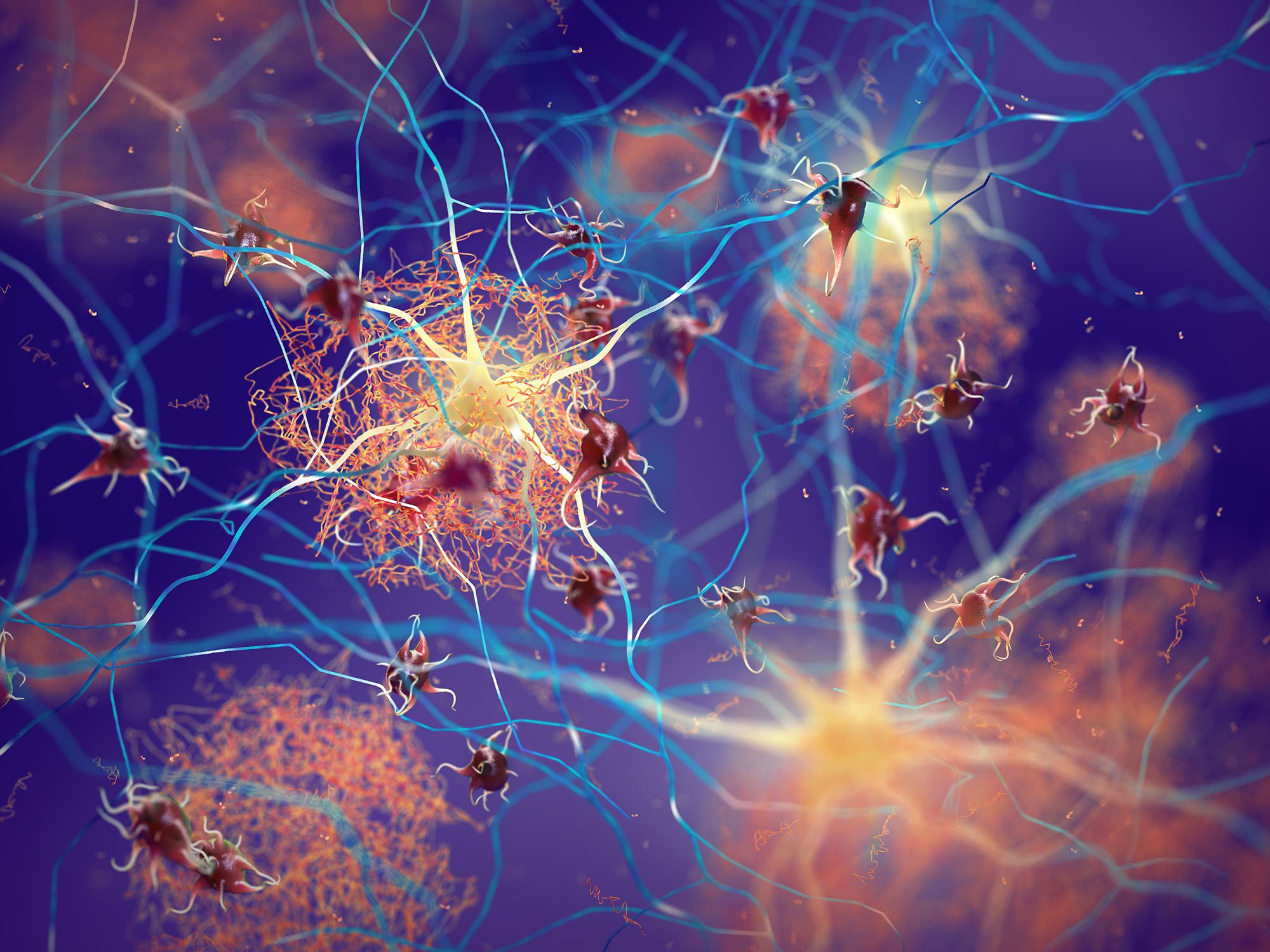
Feeding the animals a high fiber diet reduced Alzheimer ’s-related frailty, including tremors.
The gut houses the body’s largest population of immune cells. A new study from the Buck Institute has revealed that in a mouse model of Alzheimer’s disease (AD), some of these immune cells can migrate along the brain-gut axis, pointing to a possible new therapeutic strategy for the disorder. Published in the journal Cell Reports, the research also shows that providing the mice with a high fiber diet lessened AD-related frailty, including tremors.
“This paper brings the gut immune system to the forefront of neurodegenerative disease pathology,” says Buck associate professor Daniel Winer, MD, an immunologist and co-senior author of the work. “Given its size and the cells’ ability to travel, it makes sense that those immune cells would have the ability to influence larger physiology.”

Buck professor Julie Andersen, PhD, a neuroscientist and co-senior author adds, “As far as we know, this is the deepest investigation of the gut immune system in a model of neurodegenerative disease. We look forward to studying its impact in other diseases including Parkinson’s and multiple sclerosis.”
Migrating immune cells linked to AD
The study was led by postdoctoral fellow Priya Makhijani, PhD, an immunologist with joint appointments in the Winer and Andersen laboratories. She discovered that certain antibody-producing B cells—normally essential for maintaining balance between the microbiome and the gut immune system—were reduced in mice genetically engineered to develop Alzheimer’s disease (AD). Further analysis revealed that these B cells carry a migratory signature. The researchers detected gut-specific B cells and their migration receptors not only in the brain but also in its border region, the meningeal dura mater.
“Remarkably, we found that these immune cells in the brain border which recognize bacteria living in the intestines were accumulating in the AD brain,” Makhijani says.

To explore why immune cells were being depleted from the gut, Makhijani and her colleagues identified the role of a receptor’s binding partner, a chemokine well known for its role in cell migration. This chemokine was produced at higher levels in glial cells, the inflammatory cells of the AD brain. The team also confirmed the migratory signature in human AD brains by analyzing previously published datasets. In collaboration with the University Health Network at the University of Toronto, they carried out blocking experiments using a small molecule drug, pointing to the existence of a new long-range signaling mechanism along the gut-brain axis.
The benefits of a high fiber diet
Makhijani and team found that feeding the animals the anti-inflammatory prebiotic fiber inulin restored balance in the gut of the AD mice. “We found these migrating cells were replenished in the gut and that AD-related frailty, including the tremor trait, was reduced in the animals.” Noting that inulin makes short chain fatty acids and other metabolites that concentrate in the gut and can also circulate systemically, she says the diet improved gut health and reduced chemokine signaling in the brain. “Again, this involved a bi-directional axis,” she says.

Winer notes that while the high fiber diet did not consistently reduce the levels of plaques in the mice’s brain, it did impact overall well-being. “We did an assay involving 31 metrics of aging in these mice. The diet definitely extended their healthspan, giving the animals a better quality of life,” he says, adding, “This project supports the ‘eat your fruits and vegetables’ advice that is featured in nearly every dietary recommendation.”
The big picture
While the study provides a comprehensive characterization of gut immune system changes in a neurological disease, researchers say more work is needed to see if those changes are a response to brain alterations or whether they drive the disease itself. Winer says one possibility is that age-related insults might trigger AD-causing inflammation in the brain, with chemokines signaling the gut immune system for help in dealing with the insult. “In the beginning, the process is likely protective, but over time the gut becomes compromised, setting the stage for more dangerous types of bacteria to flourish, which fuels inflammation throughout the body.”
Makhijani is eager to explore the potential of understanding and/or altering the gut microbiome in the context of disease. “Maybe there is a microbiome that signals an increased risk of neurological disease. Perhaps we’ll be able to identify specific bacteria that set off immune system inflammation. What if we can inhibit the signaling chemokines early versus late in the disease process? Which would be protective for the whole system? This paper provides so many avenues for further exploration.”
Reference: “Amyloid-β-driven Alzheimer’s disease reshapes the colonic immune system in mice” by Priya Makhijani, Taylor R. Valentino, Max Manwaring-Mueller, Rohini Emani, Wei-Chieh Mu, Carlos Galicia Aguirre, Christopher Ryan Tan, Anand Rane, Kenneth A. Wilson, Alexander Kifle, Nan Chen, Huixun Du, Fei Wu, Jenny Hong Yu Ng, Benjamin D. Ambrose, Prasanna Vadhana Ashok Kumaar, Saad Khan, Shawn Winer, Chao Wang, Arthur Mortha, David Furman, Birgit Schilling, Lisa M. Ellerby, Olga L. Rojas, Julie K. Andersen and Daniel A. Winer, 29 August 2025, Cell Reports.
DOI: 10.1016/j.celrep.2025.116109
The work was funded by NIH grant 3RF! AG062280-01S1, NIA T32 AG000266, AG066591, PO1AG06659.
COI disclosure: Daniel Winer is co-founder of Proprion Inc., a company that studies gut immune and related metabolite interventions for aging and related diseases.
Never miss a breakthrough: Join the SciTechDaily newsletter.
Follow us on Google and Google News.