
Close Menu
    Facebook X (Twitter) Instagram
    SciTechDaily
    • Biology
    • Chemistry
    • Earth
    • Health
    • Physics
    • Science
    • Space
    • Technology
    Facebook X (Twitter) Pinterest YouTube RSS
    SciTechDaily
    Home»Health»Circadian Rhythms Control Immune Cells That Clear Away Alzheimer’s Disease Protein
    Health

    Circadian Rhythms Control Immune Cells That Clear Away Alzheimer’s Disease Protein

    By PLOSFebruary 10, 2022No Comments4 Mins Read
    Facebook Twitter Pinterest Telegram LinkedIn WhatsApp Email Reddit
    Share
    Facebook Twitter LinkedIn Pinterest Telegram Email Reddit
    Macrophage Clock
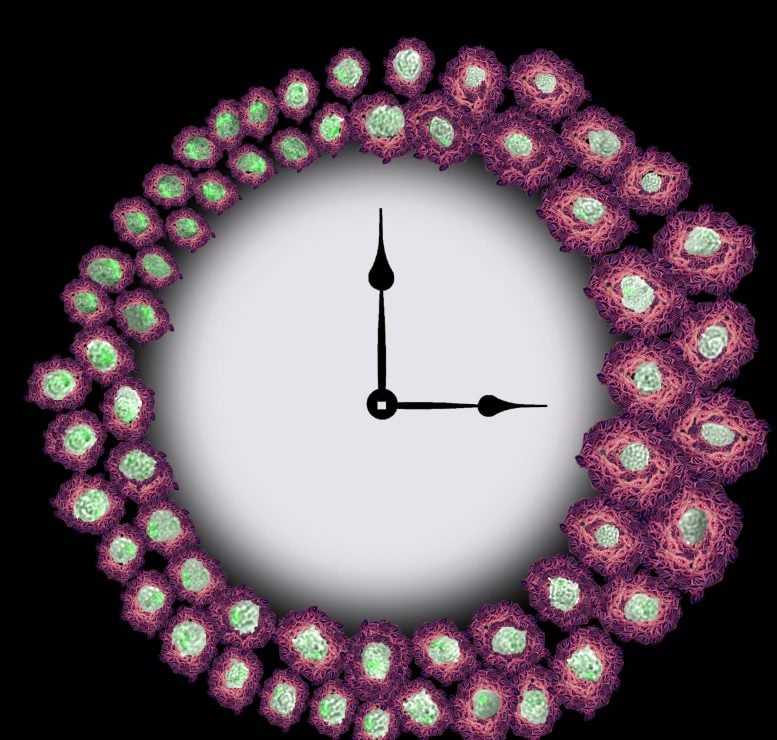
    Image Caption: The image of a clock with brightfield macrophage images around it shows how circadian changes of cell surface heparan sulfate proteoglycans, shown in pink, impedes phagocytosis of fluorescently labeled amyloid-beta, shown in green. As time goes on, and we have a reduction in heparan sulfate proteoglycans, we see an increase in phagocytosis, demonstrated by the bright green cells shown on the left of the clock. This image was made using our fluorescent microscopy cell images with an artistic rendering of the heparan sulfate proteoglycans from the app, Wombo. The clock was made using photoshop and clip art. Credit: Gretchen Clark, made using Wombo (CC-BY 4.0)

    A study reveals that immune cells clearing amyloid-beta in Alzheimer’s patients are influenced by circadian rhythms, suggesting disrupted sleep cycles could affect disease severity and progression.

    Researchers report that the immune cells responsible for clearing away a key protein that builds up in the brains of patients with Alzheimer’s disease operate according to daily circadian rhythms. The discovery, reported by Jennifer Hurley of Rensselaer Polytechnic Institute and colleagues in a new study publishing today (February 10th, 2022) in the journal PLOS Genetics, provides a potential explanation for the link between Alzheimer’s disease and disruptions to a person’s sleep cycle.

    Alzheimer’s disease is known to be associated with disruptions in circadian rhythms, the 24-hour cycle that controls many aspects of human behavior and physiology. For example, sleep disruptions begin years before symptoms of Alzheimer’s disease appear and are linked to more severe symptoms and a higher risk of developing the disease.

    Protein Clearance Cycles

    In the new paper, researchers investigated a molecular mechanism potentially responsible for the connection between Alzheimer’s disease and circadian rhythms. They measured the activity of immune cells responsible for clearing away proteins called amyloid-beta that build up as plaques in the brains of people with Alzheimer’s disease. Using cultures of these cells grown in the lab, they discovered that the immune cells clear away the amyloid-beta on an oscillating daily cycle controlled by circadian rhythms. However, when cells lost that rhythm, the daily cycle disappeared. They further established that the underlying cause of this oscillation was changes in the number of molecules of a certain protein, heparan, on the cell’s surface. The protein they identified responds to circadian rhythms and previously had been shown to play a role in clearing amyloid-beta proteins.

    Potential for New Alzheimer’s Treatments

    The new findings uncover a mechanism that links the disruption of circadian rhythms to Alzheimer’s disease. The study further highlights the role of immune cells in this relationship. While more studies will be necessary, the new findings present the possibility that, if the daily clearance of amyloid-beta proteins through this mechanism can be maintained, patients may be less likely to develop Alzheimer’s disease and exhibit less severe symptoms.

    Hurley adds, “Understanding how our circadian rhythms can regulate cell-surface heparan levels to control the build-up of amyloid-beta may lead to the development of chronotherapeutics that alleviate the symptoms of Alzheimer’s Disease as well as other inflammatory diseases.”

    Reference: “Circadian control of heparan sulfate levels times phagocytosis of amyloid beta aggregates” by Gretchen T. Clark, Yanlei Yu, Cooper A. Urban, Guo Fu, Chunyu Wang, Fuming Zhang, Robert J. Linhardt and Jennifer M. Hurley, 10 February 2022, PLoS Genetics.
    DOI: 10.1371/journal.pgen.1009994

    Funding: This work was supported by an NIH-National Institute of Biomedical Imaging and Bioengineering Grant U01EB022546 (to J.M.H), an NIH-National Institute of General Medical Sciences Grant R35GM128687 (to J.M.H.), an National Science Foundation CAREER Award 2045674 (to J.M.H.), National Institutes of Health grants 1RF1AG069039 (to C.W.), DK111958 and CA231074 (to R.J.L.), Rensselaer Polytechnic Startup funds (to J.M.H.), a gift from the Warren Alpert Foundation (to J.M.H.), and a NIH-National Institute of Aging T32 Fellowship AG057464 (to G.T.C.). The funders had no role in study design, data collection and analysis, decision to publish, or preparation of the manuscript.

    Never miss a breakthrough: Join the SciTechDaily newsletter.
    Follow us on Google and Google News.

    Alzheimer's Disease Brain Circadian Rhythm Genetics Immunology Neuroscience Physiology PLOS Sleep Science
    Share. Facebook Twitter Pinterest LinkedIn Email Reddit

    Related Articles

    Brain’s White Matter Integrity Disrupted in People With Alzheimer’s Gene Mutation

    Brain Cells Snap Open Their DNA To Make Memories – Extent of DNA Double-Strand Breaks Is “Surprising and Concerning”

    Unexpected Benefits to Starting the Day Off With Chocolate

    Researchers Identify People That Are Missing a Critical Cell Process – Unique Insight Into Human Physiology

    Secondary Infections Inflame the Brain, Worsening Cognition & Memory in Alzheimer’s Disease

    Evidence of Sleep-Dependent Brain Activity in Clearing Toxic Proteins and Preventing Alzheimer’s Disease

    Deep Sleep Takes Out the Trash: Waste Clearance Is Crucial for Brain Health

    How Stress and the Circadian Clock Affect Sleep

    Disrupted Sleep Patterns Linked to Alzheimer’s

    Leave A Reply Cancel Reply

    • Facebook
    • Twitter
    • Pinterest
    • YouTube

    Don't Miss a Discovery

    Subscribe for the Latest in Science & Tech!

    Trending News

    Millions Take These IBS Drugs, But a New Study Finds Serious Risks

    Scientists Unlock Hidden Secrets of 2,300-Year-Old Mummies Using Cutting-Edge CT Scanner

    Bread Might Be Making You Gain Weight Even Without Eating More Calories

    Scientists Discover Massive Magma Reservoir Beneath Tuscany

    Europe’s Most Active Volcano Just Got Stranger – Here’s Why Scientists Are Rethinking It

    Alzheimer’s Symptoms May Start Outside the Brain, Study Finds

    Millions Take This Popular Supplement – Scientists Discover a Concerning Link to Heart Failure

    The Universe Is Expanding Too Fast and Scientists Can’t Explain Why

    Follow SciTechDaily
    • Facebook
    • Twitter
    • YouTube
    • Pinterest
    • Newsletter
    • RSS
    SciTech News
    • Biology News
    • Chemistry News
    • Earth News
    • Health News
    • Physics News
    • Science News
    • Space News
    • Technology News
    Recent Posts
    • Scientists Say a Hidden Structure May Exist Inside Earth’s Core
    • Doctors Surprised by the Power of a Simple Drug Against Colon Cancer
    • Why Popular Diabetes Drugs Like Ozempic Don’t Work for Everyone: The “Genetic Glitch”
    • Scientists Create Improved Insulin Cells That Reverse Diabetes in Mice
    • Scientists Stunned After Finding Plant Thought Extinct for 60 Years
    Copyright © 1998 - 2026 SciTechDaily. All Rights Reserved.
    • Science News
    • About
    • Contact
    • Editorial Board
    • Privacy Policy
    • Terms of Use

    Type above and press Enter to search. Press Esc to cancel.