
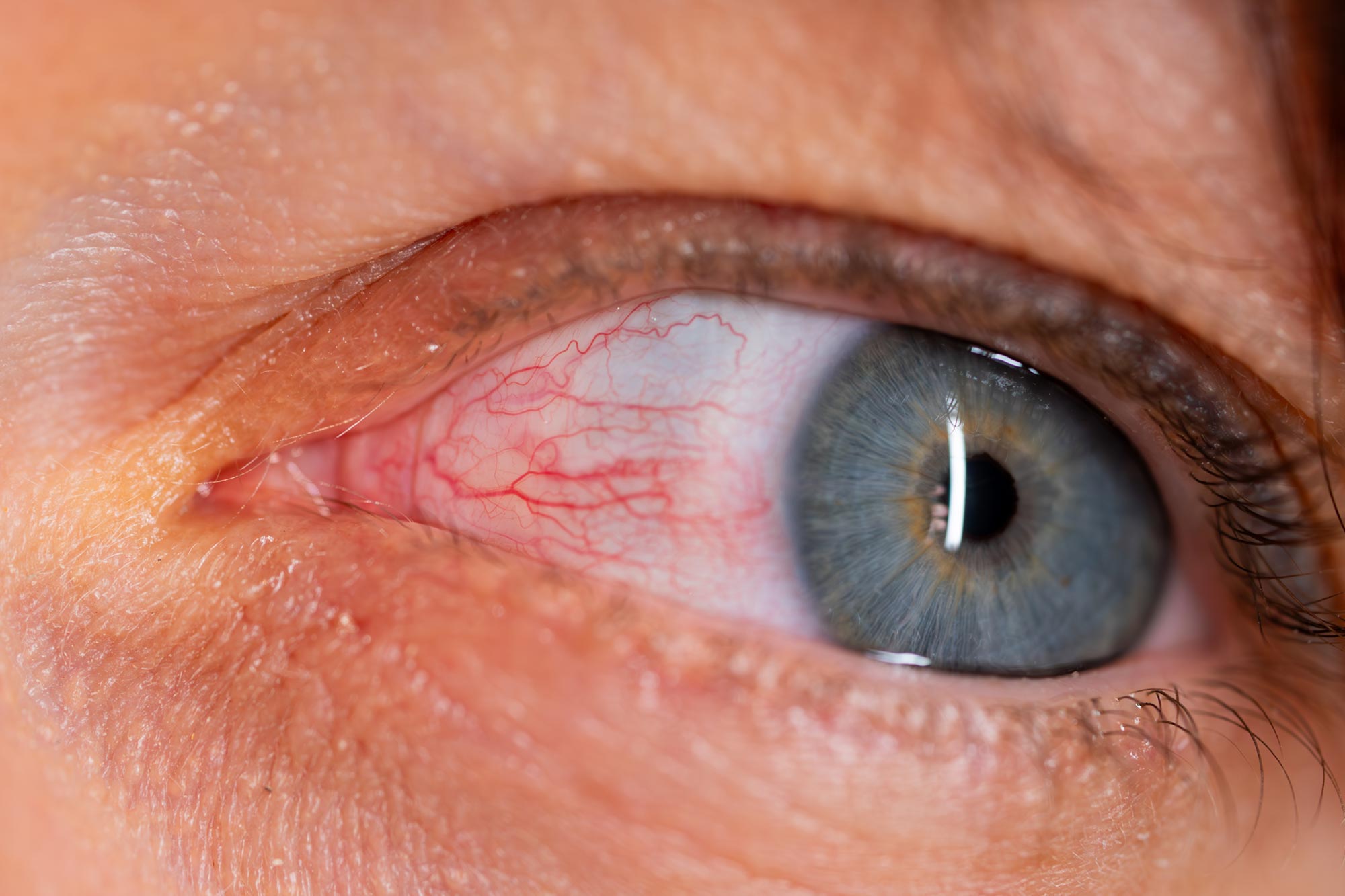
A new study suggests that a common respiratory bacterium may play an unexpected role in Alzheimer’s disease.
Cedars-Sinai researchers are pointing to an unexpected place to look for clues about Alzheimer’s disease: the eye. In a study published in Nature Communications, they report evidence that Chlamydia pneumoniae, best known for causing pneumonia and sinus infections, can persist for years in the body and may be tied to changes seen in Alzheimer’s disease.
The work raises the possibility that a long-lasting infection could help fuel the kind of inflammation that damages nerve cells, and it also hints at new ways to intervene, from inflammation-limited approaches to earlier antibiotic treatment.
The study found that the bacterium can show up in the retina, the thin layer of neural tissue at the back of the eye that directly processes visual signals. Because the retina is part of the central nervous system and can be examined without surgery, it offers a rare chance to watch brain-linked biology in real time. The team found that when Chlamydia pneumoniae reaches this tissue, it is associated with immune activity connected to inflammation, nerve cell death, and cognitive decline.
Linking Infection, Inflammation, and Neurodegeneration
“Seeing Chlamydia pneumoniae consistently across human tissues, cell cultures and animal models allowed us to identify a previously unrecognized link between bacterial infection, inflammation and neurodegeneration,” said Maya Koronyo-Hamaoui, PhD, professor of Neurosurgery, Neurology, and Biomedical Sciences at Cedars-Sinai Health Sciences University and the leading, senior author of the study. “The eye is a surrogate for the brain, and this study shows that retinal bacterial infection and chronic inflammation can reflect brain pathology and predict disease status, supporting retinal imaging as a noninvasive way to identify people at risk for Alzheimer’s.”
To test the idea, the researchers combined advanced imaging with genetic and protein-based analyses, examining retinal tissue from 104 people spanning normal cognition, mild cognitive impairment, and Alzheimer’s disease.
They detected much higher levels of Chlamydia pneumoniae in both the retinas and brains of participants with Alzheimer’s disease than in those with normal cognition, and heavier bacterial burden tracked with more severe brain changes and cognitive decline.
Genetics appeared to matter as well. Higher bacterial levels were more common among people who carried the APOE4 gene variant, a well-known risk factor for Alzheimer’s disease.
Laboratory and Animal Model Findings
Investigators also studied human neurons in the lab and in laboratory mice with Alzheimer’s disease. In both, infection with Chlamydia pneumoniae increased inflammation, nerve cell death and cognitive decline, showing the bacterium can accelerate disease processes. The infection also triggered production of amyloid-beta, the protein that accumulates in the brains of people with Alzheimer’s.
The findings were driven by co-first authors Bhakta Gaire, PhD, and Yosef Koronyo, MSc.
“This discovery raises the possibility of targeting the infection-inflammation axis to treat Alzheimer’s,” said Timothy Crother, PhD, co-corresponding author of the study and research professor at Cedars-Sinai Guerin Children’s and the Department of Biomedical Sciences at Cedars‑Sinai.
The findings suggest that targeting chronic bacterial infection—and the inflammation it triggers—could represent a new treatment strategy. The research also supports the potential use of the retina as a noninvasive way to help diagnose and monitor the disease.
Reference: “Identification of Chlamydia pneumoniae and NLRP3 inflammasome activation in Alzheimer’s disease retina” by Bhakta Prasad Gaire, Yosef Koronyo, Jean-Philippe Vit, Alexandre Hutton, Lalita Subedi, Dieu-Trang Fuchs, Natalie Swerdlow, Altan Rentsendorj, Saba Shahin, Daisy Martinon, Edward Robinson, Alexander V. Ljubimov, Julie A. Schneider, Lon S. Schneider, Debra Hawes, Stuart L. Graham, Vivek K. Gupta, Mehdi Mirzaei, Keith L. Black, Jesse G. Meyer, Moshe Arditi, Timothy R. Crother and Maya Koronyo-Hamaoui, 22 January 2026, Nature Communications.
DOI: 10.1038/s41467-026-68580-4
Funding: This work has been supported by the NIH/NIA grants R01AG056478, R01AG055865, and AG056478-04S1 (M.K.H.), R01AG075998 (M.K.H. and T.R.C.), and Alzheimer’s Association grant AARG-NTF-21-846586 (T.R.C.). MKH is also supported by The Goldrich and Snyder Foundations. ER has been supported by The Ray Charles Foundation.
Never miss a breakthrough: Join the SciTechDaily newsletter.
Follow us on Google and Google News.
4 Comments
I think we’re also going to find that many conditions previously considered “autoimmune,” are actually examples of the immune system functioning well, and in pursuit of pathogens, including bacteria, viruses, fungi, parasites, protozoa, etc. Given that we’ve identified less than 1% of all bacteria and viruses capable of infecting humans? Shouldn’t it occur to us that the alarm bells going off in our bodies are warning of real intruders rather than simply malfunctioning?
Brilliant 👍
With numerous studies finding the eyes to be visual portals to the brain, I’ve been “Linking Infection, Inflammation, and Neurodegeneration” for two decades and I now postulate that what the researchers are seeing is proof of long term sub-acute (nearly subclinical) non-IgE-mediated food (minimally) allergy reactions aggravated (or not) with toxic food additives, exhausting an individual’s resistance to infection. In the absence of an affordable, convenient and reliable laboratory testing method for Dr. Arthur F. Coca’s (by 1935; my) kind of food allergies, it now strikes me as a good (affordable and readily available) place to start to see just how prevalent my kind of food allergy related inflammation is, with dietary adjustments being preferable to medicinal interventions.
everything is liked to alzheimer’s.
because we don’t really know what it is.