
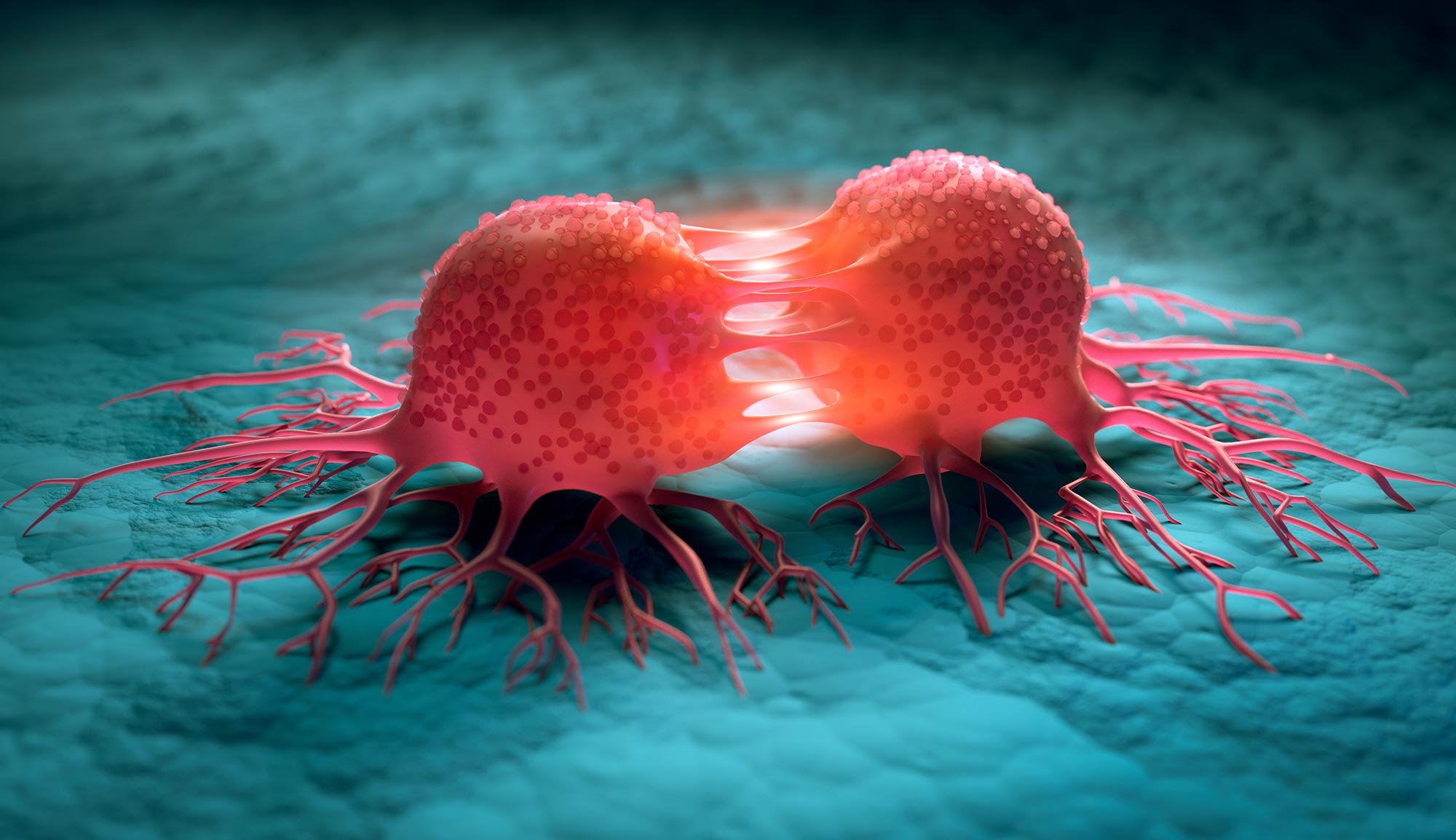
Researchers are exploring an unconventional cancer treatment that uses engineered bacteria to target the unique, oxygen-free environments inside tumors.
A research team led by the University of Waterloo is developing a new way to treat cancer by engineering bacteria that can consume tumors from the inside.
“Bacteria spores enter the tumor, finding an environment where there are lots of nutrients and no oxygen, which this organism prefers, and so it starts eating those nutrients and growing in size,” said Dr. Marc Aucoin, a chemical engineering professor at Waterloo. “So, we are now colonizing that central space, and the bacterium is essentially ridding the body of the tumor.”
The approach relies on Clostridium sporogenes, a bacterium commonly found in soil that can grow only in completely oxygen-free conditions.
The center of a solid cancerous tumor is made up of dead cells and lacks oxygen, creating an ideal environment for this bacterium to thrive and multiply.
However, there is a key limitation. As the bacteria spread toward the outer layers of tumors, they encounter small amounts of oxygen. This exposure causes them to die before they can fully eliminate the tumor.
To overcome this challenge, researchers introduced a gene from a related bacterium that is better able to tolerate oxygen. This change allows the engineered bacteria to survive longer near the tumor’s outer regions.
Engineering Bacteria to Survive
The team also developed a way to activate the oxygen-tolerance gene only when needed, which helps prevent the bacteria from growing in oxygen-rich areas such as the bloodstream. They achieved this using a natural process called quorum sensing.
Quorum sensing involves chemical signals released by bacteria. When enough bacteria accumulate inside a tumor, the signal becomes strong enough to switch on the oxygen-tolerance gene, ensuring it is not activated too early.
In one study, researchers showed that Clostridium sporogenes can be modified to tolerate oxygen. In a follow-up study, they tested the quorum-sensing system by engineering the bacteria to produce a green fluorescent protein.
“Using synthetic biology, we built something like an electrical circuit, but instead of wires we used pieces of DNA,” said Dr. Brian Ingalls, a professor of applied mathematics at Waterloo. “Each piece has its job. When assembled correctly, they form a system that works in a predictable way.”
Next Steps Toward Clinical Testing
Researchers now plan to combine the oxygen-tolerance gene with the quorum-sensing control system in a single bacterium and test it on tumors in preclinical trials.
Reference: “Construction and Functional Characterization of a Heterologous Quorum Sensing Circuit in Clostridium sporogenes” by Sara Sadr, Bahram Zargar, Marc G. Aucoin and Brian Ingalls, 8 December 2025, ACS Synthetic Biology.
DOI: 10.1021/acssynbio.5c00628
The promising project grew out of work by PhD student Bahram Zargar, who was supervised by Ingalls and Dr. Pu Chen, a retired professor of chemical engineering at Waterloo.
Never miss a breakthrough: Join the SciTechDaily newsletter.
Follow us on Google and Google News.
16 Comments
Although this is a good move. ButThis might turn out akin to the story “A man brought a cat to scare/eat the mouse out of his home after which cat became the trouble, to scare cat out he brought a dog and to scare dog out when it became hostile he brought a jackal, in the end the man had to leave the home.
Any new introduction of genes shall be first completely tested that this might not turn hostile.
Thank God there are life savers like all of you you all make the future mote promising thank you all for caring about your fellow man may God bless you all
Great work, so please tell me how does it feel to know all three of you just SAVED THE WORLD.WELL DONE
You guys and gal so rock
Great news. A bacteria who has capability to live under no oxygen environments may be dangerous if given opportunity to live in oxygen environment.
It may not be controlled anymore.
Good job though
This is true though it has to be brought into serious consideration.
Genelux.com is doing this with viruses in stage 3 trials and ovarian cancer
Back to Micro 101 for you!
Man, these people are bright.
This is an Extremely Brilliant Idea 💡. If this works it will a bring a revolution in Medical Cure. Wow this is awesome 👌
I for one applaud any progress towards a cure. Well done!
They don’t mention which type of cancer they are trying this on? Each type has it’s own oddities.
And rest assured. IF and that’s a big IF, these talented doctors succeed in making any type of cancer treatment, you can bet Pfizer (or some big pharma) will swoop in with the $Billion dollar check to purchase the rights and charge the public $20,000 per dose in medicinal dose quantities that will require 10 doses to succeed in cancer remission. I follow this stuff. I’m stage 4 colorectal. In year 3 since discovery. 🙏
And they were never seen again…
Genelux is using vaccinia virus in same way. Bioluminescence and one treatment.
Genelux.com
It might be news to some that there is a syndrome called Interstitial Cystitis which is an autoimmune condition caused by a common bacterium called Gaffkyia. ( on Amazon find the book The Pioneers of Interstitial Cystitis). GAFFKYIA thrives in and can only be grown in oxygen-free environments. No work has been done on this and it has been known since the ’80s. Might there be a parallel here? A new way to help IC patients?
It might be news to some that there is a syndrome called Interstitial Cystitis which is an autoimmune condition caused by a common bacterium called Gaffkyia. ( on Amazon find the book The Pioneers of Interstitial Cystitis). GAFFKYIA thrives in and can only be grown in oxygen-free environments. No work has been done on this and it has been known since the ’80s. Might there be a parallel here? A new way to help IC patients?
Fantastic work. You are all to be commended for the fantastic work that you do…