
Close Menu
    Facebook X (Twitter) Instagram
    SciTechDaily
    • Biology
    • Chemistry
    • Earth
    • Health
    • Physics
    • Science
    • Space
    • Technology
    Facebook X (Twitter) Pinterest YouTube RSS
    SciTechDaily
    Home»Health»Incredible New Imaging Technology Could ‘Revolutionize’ Cancer Surgery
    Health

    Incredible New Imaging Technology Could ‘Revolutionize’ Cancer Surgery

    By University of WaterlooSeptember 16, 2019No Comments3 Mins Read
    Facebook Twitter Pinterest Telegram LinkedIn WhatsApp Email Reddit
    Share
    Facebook Twitter LinkedIn Pinterest Telegram Email Reddit
    New Imaging Technology Could Revolutionize Cancer Surgery
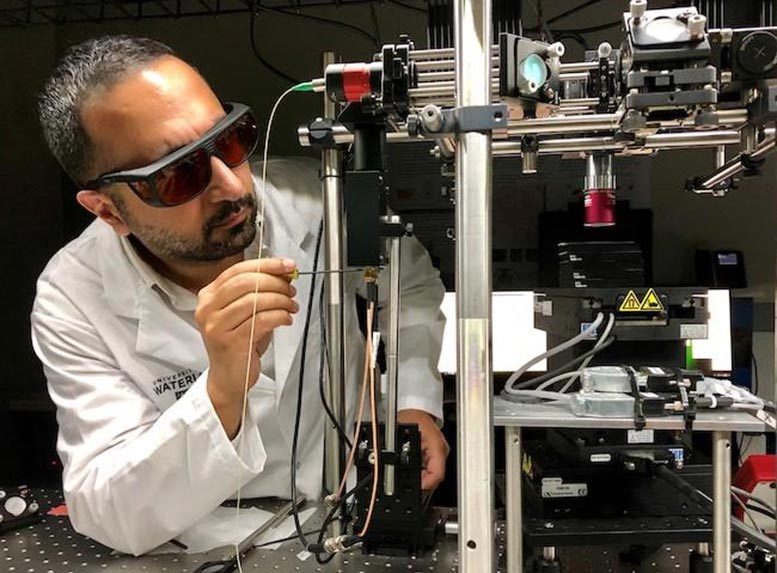
    University of Waterloo researcher Parsin Haji Reza works in his lab. Credit: University of Waterloo

    ‘This is the future, a huge step towards our ultimate goal of revolutionizing surgical oncology.’

    Cancer treatment could be dramatically improved by an invention at the University of Waterloo to precisely locate the edges of tumors during surgery to remove them.

    The new imaging technology uses the way light from lasers interacts with cancerous and healthy tissues to distinguish between them in real-time and with no physical contact, an advancement with the potential to eliminate the need for secondary surgeries to get missed malignant tissue.

    “This is the future, a huge step towards our ultimate goal of revolutionizing surgical oncology,” said Parsin Haji Reza, a systems design engineering professor who leads the project. “Intraoperatively, during surgery, the surgeon will be able to see exactly what to cut and how much to cut.”

    A paper on the work, All-optical Reflection-mode Microscopic Histology of Unstained Human Tissues, was published today (September 16, 2019) in the journal Scientific Reports.

    Doctors now rely primarily on pre-operation MRI images and CT scans, experience, and visual inspection to determine the margins of tumors during operations.

    Tissue samples are then sent to labs for testing, with waits of up to two weeks for results to show if the tumor was completely removed or not.

    In about 10 percent of cases – the rates for different kinds of cancer involving tumors vary widely – some cancerous tissue has been missed and a second operation is required to remove it.

    The photoacoustic technology developed at Waterloo works by sending laser light pulses into targeted tissue, which absorbs them, heats up, expands, and produces soundwaves. A second laser reads those soundwaves, which are then processed to determine if the tissue is cancerous or non-cancerous.

    The system has already been used to make accurate images of even relatively thick, untreated human tissue samples for the first time ever, a key breakthrough in the development process.

    The next steps include imaging fresh tissue samples taken during surgeries, integrating the technology into a surgical microscope and, finally, using the system directly on patients during operations.

    “This will have a tremendous impact on the economics of healthcare, be amazing for patients and give clinicians a great new tool,” said Haji Reza, director of the PhotoMedicine Labs at Waterloo. “It will save a great deal of time and money and anxiety.”

    Researchers hope to develop a fully functioning system within about two years, a process including the need to clear ethical hurdles and secure regulatory approvals.

    Collaborators on the project at Waterloo include master’s engineering student Saad Abbasi, post-doctoral fellow Kevan Bell, and physics co-op students Martin Le and Bazil Sonier. Also on the research team are oncologists Deepak Dinakaran and John Mackey, and pathologist Gilbert Bigras of the University of Alberta.

    Reference: “All-optical Reflection-mode Microscopic Histology of Unstained Human Tissues” by Saad Abbasi, Martin Le, Bazil Sonier, Deepak Dinakaran, Gilbert Bigras, Kevan Bell, John R. Mackey and Parsin Haji Reza, 16 September 2019, Scientific Reports.
    DOI: 10.1038/s41598-019-49849-9

    Never miss a breakthrough: Join the SciTechDaily newsletter.
    Follow us on Google and Google News.

    Biotechnology Cancer Surgery University of Waterloo
    Share. Facebook Twitter Pinterest LinkedIn Email Reddit

    Related Articles

    Scientists Engineer “Tumor-Eating” Bacteria That Devour Cancer From Within

    Mini Human Livers Grown in Lab Successfully Transplanted Into Rats

    Ultra-Sensitive Cancer DNA Detector Created With Crumpled Graphene

    Researchers Developing Handheld Device to Rapidly Diagnose Skin Cancer

    New Anti-Cancer Nanomedicine Delivers Efficient Chemotherapy

    Accurate Cancer Detection During Surgery with ‘MasSpec Pen’

    Radiation Study Using Human Gut-on-a-Chip Provides Hope for the Future

    Injectable, Spontaneously Assembling Vaccines Could Fight Cancer

    Yale Researchers Develop Method to Attack Cancer at Its Source

    Leave A Reply Cancel Reply

    • Facebook
    • Twitter
    • Pinterest
    • YouTube

    Don't Miss a Discovery

    Subscribe for the Latest in Science & Tech!

    Trending News

    Scientists Uncover Potential Brain Risks of Popular Fish Oil Supplements

    Scientists Discover a Surprising Way To Make Bread Healthier and More Nutritious

    After 60 Years, Scientists Uncover Unexpected Brain Effects of Popular Diabetes Drug Metformin

    New Research Uncovers Hidden Side Effects of Popular Weight-Loss Drugs

    Scientists Rethink Extreme Warming After Surprising Ocean Discovery

    Landmark Study Links Never Marrying to Significantly Higher Cancer Risk

    Researchers Discover Unknown Beetle Species Just Steps From Their Lab

    Largest-Ever Study Finds Medicinal Cannabis Ineffective for Anxiety, Depression, PTSD

    Follow SciTechDaily
    • Facebook
    • Twitter
    • YouTube
    • Pinterest
    • Newsletter
    • RSS
    SciTech News
    • Biology News
    • Chemistry News
    • Earth News
    • Health News
    • Physics News
    • Science News
    • Space News
    • Technology News
    Recent Posts
    • Not Just Alzheimer’s: Scientists Uncover Clues to a Second, Overlooked Disorder
    • Scientists Uncover Dangerous Connection Between Serotonin and Heart Valve Disease
    • Scientists Discover a “Protector” Protein That Could Help Reverse Hair Loss
    • Powerful Lasers Reveal How Matter Becomes Plasma in Trillionths of a Second
    • A Simpler Path to Super-Resolution: Scientists Reinvent Microscopy
    Copyright © 1998 - 2026 SciTechDaily. All Rights Reserved.
    • Science News
    • About
    • Contact
    • Editorial Board
    • Privacy Policy
    • Terms of Use

    Type above and press Enter to search. Press Esc to cancel.