
The proven technology will be designed into a handheld device that could reduce the need for painful biopsies by 50 percent — and disrupt the $5.3 billion diagnostics market.
Even the best dermatologists can’t diagnose skin cancer by eye, relying on magnifying glasses to examine suspicious blemishes and scalpels to cut tissue for analysis. Now, using shortwave rays used in cellphones and airport security scanners, researchers at Stevens Institute of Technology have developed a technique that detects skin lesions and determines whether they are cancerous or benign — a technology that could ultimately be incorporated into a handheld device that could rapidly diagnose skin cancer without a scalpel in sight.
The work, led by Negar Tavassolian, director of the Stevens Bio-Electromagnetics Laboratory, and postdoctoral fellow Amir Mirbeik-Sabzevari, not only has the ability to reduce the number of unnecessary biopsies by 50 percent but also has the potential to disrupt a $5.3 billion diagnostic market for the most common cancer in the United States, with 9,500 Americans diagnosed with skin cancer each day.
“This could be transformative,” said first author Mirbeik-Sabzevari, whose work appears in the September 2019 issue of IEEE Transactions on Medical Imaging. “No other technology has these capabilities.”
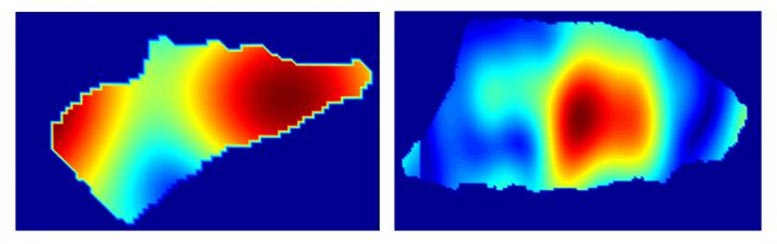
The team’s technology uses millimeter-wave radiation — the same shortwave rays used in cellphones and airport security scanners. Millimeter-wave rays penetrate certain materials and bounce off others, which is how airport security knows if you leave your keys in your pocket as you walk through a scanner. Just as metal reflects more energy than your body, so cancerous tumors reflect more calibrated energy than healthy skin, making it possible to identify diseased tissue by looking for reflectivity hotspots.
The latest tests were conducted on biopsies collected by surgeons from Hackensack University Medical Center. Tavassolian and Mirbeik-Sabzevari custom-built antennae to generate high-resolution images of this biopsied tissue, and found they could map the tiny tumors as accurately as lab-based testing. Cancerous cells reflected around 40 percent more calibrated energy than healthy tissue, showing that millimeter-wave reflectivity is a reliable marker for cancerous tissue.
“We’ve shown proof-of-concept that this technology can be used for rapidly detecting skin cancer,” said Tavassolian. “That’s a major step forward toward our ultimate goal of developing a handheld device, which would be safe to use directly on the skin for an almost instant diagnostic reading of specific kinds of skin cancer — including lethal melanomas — based on their individual reflectivity signatures.”
While the technology underpinning the device is innovative, it’s also inexpensive. Since it involves the same basic circuitry within a cellphone, manufacturing costs would be low.
“In fact, it should be possible to keep manufacturing costs below $1,000, even at low production volumes,” said Tavassolian “That’s about the same as the magnifying tools already used by dermatologists, and an order of magnitude cheaper than laser-based imaging tools, which also tend to be slower, bulkier and less accurate than millimeter-wave scanners.”
Since millimeter-wave rays penetrate the skin, the scanners can generate real-time 3D images of tumors that could guide surgeons and eliminate the need for multiple trial-and-error biopsies to fully remove cancerous tissue. The devices could also be configured to interpret images automatically, and deliver basic diagnostic information — such as a warning to get checked out by a doctor — without needing a trained operator. “We could place these devices in pharmacies, so people can get checked out and go to a doctor for a follow-up if necessary,” said Tavassolian. “People won’t need to wait weeks to get results, and that will save lives.”
Mirbeik-Sabzevari, who began working on the technology five years ago as a graduate student in Tavassolian’s lab, is confident that this invention will prove a hit. As a postdoctoral fellow at Stevens and the 2019 inaugural recipient of the Paul Kaplan Award for Distinguished Doctoral Research, Mirbeik-Sabzevari plans to launch a startup to commercialize the scanners. He was the entrepreneurial lead on a customer discovery grant on this technology from the National Science Foundation.
Reference: “High-Contrast, Low-Cost, 3-D Visualization of Skin Cancer Using Ultra-High-Resolution Millimeter-Wave Imaging” by Amir Mirbeik-Sabzevari, Erin Oppelaar, Robin Ashinoff and Negar Tavassolian, 4 March 2019, IEEE Transactions on Medical Imaging.
DOI: 10.1109/TMI.2019.2902600
Never miss a breakthrough: Join the SciTechDaily newsletter.
Follow us on Google and Google News.
1 Comment
So in 2025, what progress has been made with this device?