
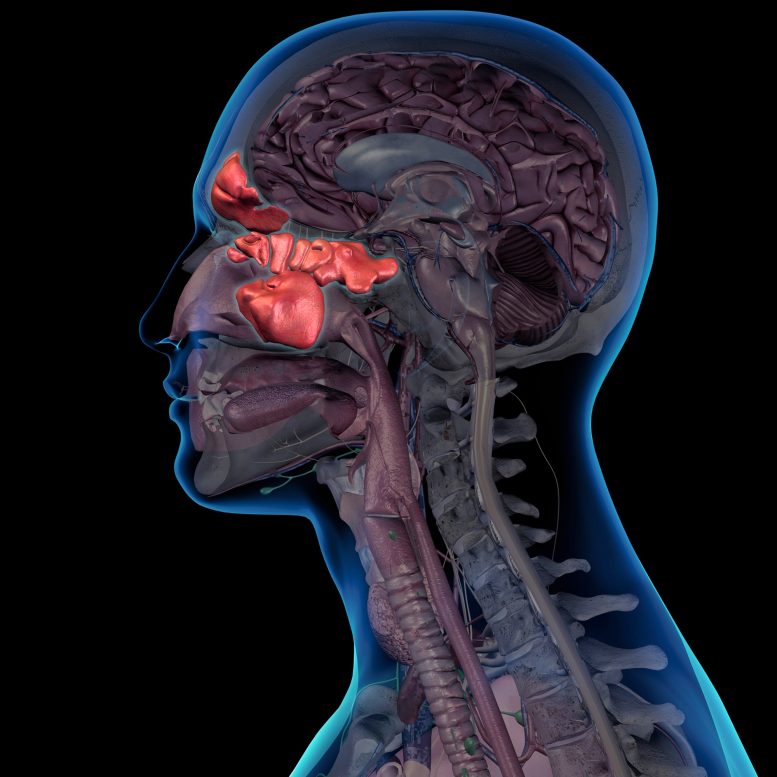
New research from Griffith University has shown that a bacterium commonly present in the nose can sneak into the brain and set off a cascade of events that may lead to Alzheimer’s disease.
Associate Professor Jenny Ekberg and colleagues from the Clem Jones Centre for Neurobiology and Stem Cell Research at Menzies Health Institute Queensland and Griffith Institute for Drug Discovery, in collaboration with Queensland University of Technology, have discovered that the bacterium Chlamydia pneumoniae can invade the brain via the nerves of the nasal cavity.
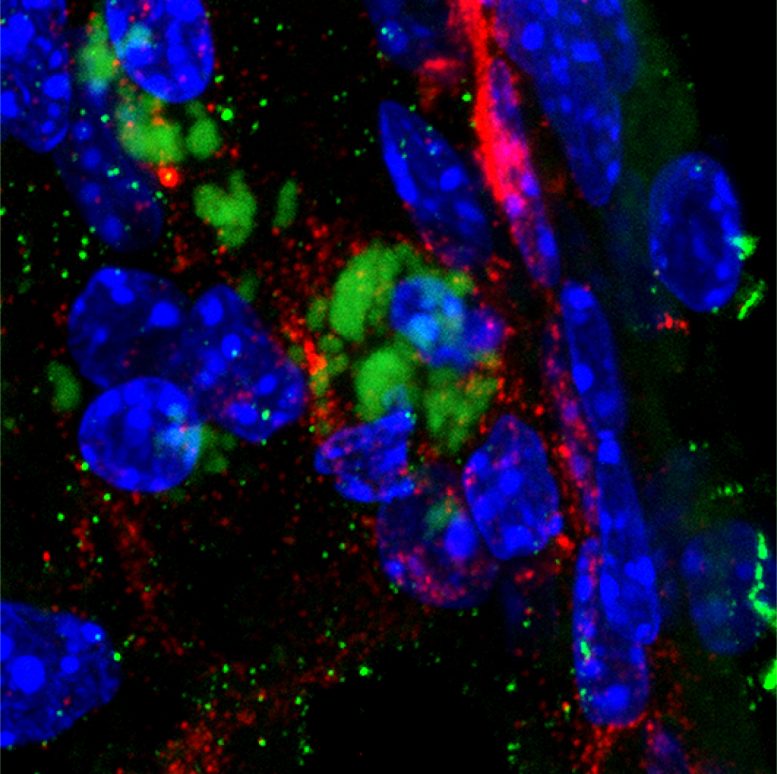
While this bacterium often causes respiratory tract infections, it has also been found in the brain which has raised the question of whether it causes damage to the central nervous system.
Linking Bacterial Infection to Alzheimer’s Pathology
The research team has performed extensive research in animal models to show not only how the bacteria gets into the brain, but also how it leads to Alzheimer’s disease pathologies.
“Our work has previously shown that several different species of bacteria can rapidly, within 24 hours, enter the central nervous system via peripheral nerves extending between the nasal cavity and the brain,” Associate Professor Ekberg said.
“With this background knowledge we were able to track how this new bacterium, Chlamydia pneumoniae can also sneak past the blood-brain barrier and quickly enter the brain.”
The new study shows that once the bacteria are in the central nervous system, the cells of the brain react within days by depositing beta-amyloid peptide, the hallmark plaque of Alzheimer’s disease.
After several weeks, numerous gene pathways that are known to be involved in Alzheimer’s disease are also dramatically activated.

The research also showed that when the bacteria invade the olfactory nerve, peripheral nerve cells (glial cells), become infected and these cells may be how the bacteria can persist within the nervous system.
“These cells are usually important defenders against bacteria, but in this case, they become infected and can help the bacteria to spread,’’ Associate Professor Ekberg said.
“We have suspected for a long time that bacteria, and even viruses, can lead to neuroinflammation and contribute to the initiation of Alzheimer’s disease, however, the bacteria alone may not be enough to cause disease in someone. Perhaps it requires the combination of a genetic susceptibility plus the bacteria to lead to Alzheimer’s disease in the long term.
“Now that we have this new evidence, it gives us the drive to urgently find treatments to stop this contributing factor to Alzheimer’s disease.
While the studies were conducted in mice, humans have the same nerves and can be infected by the same bacteria, so the researchers believe the results are translatable to humans.
“We are already working on treatment options. With the Griffith Institute for Drug Discovery, we are identifying potential drugs that can help the glial cells to destroy the bacteria which are already in the brain.
“In addition, Professor Ken Beagley at QUT is working on a vaccine against Chlamydia which may reduce the ability of the pathogen to enter the brain”.
Reference: “Chlamydia pneumoniae can infect the central nervous system via the olfactory and trigeminal nerves and contributes to Alzheimer’s disease risk” by Anu Chacko, Ali Delbaz, Heidi Walkden, Souptik Basu, Charles W. Armitage, Tanja Eindorf, Logan K. Trim, Edith Miller, Nicholas P. West, James A. St John, Kenneth W. Beagley and Jenny A. K. Ekberg, 17 February 2022, Scientific Reports.
DOI: 10.1038/s41598-022-06749-9
The study, published in the journal, Scientific Reports, was funded by the Clem Jones Foundation, the Goda Foundation, the Australian Research Council and the Menzies Health Institute Queensland.
Never miss a breakthrough: Join the SciTechDaily newsletter.
Follow us on Google and Google News.
2 Comments
Yes this is providing critical research support for the HYPOTHESIS that INFLAMMATION may well be at the root of CHRONIC “Sicknesses” as I also include at least some Psychiatric conditions as I am a practicing psychiatrist.
For decades I have had problems with my left nostril and later had surgery to move the nasal wall to reduce inflammation and increase airflow through the nostril. I think this continuous inflammation, still a bit active, has been causing my Alzheimer’s.