

Research confirms that a weakening circulation is driving the South Greenland anomaly.
For more than 100 years, a persistent pocket of unusually cold water south of Greenland has stood out against the steady warming of the Atlantic Ocean. This feature has sparked scientific debate, and a new study now points to its underlying cause: a long-term decline in a key ocean circulation system.
Researchers at the University of California, Riverside report that only one factor can account for the patterns seen in both ocean temperature and salt levels. Their analysis shows that the Atlantic Meridional Overturning Circulation, or AMOC, has been slowing down. This large system of currents influences global climate by carrying warm, salty water toward the north and returning cooler, deeper water toward the south.
“People have been asking why this cold spot exists,” said UCR climate scientist Wei Liu, who led the study with doctoral student Kai-Yuan Li. “We found the most likely answer is a weakening AMOC.”
The AMOC functions much like a conveyor belt, transporting heat and salt from the tropics into the North Atlantic. When this circulation weakens, less warm and salty water reaches the sub-polar region, producing the cool and fresh conditions observed near southern Greenland.
A reduced flow means that smaller amounts of heat and salt enter the North Atlantic, which creates cooler and less saline surface waters. This relationship is why scientists can use salinity and temperature measurements to assess the strength of the AMOC.
Reconstructing a Century of Change
Liu and Li examined temperature and salinity records covering roughly 100 years, since direct measurements of the AMOC have only been available for about two decades. Using these long-term datasets, the researchers pieced together how the circulation has changed over time and then tested their reconstruction against nearly 100 climate models.
According to the paper published in Communications Earth & Environment, only the models that depicted a weakened AMOC successfully aligned with the observed data. Simulations that relied on a stronger circulation were unable to reproduce what is actually happening in the ocean.
“It’s a very robust correlation,” Li said. “If you look at the observations and compare them with all the simulations, only the weakened-AMOC scenario reproduces the cooling in this one region.”
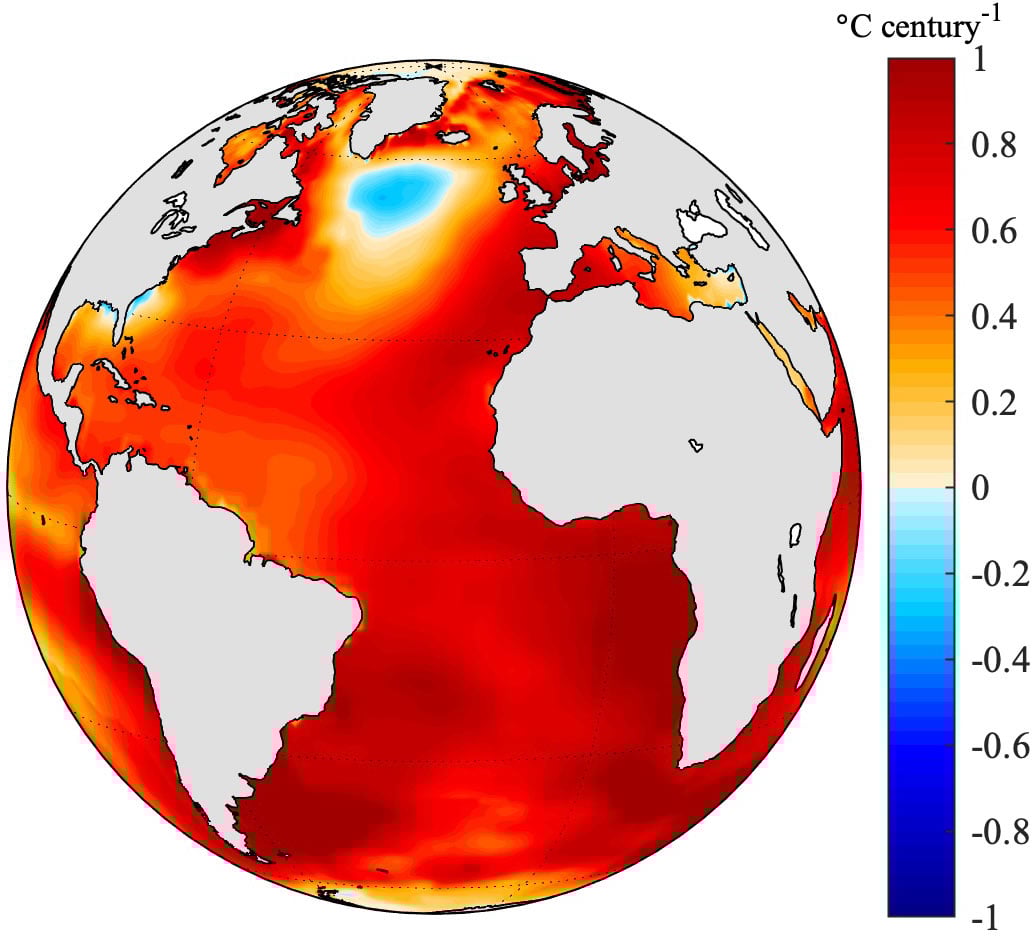
The study also found that the weakening of the AMOC correlates with decreased salinity. This is another clear sign that less warm, salty water is being transported northward.
The consequences are broad. The South Greenland anomaly matters not just because it’s unusual, but because it’s one of the most sensitive regions to changes in ocean circulation. It affects weather patterns across Europe, altering rainfall and shifting the jet stream, which is a high-altitude air current that steers weather systems and helps regulate temperatures across North America and Europe.
The slowdown may also disturb marine ecosystems, as changes in salinity and temperature influence where species can live.
A Debate Resolved
This result may help settle a dispute amongst climate modelers about whether the South Greenland cooling is driven primarily by ocean dynamics or by atmospheric factors such as aerosol pollution. Many newer models suggested the latter, predicting a strengthened AMOC due to declining aerosol emissions. But those models failed to recreate the actual, observed cooling.
“Our results show that only the models with a weakening AMOC get it right,” Liu said. “That means many of the recent models are too sensitive to aerosol changes, and less accurate for this region.”
By resolving that mismatch, the study strengthens future climate forecasts, especially those concerning Europe, where the influence of the AMOC is most pronounced.
The study also highlights the ability to draw clear conclusions from indirect evidence. With limited direct data on the AMOC, temperature and salinity records provide a valuable alternative for detecting long-term change, and for helping to predict future climate scenarios.
“We don’t have direct observations going back a century, but the temperature and salinity data let us see the past clearly,” Li said. “This work shows the AMOC has been weakening for more than a century, and that trend is likely to continue if greenhouse gases keep rising.”
As the climate system shifts, the South Greenland cold spot may grow in influence. The hope is that by unlocking its origins, scientists can better prepare societies for what lies ahead.
“The technique we used is a powerful way to understand how the system has changed, and where it is likely headed if greenhouse gases keep rising,” Li said.
Reference: “Weakened Atlantic Meridional Overturning Circulation causes the historical North Atlantic Warming Hole” by Kai-Yuan Li, and Wei Liu, 28 May 2025, Communications Earth & Environment.
DOI: 10.1038/s43247-025-02403-0
Never miss a breakthrough: Join the SciTechDaily newsletter.
Follow us on Google and Google News.
7 Comments
James Hansen comes to the same conclusion. The amoc is weakening because of freshening in the North Atlantic. He also concludes the reduction of sulfur aerosol pollution has aggravated the problem by accelerating that freshening. You imply that his research says sulfur pollution reduction is responsible for the problem. You don’t understand his publication “warming in the pipeline”
Prepare society for……..what? The only thing that H sap prepares for is killing members of the tribe next door. We have become particularly, and increasingly, good at those preparations during the last 100 years.
Preparing for anything else is sneered at as “socialism”. Remember the profound wisdom of Maggie Thatcher; greed is good.
“Researchers … report that ONLY one factor can account for the patterns seen in both ocean temperature and salt levels.”
To be more accurate, the researchers believe that the ‘cold blob’ only has one explanation. Unfortunately, their conclusion is brought into question by other recent studies that don’t find evidence for the AMOC slowing down.
Before one can assign blame to ‘Unicorns,’ one must firmly establish that unicorns exist and can perform magic.
https://scitechdaily.com/how-the-florida-current-has-defied-changes-for-40-years/
https://scitechdaily.com/climate-puzzle-scientists-uncover-mysterious-halt-in-the-atlantic-conveyor-belt-slowdown/
https://scitechdaily.com/defying-doomsday-forecasts-critical-ocean-current-is-still-going-strong-after-60-years/
The Florida Current may well have not changed. That’s Florida, not just south of Greenland. The Florida Current is also referred to in the second article you refer to. The third article in your list is more general and depends much on re-interpretation of old data, by all accounts, and it refers to unquantified uncertainties. What matters for Europe is the bits of AMOC that spiral off it and keep the place warmer than it would be otherwise. A change in the strength and/or the distribution and flow-directions of the bits that spiral off the AMOC could well be of local European climatic significance, even though the AMOC has, in general, remained, stable. Unless we know those details, simplistic statements are of little value, as was found by the remnants of the Spanish Armada off the west coast of Ireland back around 1588.
“The third article in your list is more general and depends much on re-interpretation of old data, by all accounts, and it refers to unquantified uncertainties.”
There is nothing duplitious about re-analyzing old data. Actually, revisiting old data is probably a good idea in general.
You complain that “it refers to unquantified uncertainties.” However, you then make the assertion that “the bits that spiral off the AMOC COULD well be of local European climatic significance.” Where are the quantified uncertainties that support your use of “could.” It comes across as a case of the “pot calling the kettle black.” If it is acceptable for you to use non-numeric uncertainties whose only unequivocal meaning is that it is not impossible, why are you complaining about how this paper analyzes the situation?
Actually, if you go to the link provided you will find that the authors actually did quantify the uncertainties. The Coefficient of Determination (r^2) tells one what percentage of the variance in the dependent variable is explained or predicted by changes in the independent variable. The authors state “While the existence of this relationship corroborates the underlying link between the AMOC and the SPG SST index, the coefficient of determination (r^2) of the relationship of 0.5 is substantially smaller than the one that was found for the CMIP5 ensemble (0.90).” While, as is all too common for climatology, there is no explicit association between the claimed result and the uncertainty, and in this case, also inconsistency in the use of significant figures, thus making it difficult to imply the uncertainty, they are saying that the CMIP6 ensemble Coefficient of Determination is so much smaller than that obtained with the smaller CMIP5 ensemble (~1:2) that the CMIP5 Coefficient of Determination is untrustworthy and one doesn’t have to quibble about significant digits to the right of the decimal point.
I did not say re-visiting old data was duplicitous which means, in English, deliberately misleading. It may have a different meaning in Trumpistan.
Were not the links that you provided links to the simplifications offered by SciTech Daily? No, I didn’t read the original paper, and thank you for the clarifications. As you have complained often enough the simplifications produced by SciTech Daily necessary for the non-scientific member of the public do not always contain the limits to precision to which you subscribe.
Why bring up the points of “old data” and “unquantified uncertainties” unless you were looking for reasons to denigrate the study? I do not know where “Trumpistan” is, but I suspect it exists in your head. I have never mentioned it, or the mythical land of Bidenstan. I only mention them now because you brought up the issue of politics and I want to point out how little either means to me because I prefer to stick to the facts of science. I don’t consider myself a big fan to Trump, albeit I think that most of his ideas are superior to what the democrats stand for.
It is because of my ignored, not so subtle hints on making the SciTechDaily articles a little more rigorous, that I generally read the provided DOI links. I have even been known to remark about the original article when it is also lacking any of the grammar of mathematics. Because SciTechDaily is one of the few news outlets that doesn’t censor comments, which I appreciate, I don’t want to compete with them. Therefore, if I cite a source for my claims, which I do frequently, unlike many others, I want to reward SciTechDaily by referring to their articles rather than a competitor.
You remarked about, “the simplifications … necessary for the non-scientific member of the public.” I disagree with the simplifications being “necessary.” It wouldn’t hurt the layman to expand their scientific vocabulary or to be exposed to the thinking that goes into the claims made if they are interested in scientific news. If they don’t learn some of the more common jargon and statistical tools, then they have to depend on authority alone, which leads to the issue of my original remarks about contradictions between studies. Perhaps a balance can be found between pablum and caviar.