
Close Menu
    Facebook X (Twitter) Instagram
    SciTechDaily
    • Biology
    • Chemistry
    • Earth
    • Health
    • Physics
    • Science
    • Space
    • Technology
    Facebook X (Twitter) Pinterest YouTube RSS
    SciTechDaily
    Home»Earth»New Experiment Recreates Prehistoric Ocean Conditions
    Earth

    New Experiment Recreates Prehistoric Ocean Conditions

    By Elizabeth Swanner, Iowa State UniversityMarch 9, 2018No Comments3 Mins Read
    Facebook Twitter Pinterest Telegram LinkedIn WhatsApp Email Reddit
    Share
    Facebook Twitter LinkedIn Pinterest Telegram Email Reddit
    New Experiment Sheds Light on Prehistoric Ocean Conditions
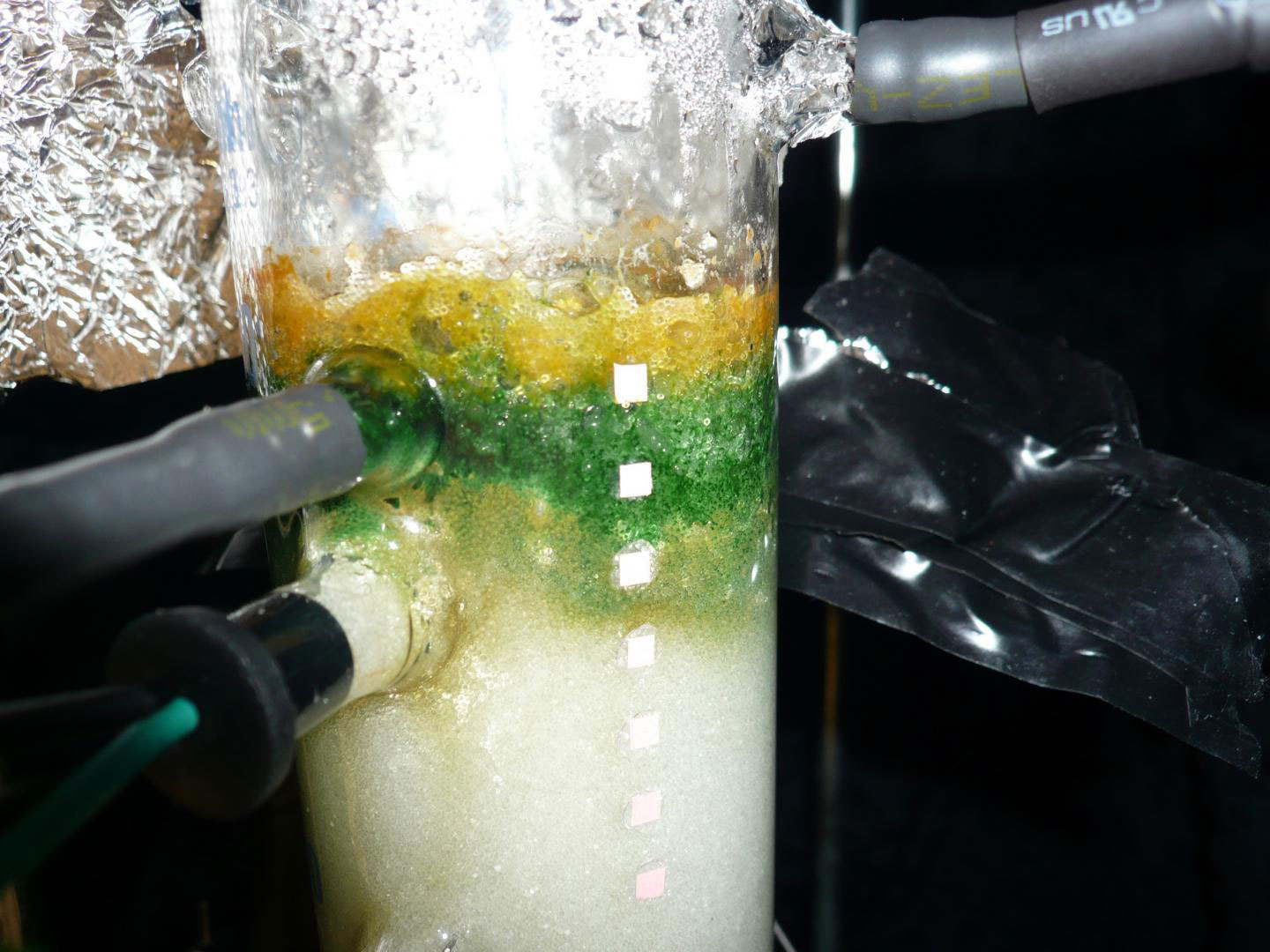
    A graduated cylinder model of the ocean. The green shows cyanobacteria and the brown shows the oxidized iron.

    A new experiment by Elizabeth Swanner evaluating the reduction of iron in prehistoric oceans may reinterpret the conditions under which iron-rich sedimentary rock is formed.

    Swanner, assistant professor of geological and atmospheric sciences, was part of an international collaborative research team including researchers from the University of Tuebingen, Germany, and the Chinese Academy of Sciences in Beijing, China. The team modeled the prehistoric ocean, similar to that of the Archean Era 2.5 billion years ago within a graduated cylinder.

    “We really only wanted to simulate it in the vertical dimension, so we used a graduated cylinder and modified it,” Swanner said.

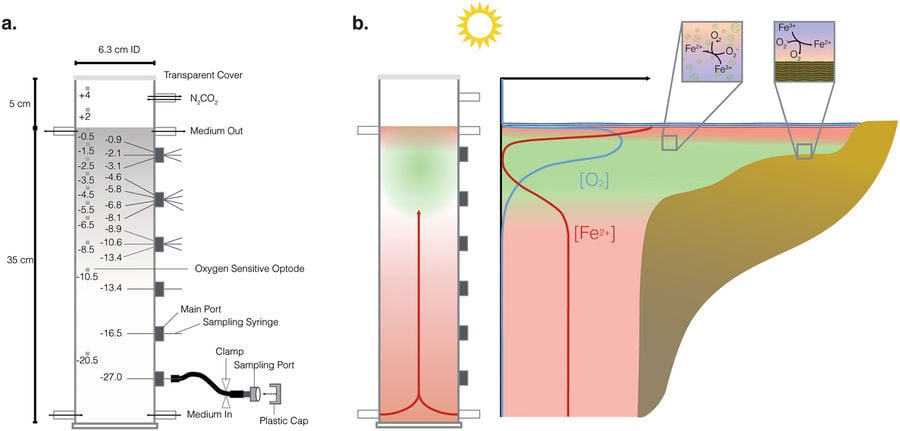
    In a previous experiment the researchers had modified the cylinder to simulate an Archean ocean with large amounts of iron and no oxygen except for what was made by cyanobacteria. Ports along the cylinder’s side allowed for sampling at various levels.
    New Experiment Reveals Prehistoric Ocean Conditions
    (a) Schematic cross-section and dimensions of the column. Small darker grey squares are optodes, labeled with the depth in the column. Dark grey sampling ports show the arrangement of fixed needles used to take aqueous samples at different depths in the center of the column. White ports show where medium was pumped in (bottom), pumped out (top), and an additional port used for flushing the headspace. (b) Schematic cross-section of a Precambrian continental margin overlying a deep, ferruginous basin, simulated in one dimension (vertically) by the column experiment. Insets show that oxic Fe(III) reduction described here could take place in the water column and/or in a benthic setting, simulated by glass beads in the column. Elizabeth D. Swanner, et al., Scientific Reports, volume 8, Article number: 4238 (2018) doi:10.1038/s41598-018-22694-y

    “We were studying cyanobacteria because these are the organisms which we think put all of the oxygen in the atmosphere originally,” she said.

    The research, published by Scientific Reports, showed that despite the oxygenation by the cyanobacteria, much of the iron did not remain oxidized but was reduced again into its dissolved form.

    This unexpected result may be explained by an enzyme on cyanobacteria which reduces iron. In the modern ocean, which contains at least 1000 times less iron, cyanobacteria reduce a small amount of iron, but the experiment showed a larger amount of iron reduction than the researchers anticipated. Another possible explanation is that the iron is reduced by a photochemical reaction occurring when the iron is hit by light.

    The implications of this finding could change the conditions under which iron-rich sedimentary rocks are thought to be formed from the ancient oceans.

    “Traditionally if you see iron enriched in sediments from the ocean you tend to think it was deposited under anoxic conditions,” Swanner said. “But potentially we have a way to still deposit a lot of iron but have it be deposited under fully oxygenated conditions.”

    The initial results in the laboratory prompt new questions for Swanner, including whether she will find evidence of this process in the Midwestern lakes that her research group is now studying. These lakes have iron at the bottom and oxygen only in the top of the water column, and also contain cyanobacteria.

    Reference: “Oxic Fe(III) reduction could have generated Fe(II) in the photic zone of Precambrian seawater” by Elizabeth D. Swanner, Markus Maisch, Wenfang Wu and Andreas Kappler, 9 March 2018, Scientific Reports.
    DOI: 10.1038/s41598-018-22694-y

    Never miss a breakthrough: Join the SciTechDaily newsletter.
    Follow us on Google and Google News.

    Atmospheric Science Cyanobacteria Earth Science Environmental Science Iowa State University Oceanography
    Share. Facebook Twitter Pinterest LinkedIn Email Reddit

    Related Articles

    Thawing Permafrost is Changing Arctic and Subarctic Lakes and Ponds

    25 Years of Satellite Data Confirms That Sea Levels Are Rising

    Climate Models Underestimate the Cooling Effect That Clouds Have

    NASA Study Provides First Direct Proof of Ozone Hole Recovery Due to Chemicals Ban

    New NASA Study Shows That Hydrofluorocarbons Contribute to Ozone Depletion

    2015 El Niño Appears Likely to Equal the Event of 1997-98

    “Grey Swan” Cyclones Will Become More Frequent and Intense

    Phytoplankton Are Extremely Sensitive to Changing Levels of Desert Dust

    Naturally Occurring Atmospheric Processes and Chinese Pollution Offset Ozone Gains

    Leave A Reply Cancel Reply

    • Facebook
    • Twitter
    • Pinterest
    • YouTube

    Don't Miss a Discovery

    Subscribe for the Latest in Science & Tech!

    Trending News

    New Study Reveals Why Ozempic Works Better for Some People Than Others

    Climate Change Is Altering a Key Greenhouse Gas in a Way Scientists Didn’t Expect

    New Study Suggests Gravitational Waves May Have Created Dark Matter

    Scientists Discover Why the Brain Gets Stuck in Schizophrenia

    Scientists Engineer “Tumor-Eating” Bacteria That Devour Cancer From Within

    Even “Failed” Diets May Deliver Long-Term Health Gains, Study Finds

    NIH Scientists Discover Powerful New Opioid That Relieves Pain Without Dangerous Side Effects

    Collapsing Plasma May Hold the Key to Cosmic Magnetism

    Follow SciTechDaily
    • Facebook
    • Twitter
    • YouTube
    • Pinterest
    • Newsletter
    • RSS
    SciTech News
    • Biology News
    • Chemistry News
    • Earth News
    • Health News
    • Physics News
    • Science News
    • Space News
    • Technology News
    Recent Posts
    • JWST Reveals a “Forbidden” Planet With a Baffling Composition
    • New Research Challenges 30-Year-Old Theory of Eye Development
    • The Protein “Sabotaging” Aging Muscle Recovery Could Be Key to Surviving Aging
    • This Diet–Gut Interaction Could Transform Fat Into a Calorie-Burning Machine
    • Why Some People Reach 100: New Study Reveals Key Biological Differences
    Copyright © 1998 - 2026 SciTechDaily. All Rights Reserved.
    • Science News
    • About
    • Contact
    • Editorial Board
    • Privacy Policy
    • Terms of Use

    Type above and press Enter to search. Press Esc to cancel.