
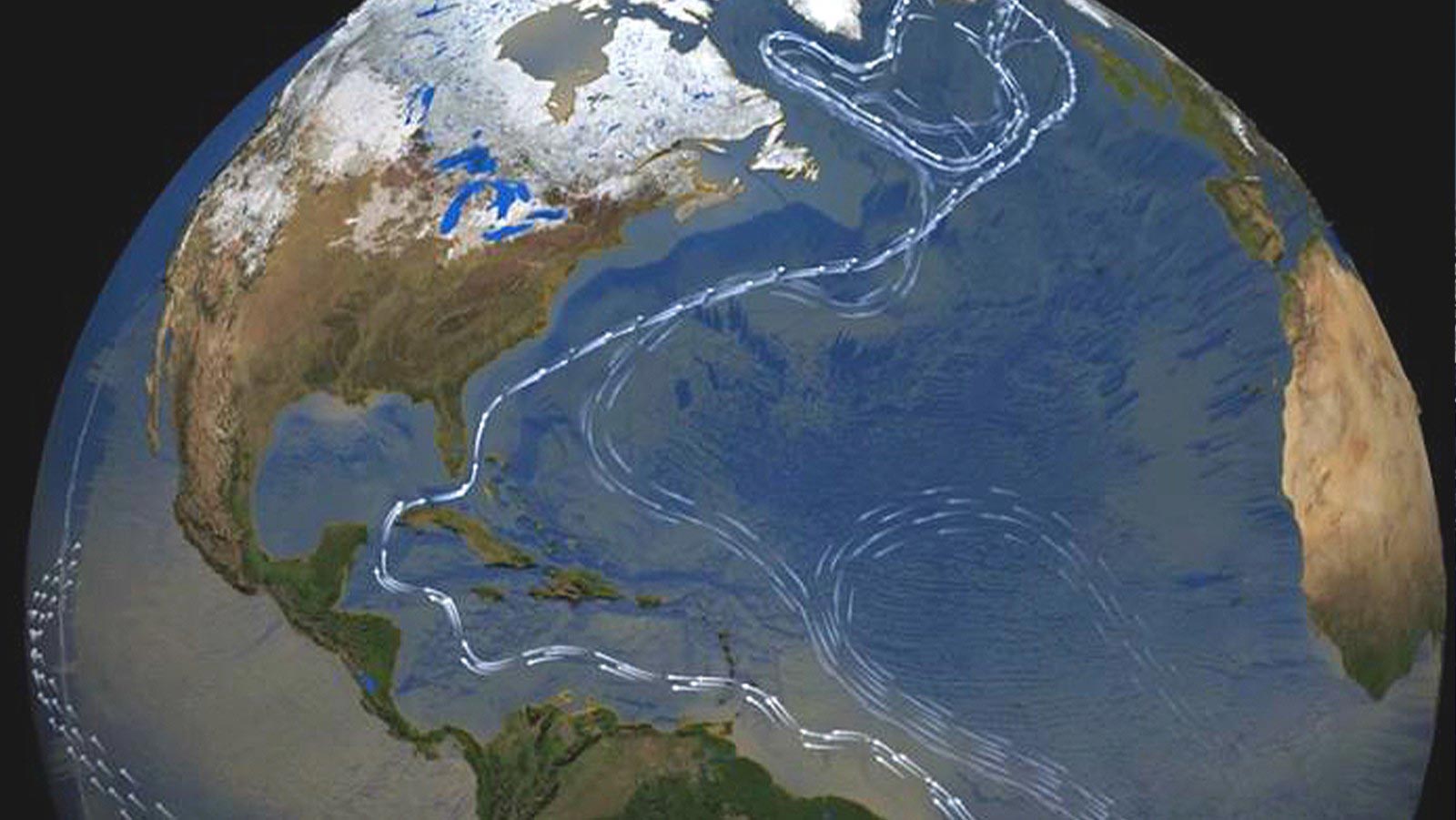
The weakening of the AMOC has paused since the early 2010s.
A recent study by scientists at AOML found that the Atlantic Meridional Overturning Circulation (AMOC) experienced significant weakening during the 2000s. However, this decline has stalled since the early 2010s due to competing influences from natural variability and human-induced factors.
The AMOC is a key part of the global ocean conveyor belt, a vast circulation system that transports heat, salt, carbon, and other biogeochemical elements throughout the ocean. As a critical regulator of global heat distribution, salinity, nutrient cycles, and carbon storage, the AMOC plays a vital role in shaping regional climates, sea levels, and marine ecosystems.
Observational Data vs. Climate Model Projections
The current state-of-the-art climate models suggest that the anthropogenic weakening of the AMOC has been happening since the mid-1980s. However, direct observational records for the past two decades have shown remarkable resilience of the AMOC.
To investigate this contradiction, scientists analyzed multiple climate and ocean model simulations together with direct observational data. They found that an extensive weakening of the AMOC occurred in the 2000s, which was primarily driven by anthropogenic forcing (i.e., increased CO2 and reduced aerosol). However, since the early 2010s, the natural component of the AMOC has greatly strengthened due to the development of a strong positive North Atlantic Oscillation (NAO). The enhanced natural AMOC signal cancels out the anthropogenic weakening signal, leading to a near stalling of the AMOC weakening.

“Interdecadal variations in the NAO are more likely generated by atmospheric internal dynamics and thus are random and unpredictable. As such, the tug-of-war between the natural and anthropogenic signals may continue in the next decades, or the NAO phase may reverse to reinforce the anthropogenic weakening of the AMOC. We should therefore explore the two possible scenarios of the AMOC state for the next decades and the impacts,” said Sang-Ki Lee, lead author of the study and AOML Oceanographer.
Although not explicitly explored in this study, the current state-of-the-art climate models, including those analyzed in this study, do not show a complete shutdown of the AMOC during the 21st century. However, potential future freshening of the North Atlantic due to land-ice melting (i.e. the Greenland ice sheet and glaciers and ice caps in the Arctic) is not adequately represented in those models. Therefore, the study stressed the importance of improving climate models by incorporating realistic scenarios of the Greenland ice sheet melting to address this low likelihood-high impact possibility of the AMOC collapse.

AOML’s research in 2024 revealed critical aspects of the AMOC
During 2024, scientists at NOAA AOML, the University of Miami Cooperative Institute for Marine and Atmospheric Studies (CIMAS), and the Northern Gulf Institute (NGI) led multiple studies to try to better understand the AMOC and its long-term variability. Changes in the AMOC’s strength could impact many global-scale climate phenomena such as sea level, extreme weather, and precipitation patterns which makes it of great importance to understand.
Additionally, the ocean’s surface waters absorb anthropogenic carbon dioxide. The AMOC pathways then push this carbon dioxide down into the deep ocean, which is often referred to as carbon sequestration. Thus, the AMOC-related carbon sinking in the North Atlantic accounts for a significant portion of the anthropogenic carbon inventory of the global ocean. Therefore, the amount of anthropogenic carbon sequestered by the ocean is closely tied to the strength of the AMOC.

Credit: NOAA
Researchers at AOML made significant progress in understanding the AMOC last year. One study, led by a University of Miami PhD student with scientists at AOML, is the first to estimate the AMOC’s heat transport at 22 5°S in the South Atlantic, highlighting the importance of sustained in situ observations. Using a novel mapping method, the study provided insights into the seasonal and year-to-year variability of the AMOC in the South Atlantic.
Another study found that despite there being no apparent weakening of the overall AMOC transport, the abyssal (near the sea floor) limb of the AMOC in the North Atlantic has weakened over the past two decades, contributing to an increase in deep sea heat content, and hence, sea level rise in the region.
Additionally, scientists at AOML found through direct observations that the Florida Current, one of the fastest currents in the ocean and an important part of the AMOC, has remained remarkably stable over the past 40 years. In this study, scientists reassessed the overall trend in the Florida Current transport inferred from submarine cable measurements and found that a correction was needed for the gradual change in the Earth’s magnetic field over time. The correction nearly removed a previously reported negative trend in the record, revealing that the Florida Current has remained stable for the past four decades. This study demonstrates the value of sustained observations for the AMOC, as existing observational records are just starting to reveal decadal-scale signals relevant to climate variability and changes.
These studies emphasize that to further advance our capability to monitor and predict the future AMOC, it is crucial to continue collecting observations of the AMOC at multiple latitudes, advance our understanding of the relevant physical processes, and improve climate models.
Reference: “A pause in the weakening of the Atlantic meridional overturning circulation since the early 2010s” by Sang-Ki Lee, Dongmin Kim, Fabian A. Gomez, Hosmay Lopez, Denis L. Volkov, Shenfu Dong, Rick Lumpkin and Stephen Yeager, 6 December 2024, Nature Communications.
DOI: 10.1038/s41467-024-54903-w
Never miss a breakthrough: Join the SciTechDaily newsletter.
Follow us on Google and Google News.
4 Comments
Might it be that the empirical evidence is evidence against the accuracy of the models? Would it really be a surprise to anyone that all Earth systems or processes vary in intensity or speed over time? I almost sense a tone of disappointment that the slowing of the AMOC isn’t supported by field measurements.
No doubt that still-unknown complexities will exist as the whole business is not predictable with the type of accuracies you desire. However, given the increase in human population since 1750 and our squandering of hydrocarbon energy it ain’t gonna stay as it was. Hell and high water are somewhere down the track; a pity I will miss it.
What I desire is to have the accuracies quantified, explicitly stated, and the envelope of uncertainty provided. That is the essence of science, in contrast to speculation, arm waving, and descriptions using ambiguous lawyer words.
The combination of those studies leave the impression the a m o c is slowing from anthropogenic forcing but accelerating from natural variation at the same time leaving a neutral situation. Of course that will change from negation to reinforcement as the natural variation shifts back. The last 2 years of sea ice absence around Antarctica can’t have a good effect and the glaciers of Greenland are cracking faster than ever. Current models don’t include all that fresh water. I don’t see any good news in the future to offset the bad news when natural variability turns against us. The binary nature of natural variability looks a lot like a roulette wheel to me and you can’t bet on red forever and expect to win.