
Close Menu
    Facebook X (Twitter) Instagram
    SciTechDaily
    • Biology
    • Chemistry
    • Earth
    • Health
    • Physics
    • Science
    • Space
    • Technology
    Facebook X (Twitter) Pinterest YouTube RSS
    SciTechDaily
    Home»Space»Cassini Sees Saturn and Its Rings Through a Haze of Sun Glare
    Space

    Cassini Sees Saturn and Its Rings Through a Haze of Sun Glare

    By Tony Greicius, NASAMarch 5, 2018No Comments2 Mins Read
    Facebook Twitter Pinterest Telegram LinkedIn WhatsApp Email Reddit
    Share
    Facebook Twitter LinkedIn Pinterest Telegram Email Reddit
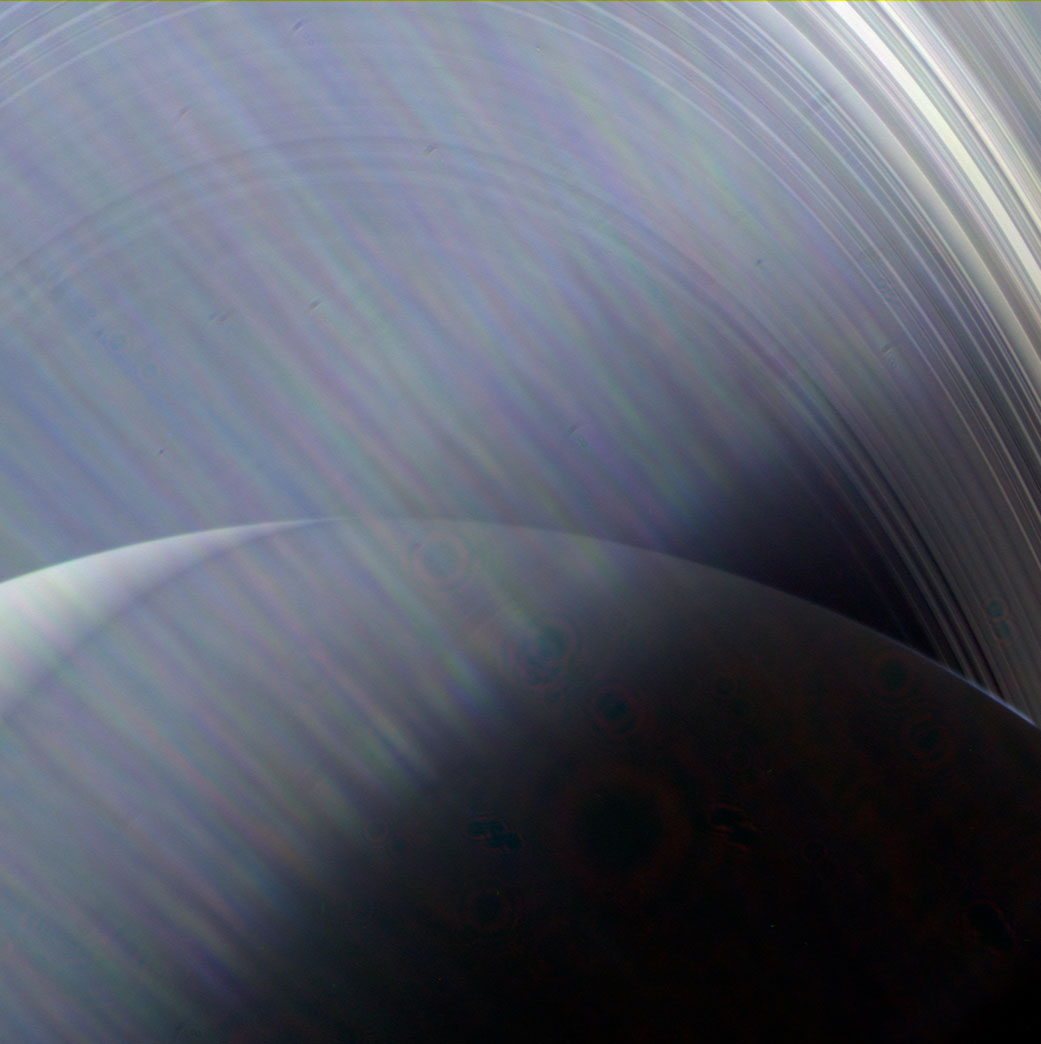
    Cassini Spacecraft Sees Saturn and Its Rings Through a Haze of Sun Glare
    Image of Saturn and its rings taken from a distance of approximately 491,200 miles (790,500 kilometers) from Saturn. Credit: NASA/JPL-Caltech/Space Science Institute

    In this image, NASA’s Cassini Spacecraft sees Saturn and its rings through a haze of Sun glare on the camera lens. If you could travel to Saturn in person and look out the window of your spacecraft when the Sun was at a certain angle, you might see a view very similar to this one.

    Images taken using red, green, and blue spectral filters were combined to show the scene in natural color. The images were taken with Cassini’s wide-angle camera on June 23, 2013, at a distance of approximately 491,200 miles (790,500 kilometers) from Saturn.

    The Cassini spacecraft ended its mission on September 15, 2017.

    The Cassini mission is a cooperative project of NASA, ESA (the European Space Agency) and the Italian Space Agency. The Jet Propulsion Laboratory, a division of the California Institute of Technology in Pasadena, manages the mission for NASA’s Science Mission Directorate, Washington. The Cassini orbiter and its two onboard cameras were designed, developed and assembled at JPL. The imaging operations center is based at the Space Science Institute in Boulder, Colorado.

    Never miss a breakthrough: Join the SciTechDaily newsletter.
    Follow us on Google and Google News.

    Astronomy Cassini-Huygens Mission Planetary Science Saturn
    Share. Facebook Twitter Pinterest LinkedIn Email Reddit

    Related Articles

    New Study Details the Changes in Saturn’s F Ring

    Cassini Reveals Possible New Moon Forming Around Saturn

    NASA Detects Ocean Inside Saturn’s Moon Enceladus

    Cassini Reveals Clues about Saturn’s Moon Titan

    Massive Saturn Storm Churns Up Water Ice from Great Depths

    Cassini Views a Spinning Vortex at Saturn’s North Pole

    Cassini Observes Meteors Colliding With Saturn’s Rings

    NASA’s Cassini Catches a Glimpse of Venus From Saturn Orbit

    Storm Spawns the Largest Tropospheric Vortex Ever Seen on Saturn

    Leave A Reply Cancel Reply

    • Facebook
    • Twitter
    • Pinterest
    • YouTube

    Don't Miss a Discovery

    Subscribe for the Latest in Science & Tech!

    Trending News

    Nanoscale “Defects” Unlock a Major Heat Transfer Breakthrough

    Adults Taking More Vitamin D Scored 13% Higher on a Cognitive Test

    A 35,000-Year-Old Neanderthal Pelvis May Explain Why Men and Women Walk Differently

    Dual Stem Cell Treatment Restores Vision in First Human Trial

    Your Waist Size May Reveal More About Your Health Than You Think

    Scientists Turn Red Strawberries White With a Single Gene Edit

    A SpaceX Falcon 9 Rocket Hit the Moon and Blasted Open a 60-Foot Crater

    Study Reveals Your Organs May Be Aging at Very Different Speeds

    Follow SciTechDaily
    • Facebook
    • Twitter
    • YouTube
    • Pinterest
    • Newsletter
    • RSS
    SciTech News
    • Biology News
    • Chemistry News
    • Earth News
    • Health News
    • Physics News
    • Science News
    • Space News
    • Technology News
    Recent Posts
    • New Drug Combination Shows Promise Against Advanced Prostate Cancer
    • Scientists Find a Troubling Effect of Sitting That Exercise Couldn’t Prevent
    • FDA Clears First-of-Its-Kind Nonmedication Treatment for PTSD
    • Quantum Simulators Put a 40-Year-Old Physics Theory to the Test
    • 125-Million-Year-Old Crocodile Fossil Reveals Astonishing New Secrets
    Copyright © 1998 - 2026 SciTechDaily. All Rights Reserved.
    • Science News
    • About
    • Contact
    • Editorial Board
    • Privacy Policy
    • Terms of Use

    Type above and press Enter to search. Press Esc to cancel.