
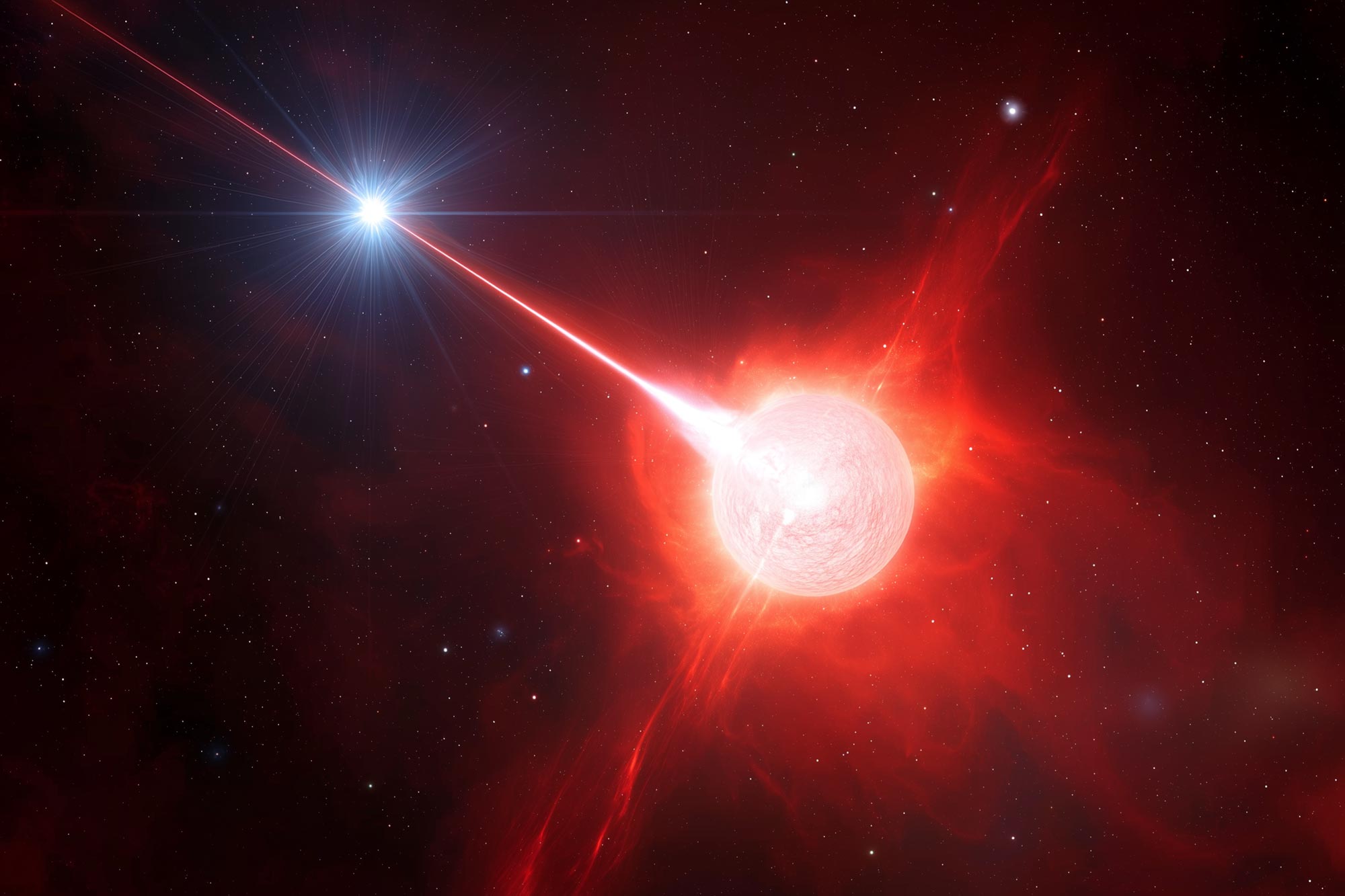
A star caught feeding on its companion has finally revealed the source of some of the galaxy’s most mysterious repeating signals.
An international research team led by scientists at the University of Sydney has uncovered the strongest evidence yet explaining the origin of a puzzling type of cosmic signal. Their work has also revealed a rare stellar system that offers a unique opportunity to study some of the most extreme conditions in the universe.
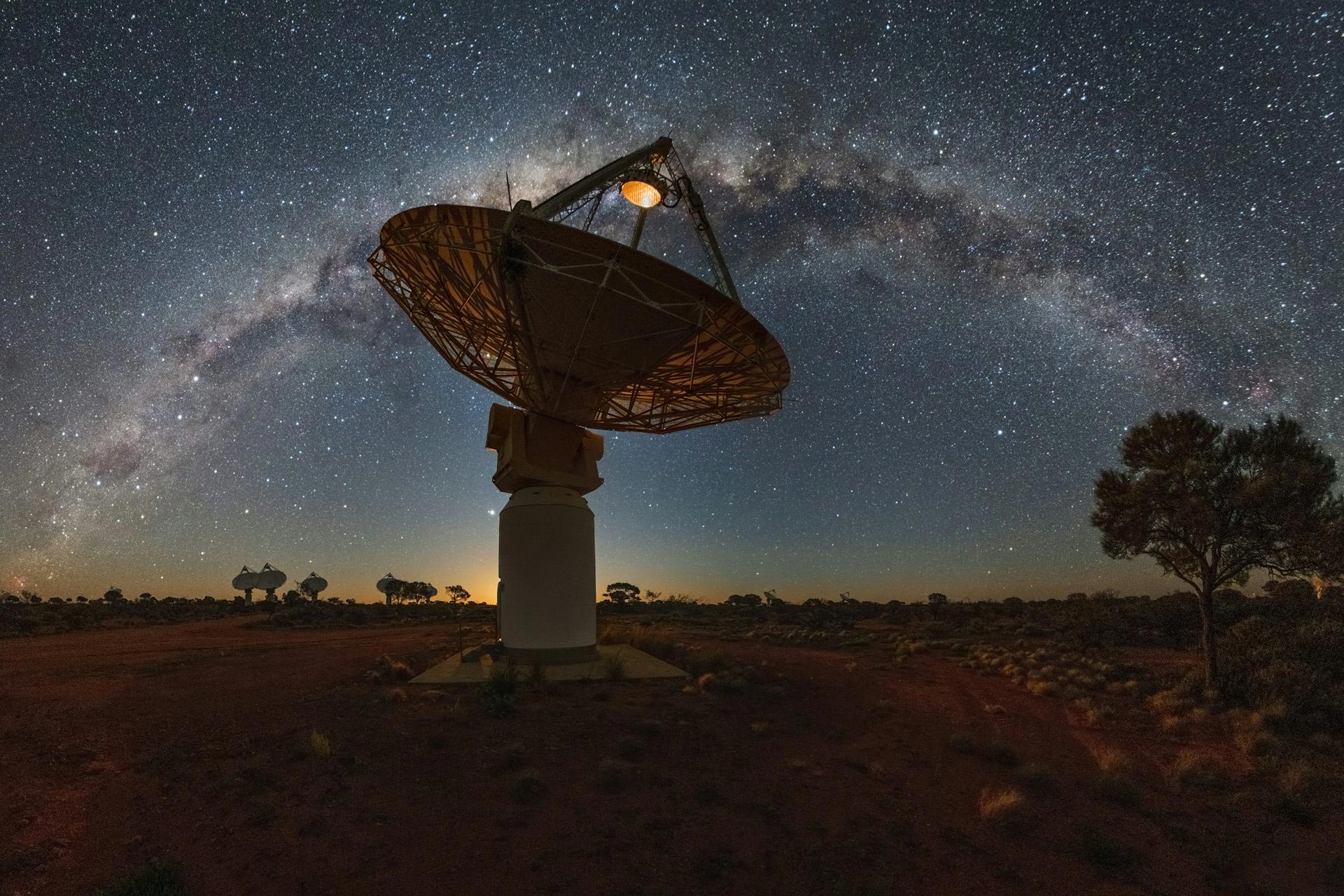
Using CSIRO’s ASKAP radio telescope, the researchers found a compact white dwarf star pulling material away from a larger companion star. As the stolen matter spirals toward the white dwarf, the system produces powerful bursts of radio waves and X-rays on a repeating cycle every 1.4 hours.
The findings were published in Nature Astronomy.
Lead author Kovi Rose, a PhD student in the University of Sydney’s School of Physics and CSIRO, said the discovery provides the first confirmed explanation for a mysterious class of objects known as long-period radio transients. These unusual signals have been detected in only a handful of locations across the Milky Way.
“For the first time we have pinpointed the origin of these signals, confirming the source to be a ‘cataclysmic variable’, or an accreting white dwarf star,” said Mr. Rose.
“Long-period radio transients have puzzled astronomers for years,” Mr. Rose said. “We’ve only found about a dozen, and their origins have been unclear. Now, we’ve been able to show that the source for one of these transients comes from a white dwarf actively pulling material from a companion star.”
Rare Binary Star System Revealed
The newly identified object, known as ASKAP J1745−5051, consists of a white dwarf and a red dwarf star locked in an extremely tight orbit. Although the white dwarf is roughly Earth-sized, it contains nearly as much mass as the Sun. Its companion is much larger in size but has only about one-tenth of the Sun’s mass.
The two stars circle each other in just over an hour.
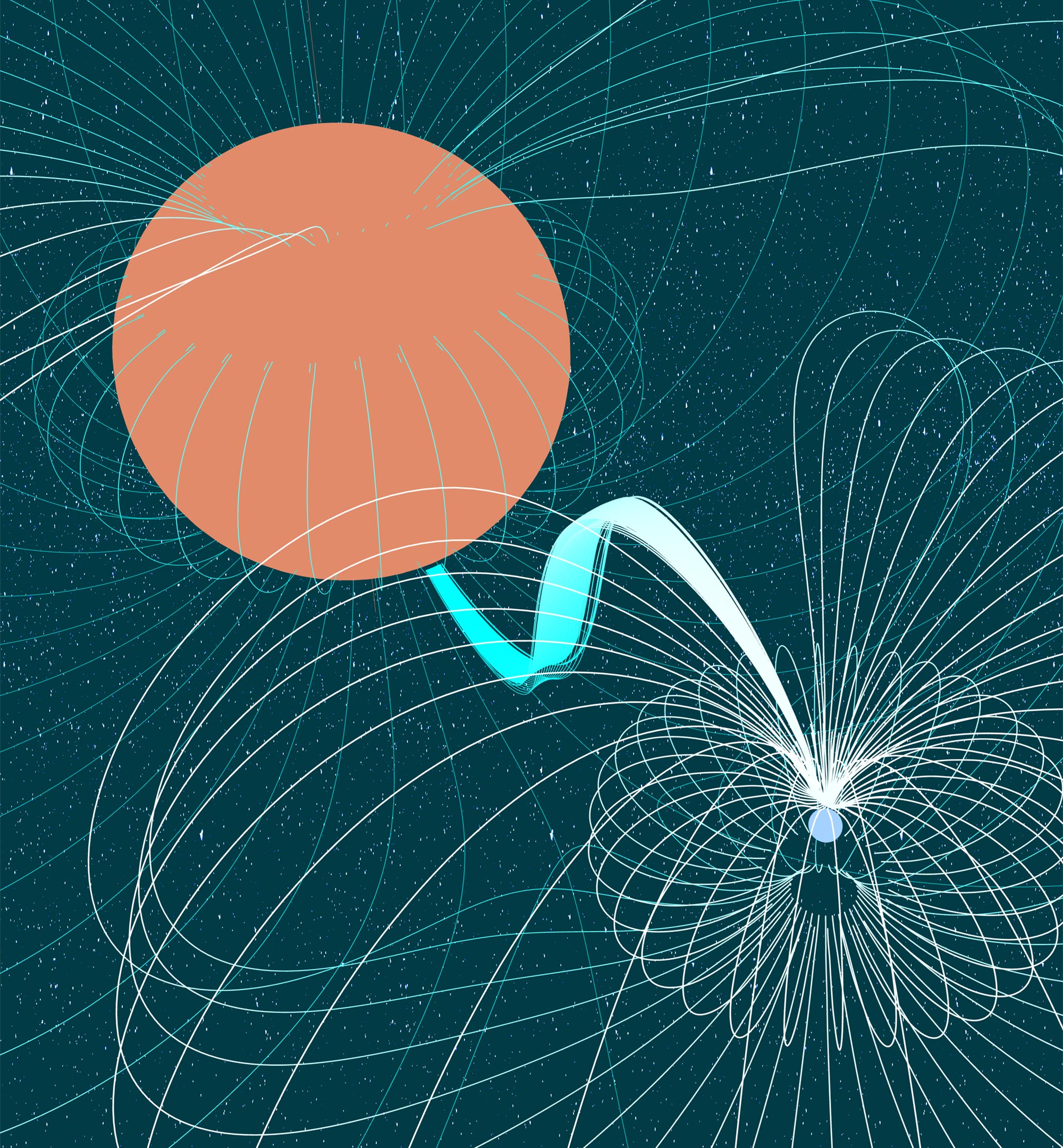
As gas from the red dwarf flows toward the white dwarf, it becomes intensely heated and emits X-rays. At the same time, interactions involving the stars’ magnetic fields generate regular radio bursts, creating the repeating signal observed by astronomers.
“These emissions are all tied to the orbital motion of the system,” Mr. Rose said. “But interestingly, the radio and X-ray signals don’t peak at the same time, which tells us they’re being produced in different regions of the system.”
The researchers believe the radio bursts originate where the magnetic fields of the two stars interact with the stream of charged material being stripped from the companion star. Those interactions create tightly focused beams of radio emission.

Solving the Long-Period Radio Transient Mystery
When long-period radio transients were first discovered, some astronomers suspected they might be slowly rotating neutron stars called pulsars. However, current theories indicate neutron stars spinning this slowly should not be capable of generating these signals.
The new findings support a different explanation. At least some long-period radio transients appear to come from binary star systems involving white dwarfs.
“Some similar objects had been linked to binary systems before, but this is the first one where we can clearly see both stars and the accretion process in action,” said Professor Murphy, Head of School at the University of Sydney School of Physics and Chief Investigator at the ARC Centre of Excellence for Gravitational Wave Discovery (OzGrav).
The system is also only the second known long-period radio transient that produces regular X-rays. It is the first example in which scientists have confirmed exactly what causes the repeating pattern.
A Cosmic “Rosetta Stone” for Future Discoveries
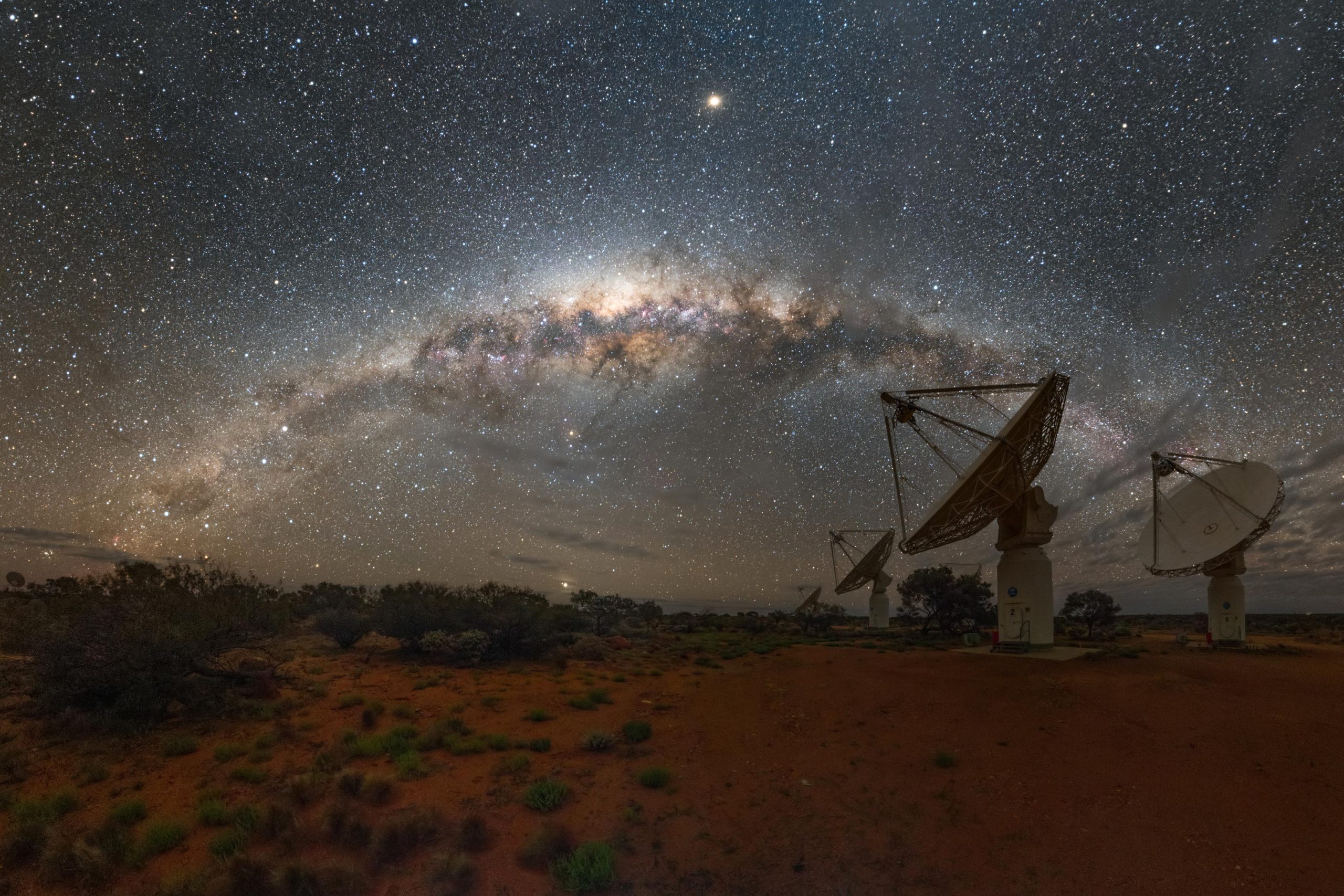
ASKAP J1745−5051 was detected with the ASKAP radio telescope, which is owned and operated by CSIRO, Australia’s national science agency. ASKAP’s combination of sensitivity, resolution, and wide sky coverage allows astronomers to detect unusual signals that might otherwise go unnoticed.
Researchers believe the newly discovered system could become an important reference point for understanding other long-period radio transients.
“This system gives us a way to decode these signals. It could help us determine whether other long-period transients are more like pulsars or like white dwarf systems, acting like a stellar Rosetta stone,” said Mr. Rose, referring to the archaeological object discovered in Egypt that helped translate ancient hieroglyphics.
The discovery also opens a window into physical processes that cannot be recreated in laboratories on Earth. Scientists can use the system to study how matter behaves in powerful magnetic fields and under intense gravitational forces.
“These systems are natural laboratories,” Mr. Rose said. “They allow us to test our understanding of how matter behaves in strong magnetic fields and under intense gravitational forces.”
Future Observations Planned
The team intends to continue studying the system with a combination of radio, optical, and X-ray telescopes. Future observations will help researchers better understand how the emissions are produced and whether similar processes can explain the broader population of long-period radio transients.
“Each new discovery is helping us piece together the bigger picture,” Mr. Rose said. “We’re only just beginning to understand this new class of cosmic events.”
Reference: “Periodic radio and X-ray emission from an accreting white dwarf binary” by Kovi Rose, Joshua Pritchard, Tara Murphy, L. N. Driessen, D. L. Kaplan, M. Caleb, Ziteng Wang, A. Zic, I. Andreoni, J. Carney, B. N. Barlow, D. Dobie, M. Gu, G. Heald, D. Huber, E. Lenc, J. K. Leung, W. Lu, R. Momose, M. G. Pedersen, Y. Qu, N. Rea, I. de Ruiter, K. Shaji, G. R. Sivakoff, A. J. M. Thomson, Y. L. Wang, G. J. Yang and F. Zahedy, 1 June 2026, Nature Astronomy.
DOI: 10.1038/s41550-026-02882-x
The international collaboration included researchers from Australia, the United States, Canada, China, Spain, and Israel. Observations were carried out using CSIRO’s ASKAP and Australia Telescope Compact Array in Australia, the MeerKAT radio telescope in South Africa, the SOAR and Magellan optical telescopes in Chile, and the Swift (UV/X-ray) and Einstein Probe (X-ray) space telescopes.
The authors reported no competing interests. Funding for the research was provided by the Australian Research Council Centre of Excellence for Gravitational Wave Discovery (OzGrav), NASA, the Alfred P. Sloan Foundation, the Professor Harry Messel Research Fellowship in Physics Endowment, the European Research Council, and the China Scholarship Council.
Never miss a breakthrough: Join the SciTechDaily newsletter.
Follow us on Google and Google News.