
Close Menu
    Facebook X (Twitter) Instagram
    SciTechDaily
    • Biology
    • Chemistry
    • Earth
    • Health
    • Physics
    • Science
    • Space
    • Technology
    Facebook X (Twitter) Pinterest YouTube RSS
    SciTechDaily
    Home»Health»Brain Scans Reveal Which Disorders May Accelerate Brain Aging
    Health

    Brain Scans Reveal Which Disorders May Accelerate Brain Aging

    By PLOSJuly 28, 20261 Comment3 Mins Read
    Facebook Twitter Pinterest Telegram LinkedIn WhatsApp Email Reddit
    Share
    Facebook Twitter LinkedIn Pinterest Telegram Email Reddit
    SD Brain on Fire
    Large-scale MRI analysis suggests that several brain disorders are linked to brains that appear older than a person’s chronological age. Credit: Shutterstock

    Accelerated brain aging was associated with dementia, addiction, and psychiatric disorders such as schizophrenia.

    A brain scan can make a person’s brain appear older or younger than their actual age. Across tens of thousands of scans, researchers found that dementia, mild cognitive impairment, alcohol addiction, and psychiatric conditions such as schizophrenia were associated with older-appearing brains, although each condition showed a different anatomical pattern.

    The findings were reported in the open-access journal PLOS Medicine by Shile Qi of the Nanjing University of Aeronautics and Astronautics in China and colleagues.

    Researchers estimate brain age using predictive age difference (PAD), which compares a person’s chronological age with the age predicted from brain imaging. A positive PAD means the brain appears older than expected.

    To examine how different neurological, psychiatric, developmental, and addiction-related conditions might affect this measure, the researchers analyzed structural magnetic resonance imaging (MRI) data from 45,900 control participants across several brain imaging databases.

    They compared those scans with data from 2,698 people with attention-deficit/hyperactivity disorder (ADHD), autism spectrum disorder (ASD), alcohol or tobacco addiction, Alzheimer’s disease (AD), mild cognitive impairment (MCI), schizophrenia, bipolar disorder, or major depressive disorder.

    Dementia shows the widest brain age gap

    Alzheimer’s disease and mild cognitive impairment had the strongest associations with elevated PAD, indicating the largest gaps between predicted brain age and chronological age. Addiction and psychiatric disorders were also linked to older-appearing brains.

    The researchers found no PAD differences between control participants and people with ADHD or ASD.
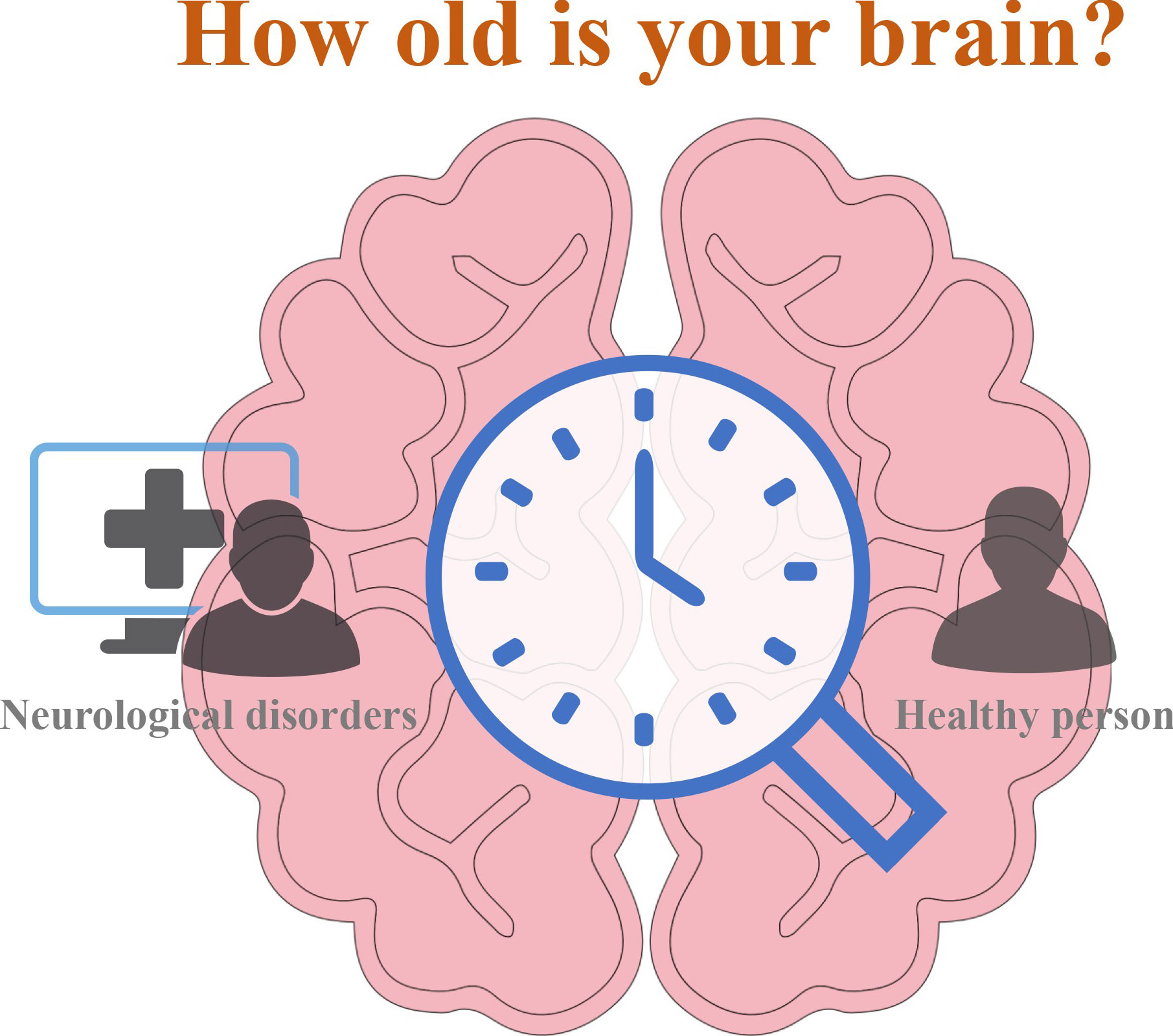
    Illustration Depicting a Brain Aging Clock
    Illustration depicting a brain aging clock. Credit: Shile Qi and Chuang Liang (CC-BY 4.0)

    Each condition leaves a regional signature

    The analysis also examined brain age differences within specific regions and identified genes whose activity varied among people with different conditions.

    Elevated PAD appeared in the prefrontal cortex across multiple brain disorders. Psychiatric conditions were associated with older-appearing tissue in the frontal and temporal lobes, while dementia was linked to higher PAD in the frontal and occipital cortices.

    Addiction showed a different pattern, with elevated PAD in the default mode and salience networks, as well as the putamen and thalamus. The researchers also identified condition-specific differences in gene transcription.

    The findings show associations rather than cause and effect. Interpretation is also complicated by the frequent co-occurrence of some conditions, particularly psychiatric disorders and addiction. Even with those limitations, the researchers suggest that further study of PAD could support the development of biomarkers for common brain disorders.

    The authors add, “Different neurological disorders appear to leave different signatures on the brain aging clock, which may help researchers better understand the neural and biological pathways involved in these conditions.”

    Reference: “Brain aging patterns among nine neurological disorders: A case-control study” by Chuang Liang, Godfrey Pearlson, Juan Bustillo, Peter Kochunov, Jiayu Chen, Xiangrong Zhang, Rongtao Jiang, Kent E. Hutchison, Jing Sui, Zening Fu, Xiao Yang, Yuhui Du, Daoqiang Zhang, Shile Qi and Vince D. Calhoun, 21 July 2026, PLOS Medicine.
    DOI: 10.1371/journal.pmed.1004860

    Never miss a breakthrough: Join the SciTechDaily newsletter.
    Follow us on Google and Google News.

    Alzheimer's Disease Biomarkers Dementia Neuroscience PLOS
    Share. Facebook Twitter Pinterest LinkedIn Email Reddit

    Related Articles

    A Simple Blood Test Could Predict Dementia Risk 25 Years Early

    Dirty Air Linked to Higher Alzheimer’s Risk in Massive US Study

    This Simple Blood Test Might Catch Alzheimer’s Before It Steals Your Memory

    Scientists Have Discovered New Pathways of Alzheimer’s Disease

    A Sweet Clue to Alzheimer’s: Sugar Molecule Predicts Disease Risk

    Identifying “The Terrorist Inside My Husband’s Brain” – Living Brain Imaging Can Clearly Differentiate Between Types of Dementia

    Pulse Pressure: A Game Changer in the Fight Against Dementia

    The Combination of Foods You Eat Together May Raise Dementia Risk

    An Aspirin a Day Does Not Keep Dementia at Bay – No Difference Than Placebo

    1 Comment

    1. AGEAZIT EMBAYE on July 28, 2026 12:15 pm

      THE NEW TYPTICAL ISSUES ARE FORMS OF ANALYSIS ARE INCREASED INTO QUESTIONS ACCOMPLISHED SERIES OF COLLECTIONS IN THESE “QUITE” (BIO-ETHICS) A COMPREHENSION OF DOUBTS IS FORMED COLLECTIONS OF DESCRIPTIONS ARE COMPLETED NOR REVISED THROUGHT A COMMON DIVISONS ARE CONCERNS OF INNER-CORE IS THESE INCLUDES A MASSIVE-MULTIPLE INTEREST OF REALITY (“BIO”) A COMPLETED THREE-WORDS ARE FROM ANCESTRY PARTS OF EACH IS THE LOST CONTINENTS AMOUNTS ARE DESCRIPTIONS IN WHICH WITHOUT NOTHING COMPLETED (B)LETTER-BAROMETERS(I)INTERN-CONTINESTS(O)OCTIVAUS A PROCESS DESCRIBES A SIMPLE COLLECTIONS ASSUMPTIONS INCLUDES A SIMPLE INTERNAL-VIRTUES OF LOGICAL-COMPREHENSIONS ARE COMBINATIONS OF RATIO(S) OF MATHAEMATICAL-CONCEPTUAL-VELOCITY AND DESCRIPTIONS ARE COMPLETES A COMPLETED INTO THESE ASSUMPTIONS ARE INTO INNER-CORE ISSUES ACCOMPLISHES A CENTRAL-VALUE OF COLLECTIONS AND SIMPLE FACTORS ARE NOTES OF DESCRIPTIONS INCLUDES:

      Reply
    Leave A Reply Cancel Reply

    • Facebook
    • Twitter
    • Pinterest
    • YouTube

    Don't Miss a Discovery

    Subscribe for the Latest in Science & Tech!

    Trending News

    Scientists Say Love Follows Mathematical Patterns

    “Zombie Cells” Reveal a Hidden Weakness That Could Help Fight Aging

    Alien Signals May Be Hiding in a Radio Band SETI Has Barely Explored

    Earth’s Hidden Thermostat Has Regulated Climate for 60 Million Years

    This 518-Million-Year-Old Creature Reveals How Spiders Got Their Bite

    Scientists Built a Programmable Chip That Can Slow Light on Command

    The Backyard “Silly Sprinkler” That Cracked One of Physics’ Biggest Puzzles

    This Common Sleep Habit Could Be Making You Gain Weight

    Follow SciTechDaily
    • Facebook
    • Twitter
    • YouTube
    • Pinterest
    • Newsletter
    • RSS
    SciTech News
    • Biology News
    • Chemistry News
    • Earth News
    • Health News
    • Physics News
    • Science News
    • Space News
    • Technology News
    Recent Posts
    • Screen Time at Ages 1 and 6 Linked to Lasting Learning and Memory Effects
    • Brain Scans Reveal Which Disorders May Accelerate Brain Aging
    • Viagra May Block a Hidden Pathway Cancer Cells Need To Spread
    • Underwater Drones Find “Dead” Coral Reefs Teeming With Life
    • How Brown Tree Snakes Became an Unstoppable Invasive Species
    Copyright © 1998 - 2026 SciTechDaily. All Rights Reserved.
    • Science News
    • About
    • Contact
    • Editorial Board
    • Privacy Policy
    • Terms of Use

    Type above and press Enter to search. Press Esc to cancel.