
Scientists are discovering that animals use surprisingly sophisticated communication to form partnerships and cooperate across species boundaries.
Animals from different species often cooperate in ways that seem surprisingly sophisticated. A new review published in Animal Behaviour shows that communication plays a crucial role in making these partnerships possible. According to the researchers, movements, visual displays, calls, and other signals help animals coordinate their behavior and maintain mutually beneficial relationships across species boundaries.
Examples of this kind of cooperation can be found throughout nature. Some birds guide humans to bees’ nests in exchange for access to beeswax, while cleaner fish remove parasites from larger reef fish and receive food in return. Drawing on examples involving birds, fish, insects, and mammals, the review explores how animals share information to organize their activities and sustain cooperative interactions.
How Different Species Coordinate Their Actions
For cooperation to succeed, animals must often synchronize their behavior to achieve a common goal, even when they experience the world through very different senses.
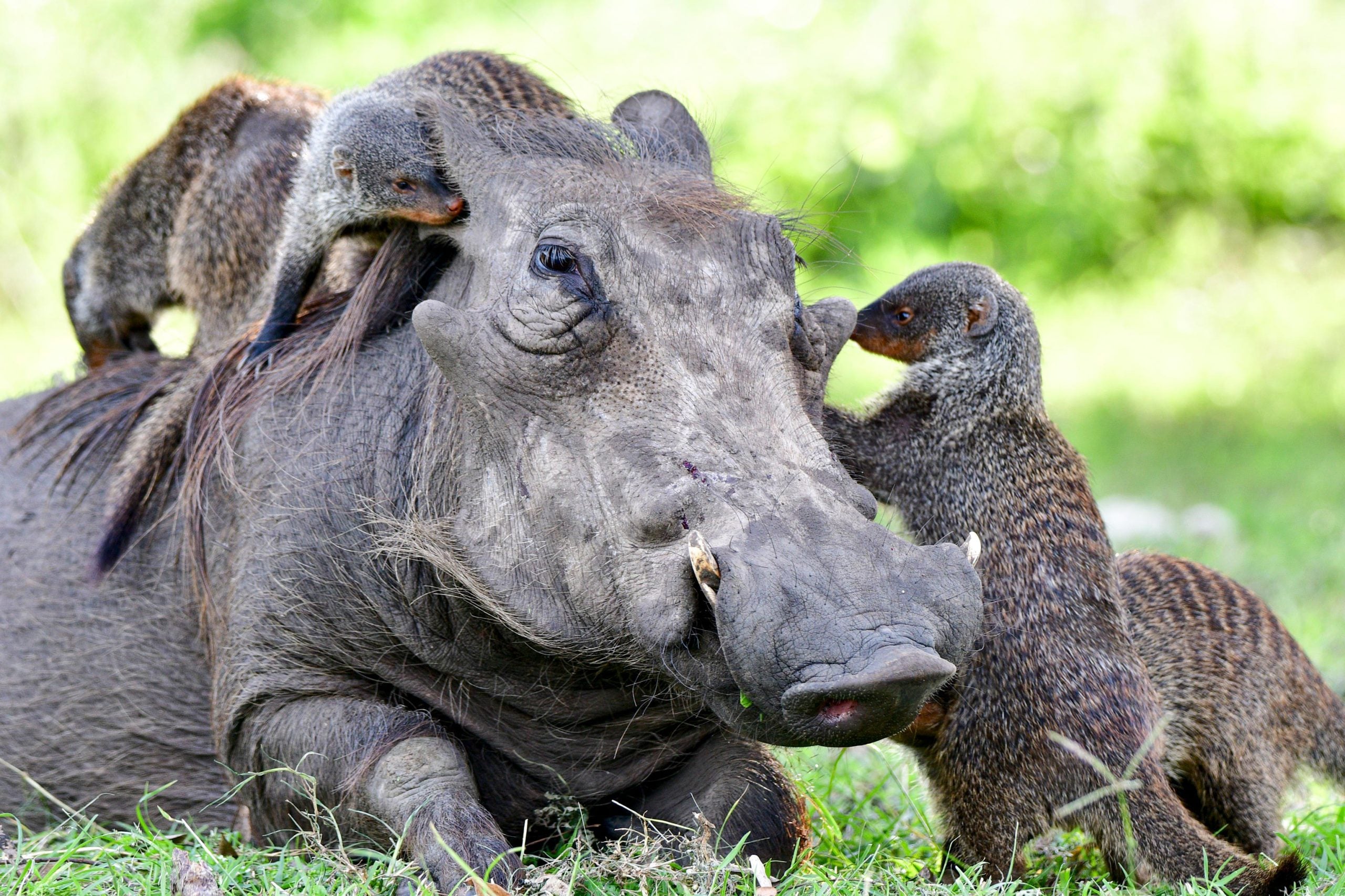
One example involves the greater honeyguide bird (Indicator indicator), which uses specialized calls to lead humans to bees’ nests and responds to calls made by humans. Another example comes from warthogs, which adopt distinctive body postures to request cleaning services from birds and mammals that remove parasites.
“From the examples we know, individuals coordinate their actions to access shared resources, like food, or to exchange resources for services, such as protection from predators,” said Dr. Katie Dunkley, lead author and researcher at the University of Oxford. “We were particularly interested in how sharing information allows such close coordination between species.”
Human honey-hunters (Homo sapiens) can cooperate with greater honeyguides (Indicator indicator) by following their calls and flight to locate hidden bees’ nests, then harvesting the honey while leaving behind wax and larvae that the birds feed on. Example footage from Niassa Special Reserve, northern Mozambique. Credit: Dominic Cram
Communication Helps Manage Risks and Rewards
Communication is not only important for finding cooperative partners. It also helps animals begin interactions, coordinate their behavior, and reduce the risk of being exploited.
Interactions between different species can be risky, making reliable signals especially valuable. Some cleaner fish (e.g., Labroides dimidiatus) and shrimp (e.g., Urocaridella sp.) use bright colors and distinctive movements to signal their role when approaching predatory fish, allowing them to clean parasites without being attacked. Meanwhile, lycaenid butterfly larvae produce chemical and vibrational signals that encourage ants to protect them rather than treat them as prey.
The review also notes that many animals rely on multiple senses when communicating. As a result, focusing only on obvious visual displays may cause researchers to overlook other important forms of information exchange between species.
Flexible Signals Across Different Environments
Not all forms of interspecies communication are equally fixed.
Some signals remain consistent across situations. Fish seeking cleaning services, for example, often use recognizable head or tail stand postures. Other signals can vary depending on local conditions. Fishermen working with dolphins may interpret specific dolphin behaviors as cues indicating the best moment to cast their nets.
“In some forms of interspecies cooperation, cues and signals vary depending on the ecological context, the species involved, and whether the signal is inherited or learned,” said senior author Dr. van der Wal, a researcher affiliated with UCT’s FitzPatrick Institute of African Ornithology. “This highlights just how flexible and adaptable interspecies communication can be.”
How Cross-Species Communication Evolves
The researchers also examined how communication systems between species may develop over time.
Some signals may begin as simple cues, which are features or behaviors that affect how another animal responds despite not originally evolving for communication. Over generations, these cues can become more specialized and develop into clear signals.
Other signals may start as behaviors used for entirely different purposes, such as resolving conflicts or caring for offspring, before later being adapted to support cooperation between species.
“Studying how information flows between species gives us a powerful window into how communication systems originate, change and sometimes coevolve,” said Dr. Dunkley.
A Large Collaborative Research Effort
The review emerged from an interdisciplinary workshop on interspecies cooperation held in Cambridge in July 2023. Researchers from a wide range of fields gathered to discuss different examples of cooperation across species.
In total, the paper includes 58 authors from disciplines including anthropology, biology, and linguistics. It also draws on expertise from scientists studying animal cooperation, mixed-species interactions, and systems in which humans actively train non-human animals.
New Questions for Future Research
The authors say their review highlights the ecological importance of cooperation between species and opens new opportunities for studying how communication evolves across species boundaries.
They also emphasize the need for broader research covering more groups of animals, along with additional experiments to better understand how signals emerge, persist, and influence cooperative behavior.
“We still have much to learn about how these systems function and evolve,” said Dr. van der Wal. “We look forward to future research revealing both these interactions and other forms of interspecies cooperation yet to be discovered.”
Reference: “The ecology and evolution of cues and signals in animal interspecies cooperation” by K. Dunkley, M. Cantor, A.I. Afan, D.S. Ahlibi, S.J. Allen, J. Amphaeris, S. Atkins, M.C. Attwood, K. Bankhead, C.J. Blair, J.L. Bronstein, Y.R.R. Camargo, S. Carvalho, L.W. Channer, R.R.T. Cuthill, J. Das, F.G. Daura-Jorge, A.K. Deb, T. Dixit, E. Dounias and J.E.M. van der Wal, 18 June 2026, Animal Behaviour.
DOI: 10.1016/j.anbehav.2026.123611
Never miss a breakthrough: Join the SciTechDaily newsletter.
Follow us on Google and Google News.