

A decades-long search has revealed signs of a subtle outflow from the Milky Way’s central black hole.
Something has been missing from the Milky Way’s central black hole.
For more than half a century, astronomers searched for a telltale wind that theory said must be blowing from Sagittarius A* (Sgr A*), the supermassive black hole lurking at the heart of our galaxy. Despite increasingly powerful telescopes and decades of observations, the predicted outflow remained frustratingly elusive.
Now, researchers at Northwestern University say they have finally found it, shedding new light on the behavior of the Milky Way’s mysterious centerpiece.
50-Year Search for Sagittarius A’s Missing Wind
By capturing the clearest view so far of the region surrounding Sgr A*, the researchers have solved one of astronomy’s longest-running mysteries. Their findings also provide new insight into the physical processes occurring at the heart of the Milky Way.
The study was published in The Astrophysical Journal Letters.
“Unless a black hole exists in a perfect vacuum, it must blow a wind somehow,” said Northwestern’s Mark Gorski, who co-led the study. “And there is no perfect vacuum in the universe. With new observations, this is the first time we’ve had a clean enough view to see the wind’s imprint. We looked at the data and said, ‘There it is. There is the thing that everybody’s been looking for for 50 years.’”
“We were the first to show that molecular gas very, very close to the black hole is feeding it,” said Elena Murchikova, who co-led the study with Gorski. “The wind is not powerful, and its direction probably wanders with time. It shows that our black hole is not unique, and our place in the universe is not unique.”
How Black Hole Winds Shape Galaxies
Gorski studies galaxy evolution as a research assistant professor at Northwestern University’s Center for Interdisciplinary Exploration and Research in Astrophysics (CIERA). Murchikova, a specialist in black hole astrophysics, is an assistant professor of physics and astronomy in Northwestern’s Weinberg College of Arts and Sciences and a member of CIERA.
Although black holes are known for pulling in nearby matter, they can also expel material. For years, scientists have predicted that actively feeding black holes launch energetic outflows. As gas spirals inward, it accelerates to speeds approaching that of light. The resulting energy and pressure can drive some of that material back into space as winds or jets.
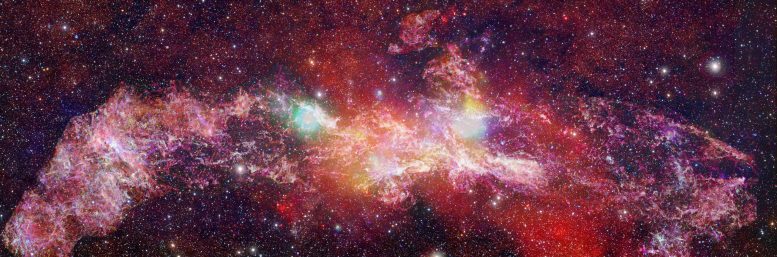
Astronomers have previously found signs that Sgr A* erupted in the past, but evidence of an ongoing outflow remained elusive. The Northwestern team believes this is because the black hole is currently in a relatively quiet state and is extremely difficult to observe.
“To observe our own black hole, we have to look through the plane of our galaxy,” Murchikova said. “That means we have to peer through gas, dust, and ionized structures, and you can’t really see through all of that easily.”
ALMA Reveals the Closest View of the Galactic Center
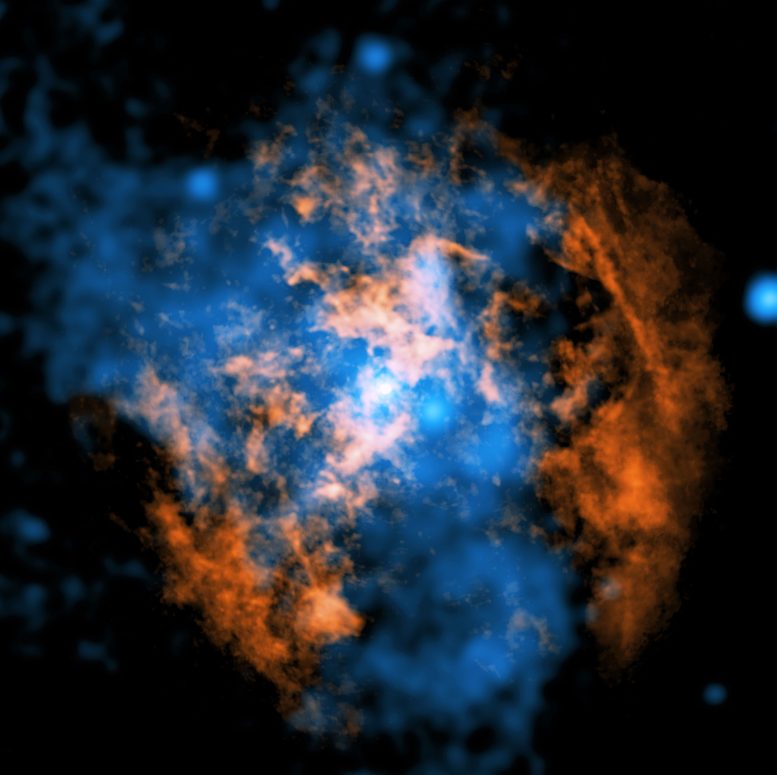
Advances in observational techniques finally allowed the team to examine the region in unprecedented detail. Using five years of deep observations from the Atacama Large Millimeter/Submillimeter Array (ALMA) in Chile, Gorski and Murchikova produced the most detailed image yet of the cold molecular gas surrounding Sgr A*.
The image captured gas located within just one parsec (about three light-years) of the black hole. After applying a calibration technique to remove the black hole’s bright radio emissions, the researchers created a map that was 100 times deeper and 80 times sharper than previous versions. The enhanced view exposed structures that had never been seen before.
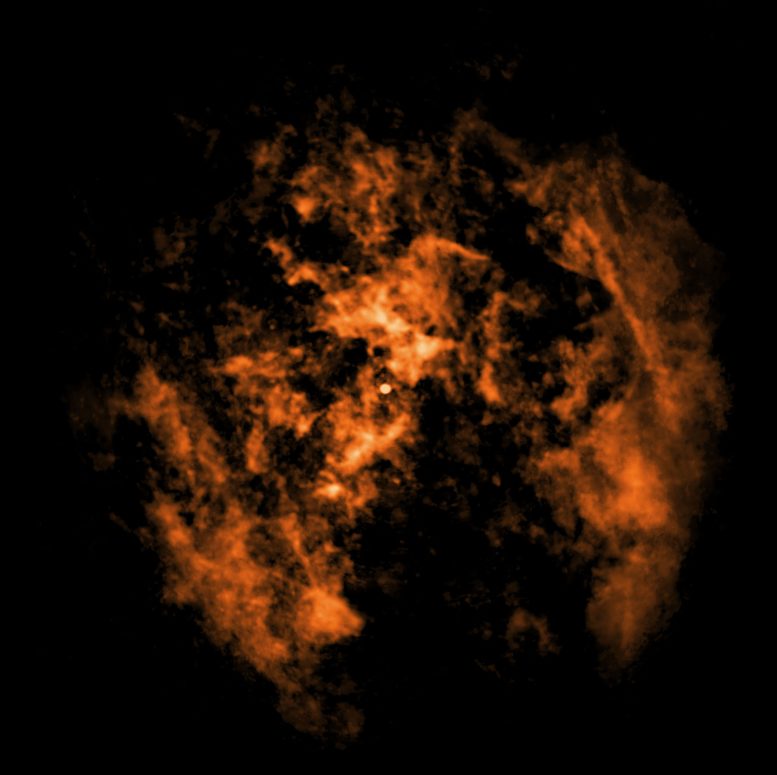
One newly identified feature immediately stood out. The researchers found a large cone-shaped cavity, nearly one parsec (about three light-years) long and spanning 45 degrees, that contained no cold molecular gas. They concluded that the most likely explanation was a hot wind originating from Sgr A*. As the wind moves through the region, it either pushes cold gas away or heats it beyond detectability.
“If you blow hot material from the black hole, it’s not going to want to exist with the cold material,” Gorski said. “It’s either going to push the cold material out or heat it up. And, if it’s too hot, you will no longer see the cold gas.”
Giant Cone-Shaped Cavity Points to Black Hole Activity
Stars also generate winds, but the team found that stellar winds alone could not create a cleared-out region this large. Even the combined energy output of nearby stars was insufficient.
“It’s a huge absence of material,” Gorski said. “We calculated how much energy was needed to create this cavity. It is more than can be provided by the stars in that area. Basically, there has to be input from the supermassive black hole. And, if you follow the shape of the cone, it’s pointed directly at the black hole.”
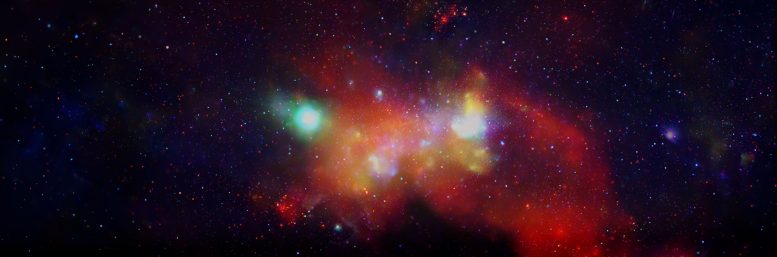
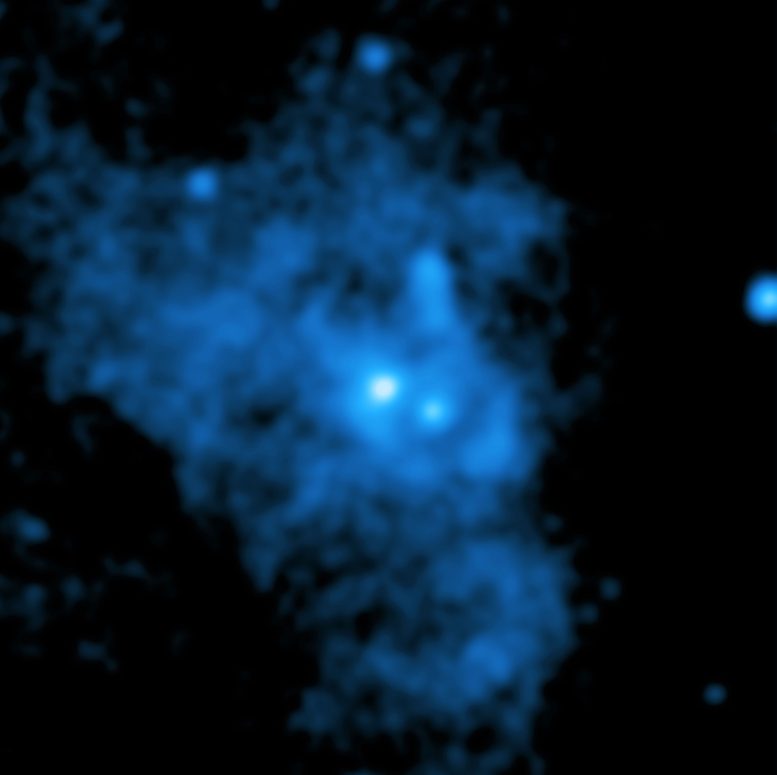
Before announcing their findings, the researchers sought additional confirmation. They compared their results with previous observations from NASA’s Chandra X-ray Observatory, which had detected bright X-ray emissions in the same area. The X-ray data aligned with the gas-free cone seen in the ALMA observations.
“Exceptional claims require exceptional evidence,” Gorski said. “We wanted to make sure that we weren’t just looking at some sort of imaging artifact. Then, the X-ray image from Chandra just slotted in perfectly. The molecular features lined up.”
Chandra X-Ray Data Confirms the Discovery
“When you find something that no one has seen before, the first thought that runs through your mind is not ‘Oh my god, we made a discovery,’” Murchikova said. “It’s ‘Oh my god, what’s wrong with my analysis?’ But when we overlaid our image with the X-ray image, it started to make sense.”
Based on the extent of the wind’s influence on a nearby stream of ionized gas, the team estimates that the outflow has been active for at least 20,000 years. The findings also suggest that Sgr A* is comparatively quiet when measured against many supermassive black holes in other galaxies.
“The majority of other galaxies spend most of their lives in a state where they are not particularly active,” Murchikova said. “But we can only see them when they are in a fireworks stage. It is very attractive to study black holes when they are in the fireworks stage, but that’s not actually their dominant state. Sgr A* finally gives us a window into the life of a black hole in this quiet state.”
Reference: “The Discovery of an Active Wind from the Milky Way’s Central Black Hole” by Mark D. Gorski and Lena Murchikova, 4 June 2026, The Astrophysical Journal Letters.
DOI: 10.3847/2041-8213/ae63cf
The study was supported by the Weinberg College of Arts and Sciences and CIERA.
Never miss a breakthrough: Join the SciTechDaily newsletter.
Follow us on Google and Google News.
1 Comment
“It turns out even a ‘quiet’ black hole never truly stops working. This $45^\circ$ conical wind is a textbook demonstration of how localized rotational torque transforms into an outward physical Effect. Rather than acting as a simple, empty drain, the galactic core behaves like a highly structured helical engine—proving that space shapes and organizes surrounding matter along precise geometric lines.”