
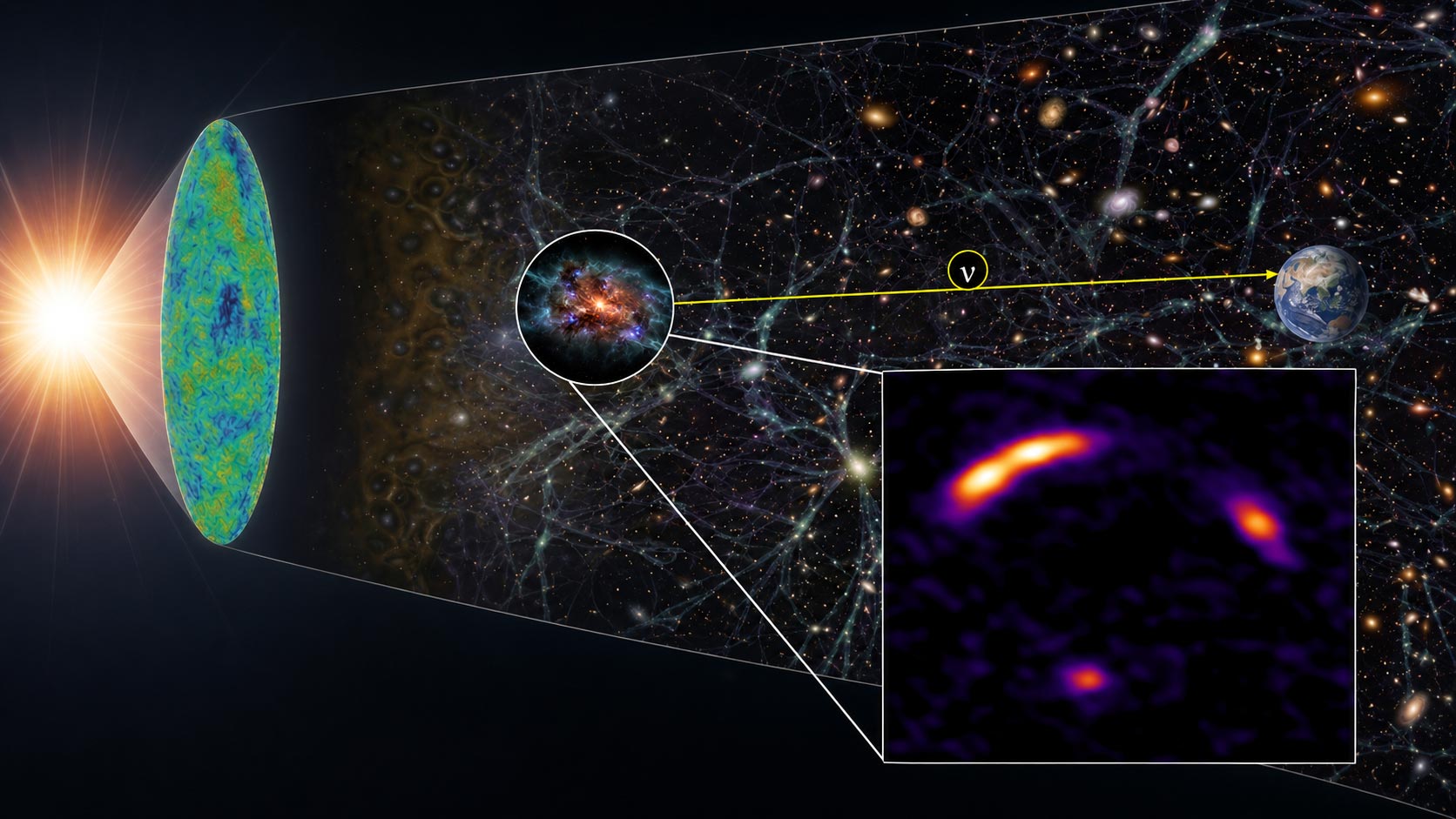
A mysterious neutrino signal has led astronomers to a surprising discovery: a hidden star-forming galaxy, not a supermassive black hole, may be generating some of the Universe’s most powerful particles.
Astronomers have traced a burst of high-energy neutrinos to an unexpected source. Using the Atacama Large Millimeter/submillimeter Array (ALMA) and a powerful natural magnifying effect created by gravity, researchers investigated a remarkably bright distant galaxy. They initially suspected that a supermassive black hole was powering the galaxy. Instead, they found evidence that intense star formation was driving its activity. The discovery provides important clues about the origin of cosmic neutrinos, one of the Universe’s most mysterious particles.
Neutrinos are among the most elusive signals that reach Earth from space. Although a handful of galaxies have already been linked to neutrino production, those known sources cannot account for the large number of high-energy neutrinos detected by observatories.
Tracking the Source of a Neutrino Event
An international team of researchers from MITOS Science Co., LTD., National Central University, Chung Yuan Christian University, Tohoku University, Fukui University of Technology, and the National Astronomical Observatory of Japan conducted follow-up observations of a high-energy neutrino event known as IC 210922A. The event was originally detected by the IceCube Neutrino Observatory at the South Pole.
Using ALMA and other telescopes, the team searched for the source of the signal and identified an exceptionally luminous galaxy called JCMT0402−0424. The galaxy is located roughly 11 billion light-years from Earth.
Previously identified neutrino-producing galaxies have all been associated with supermassive black holes. However, the observations of JCMT0402−0424 revealed no signs of the energetic emissions typically produced by such objects.
The galaxy is also heavily veiled by dust, making it difficult to observe in visible light. At submillimeter wavelengths, however, it shines brightly. Because of its hidden nature, the researchers gave it the nickname ‘Shadow Blaster.’
A Natural Telescope Reveals the Galaxy’s Interior
The team was able to examine Shadow Blaster in remarkable detail thanks to a fortunate cosmic alignment. A galaxy located between Earth and Shadow Blaster acted as a gravitational lens. Its gravity bent and amplified radio waves coming from the distant galaxy, effectively creating a natural telescope that produced brighter and enlarged images for ALMA to study.
ALMA’s observations of the galaxy’s interior again failed to reveal evidence of a powerful black hole. Instead, the data pointed toward another explanation. The researchers concluded that the gas and dust within the galaxy are most likely being heated by extremely intense star formation.
Further analysis uncovered a dense “compact core” at the center of Shadow Blaster. Vast amounts of gas and dust are concentrated within a region only about 1,500 light-years across. Such extraordinarily dense conditions are capable of producing neutrinos.
A New Explanation for Cosmic Neutrinos
The findings suggest that high-energy neutrinos can be generated through a different process than previously recognized. Rather than relying primarily on supermassive black holes, some neutrinos may originate in compact, dust-rich starburst galaxies undergoing intense episodes of star formation.
Researchers estimate that these galaxies could account for a substantial share of the high-energy neutrino background, potentially contributing as much as 20% of the total population observed across the Universe.
Reference: “Compact dusty starbursts at cosmic noon linked to high-energy neutrinos” by Yuji Urata, Kuiyun Huang, Bunyo Hatsukade, Mansi Kasliwal, Shigeo S. Kimura, Yuichi Matsuda, Yusuke Miyamoto, Hiroshi Nagai, Kouichiro Nakanishi and Robert Stein, 17 June 2026, Nature Astronomy.
DOI: 10.1038/s41550-026-02884-9
Never miss a breakthrough: Join the SciTechDaily newsletter.
Follow us on Google and Google News.
1 Comment
Memo 2606261709_Source 1. Reinterpretation【()】
Source 1.
https://scitechdaily.com/a-hidden-galaxy-called-shadow-blaster-may-explain-one-of-astronomys-biggest-mysteries
1.
_A hidden galaxy called the Shadow Blaster may explain one of the greatest mysteries in astronomy.
_ALMA has captured a star-forming galaxy called the “Shadow Blaster” in the same direction as the high-energy neutrino event IC 210922A.
1-1.
_A mysterious neutrino signal has led astronomers to a surprising discovery: that a hidden star-forming galaxy, rather than a supermassive black hole, may be generating the most powerful particles in the universe.
_Astronomers have found the cause of the high-energy neutrino burst in an unexpected place. Using the Atacama Large Millimeter/Submillimeter Array (ALMA) and the powerful natural magnification effect caused by gravity, the research team investigated a very bright, distant galaxy.
1-2.
_Initially, it was speculated that a supermassive black hole was supplying energy to this galaxy, but (instead, evidence was found that active star-forming activity is driving the galaxy’s activity).
========
【&&&&&&&b2.() If my intuition is correct, neutrinos could also be the remnants of qpeoms=1 that emerged during the disintegration of stars. Hmm.2706280309.
>>>>> There is a possibility that neutrinos are qpeoms=1. nks Since there is a collective correlation in the creation and destruction of stars, even black holes show mass changes during the disintegration of stars. Hmm. 06270317.
>>>> If neutrinos are involved in such universal mass changes, wouldn’t ‘qpeoms = neutrino = 1 unit’ as the unit of mass of the universe? I wonder. Heh. 0319.
^^^&& I’ve always wondered why neutrinos ‘pass through everything’ whether it’s ordinary matter or dark matter, but it might be possible because it is the ‘quantum unit of mass of the universe!!!??’. 0341.
^^^^&^ If so, it could be ‘qpeoms.neutrino???? !!!, a more universal unit of mass of the universe’ than the candidate for msoss.dark_matter????? . Yawn. 0324. Continuous yawning. Hmm. 0325.
>>>>>> Then, here, other speculations 1. remain as tasks.
1.) Conjecture 1. that neutrino(*) operated ‘uninterference-free, free, and forever in the independent quantum entanglement teleportation of qpeoms.intro(vixxa.susqer)’ in the system qpeoms.nvixer is another more profound task. 2606270332.
2.) Also, Conjecture 2. that neutrinos are ‘related to msoss.zerosum.value.magicsum.mass,charge(zero)’ remains another task. 0339.
3.) If neutrinos exhibit a pattern of partial qms.msbase bulk increase or decrease as a unit of qpeoms quantum mass,
4.) If qpeoms.set, is it a module? More specifically, the scope of application might be related to the concept of mass transport regarding the mass transfer(*) of massive cosmic objects in ‘qpeoms.Moiré Patterns.mode(qqcell.tsp),’ which is the collective nature of overlapping grids (mscell). Hmm. 2606270348. 54.
^^^&&& The implication is that neutrinos, like gravitational waves, can move (distort) the mass of spacetime matter as a whole.
#1. Q&A///AI Answer. What is the relationship between neutrinos and gravitational waves?
/// Neutrinos and gravitational waves share the commonality of being key multi-messenger means for observing the universe, and that they reach Earth directly from distant parts of the universe without interacting with matter due to their lack of electric charge.
Their relationship and differences are as follows.
[Relationship]: Multimessenger, the Core of Astronomy
When violent cosmic events occur, such as neutron star collisions or supernova explosions, gravitational waves (distortions of spacetime) and neutrinos (high-energy particles) are emitted almost simultaneously. By observing these two signals together, it is possible to accurately understand the secrets of the explosion’s core and the process of cosmic evolution.
[Comparison]: Differences in Origin Principles and Characteristics
Classification
Gravitational Wave
Neutrino
Definition: Waves in spacetime generated when objects with mass accelerate.
Extremely light fundamental particles created through nuclear reactions within stars.
Causes: Movement of massive masses, such as the merger or collision of black holes or neutron stars.
Microscopic reactions occurring in the core, such as the Sun’s nuclear fusion or supernova explosions.
Measurement Methods:
Measurement of minute changes in spacetime distances using laser interferometers (e.g., LIGO).
Measurement of traces of particle-matter collisions using giant water tanks or ice deep underground.
Both phenomena transmit information about the interior of stars or the extreme environments around black holes without interference from light (electromagnetic waves).
>>>>>///When violent cosmic events such as neutron star collisions or supernova explosions occur, gravitational waves (distortions of spacetime) and neutrinos (high-energy particles) are emitted almost simultaneously?.///
^^&&&&&&^^^^
In my cosmology, gravitational waves are represented as sample4., led by msbase.frime_dragging appearing in msoss.charge.zerosum, but neutrinos also appear as qqcell.tsp?? Haha. It’s getting more and more exciting!!! Hmm. *Thump thump*..0408.
】
_This discovery provides an important clue regarding the origin of cosmic neutrinos, one of the most mysterious particles in the universe.
_Neutrinoes are one of the most difficult signals to detect among the signals coming from the universe to Earth. Although it has been revealed that some galaxies are associated with neutrino generation, these known sources alone cannot explain the numerous high-energy neutrinos detected by observatories.
=========
【&&&&&&&b1.()
The source of the neutrino was speculated to be vixxa.neutrino.susqer.rprocess.entangle.move1.
>>> But the moving particle is treated as tsp dust?
>>> That dust might be the msbanc.banc_collapse.qpeoms system, and
^^^^ within it, vixxa.susqer might be a customized optimized state suitable for performing rprocess. Hmm. 1659.
】
2. Tracing the Source of the Neutrino Event
The research team, using ALMA and other telescopes to locate the source of the signal, discovered a very bright galaxy called JCMT0402−0424. This galaxy is located about 11 billion light-years from Earth.
2-1.
_Previously identified neutrino-generating galaxies are all known to be associated with supermassive black holes. However, observations of JCMT0402−0424 revealed no signs of the high-energy emissions typically seen in such objects.
_This galaxy is heavily obscured by dust, making it difficult to observe in visible light. However, it shines brightly at submillimeter wavelengths. Due to these hidden characteristics, the research team nicknamed this galaxy the ‘Shadow Blaster.’
2-2. Natural Telescopes Reveal the Galaxy’s Interior
_Fortunately, thanks to a synergy of cosmic phenomena, the research team was able to observe the Shadow Blaster in astonishing detail.
_A galaxy located between Earth and the Shadow Blaster acted as a gravitational lens.
_The gravity of this galaxy bent and amplified radio waves coming from distant galaxies, acting much like a natural telescope to produce brighter, magnified images that ALMA could observe.
2-3. ALMA’s observations of the galaxy’s interior once again failed to provide evidence suggesting the existence of a powerful black hole. Instead, the data presented a different explanation.
The research team concluded that the gas and dust inside the galaxy are most likely being heated due to highly active star-forming activity.
Further analysis revealed a dense “compact core” at the center of the Shadow Blaster. Enormous amounts of gas and dust are concentrated in an area approximately 1,500 light-years in size. Neutrinos can be generated in such an extremely dense environment.
========
【&&&&&&02.() When the dust here could be an aggregate of qpeoms, nkstars.msbase.galaxy appears. Uh-huh1. 1646.1722.
】
3. A New Explanation of Cosmic Neutrinos
_The results of this study suggest that high-energy neutrinos may be generated through pathways different from previously known processes.
_Instead of relying primarily on supermassive black holes, some neutrinos may be generated in dense, dusty starburst galaxies undergoing active star-forming activity.
_Researchers estimate that these galaxies could account for a significant portion of the high-energy neutrino background and may contribute up to 20% of the total number of neutrinos observed throughout the universe.
==========
【&&&&&&a1. The cause of massive neutrino generation may be related to msbase.power or msoss.dark_matter. Hmm. 2606261527.
>>>>>> mspower refers to starburst galaxies that have grown massive through explosive proliferation, unlike ordinary galaxies.
^^^^^ Another massive galaxy along a different path is a dark galaxy, a high-mass particle condensation galaxy as sample4. charge.zerosum.
^^^^^^ The condensation energy was driven by nqvixer.blackhole, and through the explosive reverse reaction of qqcell.tsp, it produces a massive amount of neutrinos via susqer.square.entanglements.vixxa.moving.rprocess. Uh-huh. 1548.
>>>> The possibility that these will burst is due to explosive parpi.intro.[condensation mass E=energy m/c²]. Hmm. 1542. Haha. 1723.
】