
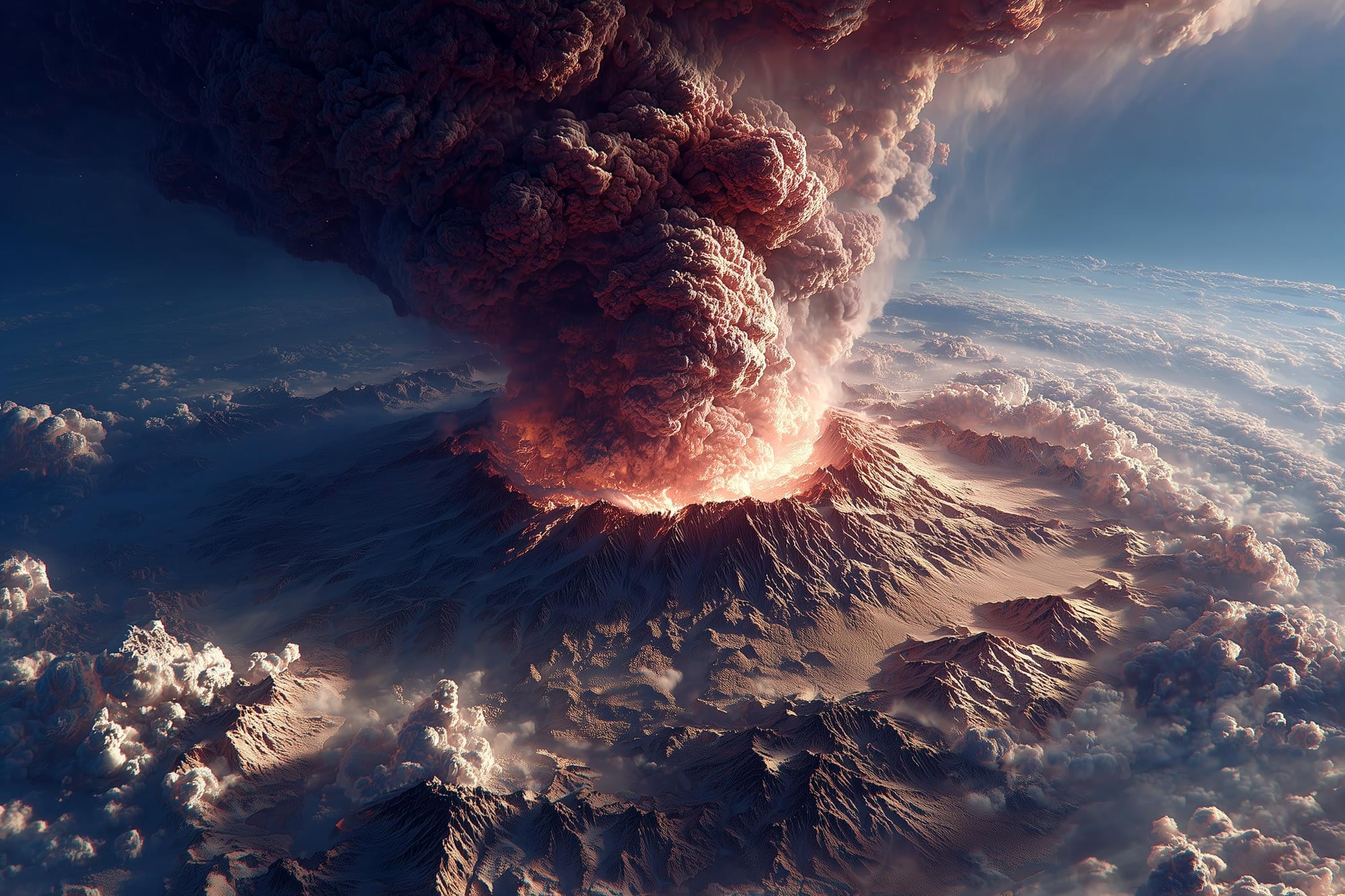
Some of history’s most powerful eruptions may have plunged Earth into centuries of sustained cooling.
A volcanic eruption can darken skies and cool the planet for a year or two. New research suggests that some of the largest eruptions did something far more powerful: they pushed Earth into cold spells that lasted for centuries.
The discovery could help explain a long-standing climate mystery. The Holocene, the relatively warm epoch that began about 11,700 years ago, is often described as a period of stability. Yet that stability was repeatedly interrupted. Researchers have identified about 22 major episodes when temperatures dropped, rainfall patterns shifted, ecosystems were disrupted, and mountain glaciers advanced.
Volcanoes May Solve a Long-Standing Climate Mystery
“Until now, there has been no convincing explanation for this phenomenon. It always seemed as though something was missing,” says Alice Paine, an SNSF-funded postdoctoral researcher based at the University of Basel.
Scientists had previously suggested several possible causes, including changes in solar activity, disruptions to ocean circulation, and large movements of icebergs into the North Atlantic. Paine and an international team instead examined whether explosive volcanic eruptions may have provided the initial shock.
Their findings, published in Nature Communications, indicate that major eruptions were closely associated with most of the Holocene’s prolonged cold periods. The volcanoes did not keep the planet cold by continuously filling the atmosphere with ash. Instead, they appear to have triggered a chain of changes involving sunlight, sea ice, rainfall, and ocean circulation.
Reconstructing 12,000 Years of Eruptions
The team assembled records of 51 major eruptions that occurred during the Holocene north of 20° south latitude. Many took place around the Pacific Ring of Fire, the vast belt of volcanoes and earthquake zones surrounding much of the Pacific Ocean. Here, the movement and collision of tectonic plates can produce exceptionally explosive eruptions.
Reconstructing eruptions from thousands of years ago is difficult because erosion, later eruptions, and shifting landscapes can destroy much of the geological evidence. The researchers combined volcanic deposits with sulfate preserved in Greenland and Antarctic ice cores, radiometric dates from volcanic rock, and organic material buried in layers of ash.
They then compared the eruption timeline with 22 periods of major glacier growth documented across 17 regions. These advances were identified largely through moraines, piles of rock and sediment left behind when glaciers reached their maximum extent.
A Striking Link to Glacier Growth
Only four of the 22 advances did not overlap, within the uncertainties of the dating methods, with a known major eruption. More than 80 percent coincided with at least one.
The connection was even stronger for the most extreme events. Every known Holocene eruption with a magnitude of 7 or greater occurred close in time to a glacier advance. For about 72 percent of those eruptions, evidence of advancing glaciers appeared in both hemispheres.
To test whether the pattern could have occurred by chance, the team generated 10 million random sets of eruption dates. The association between the largest eruptions and glacier advances remained significant at the 99 percent confidence level.
“By combining the results of our statistical analysis with existing paleoclimate reconstructions, we are very confident that this is no coincidence. What’s more, the analysis also reconciles all the findings to date on these mechanisms,” says Paine.
How Volcanic Sulfur Cools Earth
The researchers propose that the process begins when an eruption drives large quantities of sulfur high into the atmosphere. The sulfur forms tiny aerosol particles that reflect part of the incoming sunlight back into space, rapidly cooling the surface below.
Ash is often blamed for volcanic cooling, but it usually falls out of the atmosphere relatively quickly. Sulfur aerosols are more important because they can spread widely through the upper atmosphere and remain there much longer.
Not every large eruption has the same climate effect. Its influence depends on factors such as its location, the amount of sulfur released, the height reached by the plume, and the condition of the climate at the time. A huge eruption can have a relatively limited effect if much of its sulfur is removed before reaching the upper atmosphere, while a smaller but sulfur-rich eruption can produce substantial cooling.
Ancient Eruptions Unleashed Massive Sulfur Loads
Some Holocene eruptions released extraordinary amounts. The Samalas eruption in 1257, the K-Ah eruption in what is now Japan, and the eruption that formed Kurile Lake in Russia each appear to have placed more than twice as much sulfur into the atmosphere as the 1815 eruption of Mount Tambora.
That initial burst of sulfur could cool the atmosphere enough to set slower and more lasting changes in motion. As temperatures fall across the Northern Hemisphere, Arctic sea ice begins to spread. Because bright ice reflects more sunlight than dark ocean water, its expansion deepens the cooling. The ice also limits the transfer of heat and moisture between the ocean and atmosphere, further disrupting the climate system.
Expanding sea ice can eventually alter North Atlantic circulation, reducing the amount of heat carried northward by ocean currents. At the same time, the planet’s tropical rain belt may shift south, changing precipitation across wide areas and allowing colder, drier conditions to spread through much of the Northern Hemisphere.
“All these effects reinforce one another; it’s a snowball effect,” says Paine.
Why the Cooling Lasted for Centuries
The initial volcanic disturbance may last only a few years, but the ocean and sea ice respond much more slowly. Once those systems have been pushed into a different state, they can sustain the cooling for decades or centuries. Glaciers then have enough time to grow, particularly in high mountain regions such as the Alps.
“The sulfur particles simply get the snowball rolling. But their impact on the Earth system lasts for decades or even centuries, long after the particles have been washed out of the atmosphere.”
This mechanism differs from what happened after Mount Tambora erupted in what is now Indonesia. The following year, 1816, became known as the ‘Year Without a Summer.’ Temperatures fell by several degrees in some regions, harvests failed, and food shortages spread across parts of the world. The most severe effects faded after the volcanic particles cleared from the atmosphere.
Could It Happen in Today’s Climate?
The new study suggests that under the right conditions, an eruption can do more than cause a brief temperature shock. It can activate slower feedbacks that continue reshaping the climate long after the sky has cleared. Whether those feedbacks would behave the same way in today’s much warmer world, however, remains uncertain.
“For the events we studied, the climate was, so to speak, in its natural state,” Paine points out. Human activity has since transformed the atmosphere and warmed the planet, creating conditions with no close equivalent in the Holocene record.
Some researchers argue that a rapidly changing climate could be more vulnerable to sudden disruption. Others believe even an enormous eruption would provide only a temporary interruption to the much larger and continuing warming caused by greenhouse gas emissions.
“The more our climate changes, the more complex the processes become,” says Paine. “There is still a huge knowledge gap to be filled here.”
Reference: “Evidence for volcanic forcing of Holocene cold events” by Alice R. Paine, James U. L. Baldini, Charlie L. Rex, Michael Sigl, Francesco S. R. Pausata and Richard J. Brown, 28 May 2026, Nature Communications.
DOI: 10.1038/s41467-026-73492-4
Never miss a breakthrough: Join the SciTechDaily newsletter.
Follow us on Google and Google News.
4 Comments
Is the added substance on the Parkside of the moon causing tectonic shifts?
Sounds like it might not be difficult to disrupt earth equilibrium
“Because bright ice reflects more sunlight than dark ocean water, …”
This is a common misconception with the durability of all Urban Legends. Yes, snow is bright. However, when one looks at a photograph of ocean water in the Arctic, with the sun low on the horizon, it is obvious that light reflecting off the water is much brighter than rays reflecting off nearby snow-covered ice.
The difference is that snow is a diffuse reflector that reflects in all directions. Thus, an observer always sees bright snow, regardless of the observer’s position or direction of observation. The total light reflected has to be calculated from the hemispherical Bi-directional Reflectance Distribution Function (BRDF). Because snow is made of flat crystals, it tends to have a sub-parallel alignment with the surface. That means it has a strong forward lobe, resulting in snow blindness being a risk if walking into the sun.
On the other hand, water is a specular (mirror-like) reflector. That means that the light reflected tends to be a narrow sheaf of rays. To observe it, one has to be looking towards the sun, and looking at about the same vertical angle as the sun is above the horizon. Looking anywhere else there is no light; water looks dark. Additionally, the reflectivity changes with the angle of incidence. With the sun directly overhead (which doesn’t happen north of the Tropic of Cancer at the Solstice) the reflectivity is about 2%; at glancing angles, i.e. the terminator or the North Pole at the Equinoxes the reflectivity is 100%. If you have driven a car into the setting sun on wet pavement, you have experienced the same situation. Obviously, if all the impinging light is reflected, there is none left over to enter the water. That is an additional reason that Arctic waters look dark. The higher the angle of incidence, the less light that enters the water to be diffusely reflected off suspended sediment or plankton.
“It Ain’t What You Don’t Know That Gets You Into Trouble. It’s What You Know for Sure That Just Ain’t So.” — Mark Twain
https://wattsupwiththat.com/2016/09/12/why-albedo-is-the-wrong-measure-of-reflectivity-for-modeling-climate/
Watts Up With That is about the worst source imaginable.
I’ve spent many thousands of hours at real climate science sources available online. It’s often been like being in a university climate science class. I would often read dozens, even hundreds of comments at an article, almost all by climate scientists.
WTFUWW is like being in a 3rd grade classroom, where kids are giving their opinions about how babies are made.